MCQ
The velocity $v$ (in $cm/\sec $) of a particle is given in terms of time $t$ (in sec) by the relation $v = at + \frac{b}{{t + c}}$ ; the dimensions of $a,\,b$ and $c$ are
  • A
    $a = {L^2},\,b = T,\,c = L{T^2}$
  • B
    $a = L{T^2},\,b = LT,\,c = L$
  • $a = L{T^{ - 2}},b = L,\,c = T$
  • D
    $a = L,\,b = LT,\,c = {T^2}$

Answer

Correct option: C.
$a = L{T^{ - 2}},b = L,\,c = T$
c
(c) From the principle of dimensional homogenity $[v] = [at] \Rightarrow [a] = [L{T^{ - 2}}]$.

Similarly $[b] = [L]{\rm{ and}}\;[c] = [T]$

Need a full question paper?

Generate a complete, print-ready paper with questions like this in minutes — across 16+ boards, with answer keys.

Start Generating Free

Similar questions

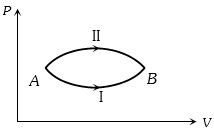
A system goes from $A$ to $B$ via two processes $I$ and $II$ as shown in figure. If $\Delta {U_1}$ and $\Delta {U_2}$ are the changes in internal energies in the processes $I$ and $II$ respectively, then
The cross sectional area of a horizontal tube increases along its length linearly, as we move in the direction of flow. The variation of pressure, as we move along its length in the direction of flow ($x-$ direction), is best depicted by which of the following graphs
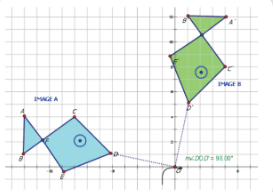
The figure below shows a pattern of two fishes. Write the mapping rule for the rotation of Image A to Image B.
A body of mass $100 g$ is rotating in a circular path of radius $r$ with constant velocity. The work done in one complete revolution is
If on heating liquid through $80°C$, the mass expelled is $(1/100)^{th}$ of mass still remaining, the coefficient of apparent expansion of liquid is
Two bodies at different temperatures are mixed in a calorimeter. Which of the following quantities remains conserved?
$50$ tuning forks are arranged in increasing order of their frequencies such that each gives $4 \,beats/sec$ with its previous tuning fork. If the frequency of the last fork is octave of the first, then the frequency of the first tuning fork is  ... $Hz$
Match the $\frac{C _{ P }}{ C _{ v }}$ ratio for ideal gases with different type of molecules
Moleculae type $\frac{C _{ P }}{ C _{ v }}$
$(A)$ Monoatomic $(I)$ $\frac{7}{ 5}$
$(B)$ Diatomic rigid molecules $(II)$ $\frac{9}{7}$
$(C)$ Diatomic non-rigid molecules $(III)$ $\frac{4}{3}$
$(D)$ Triatomic rigid molecules $(IV)$ $\frac{5}{3}$
A cylindrical plastic bottle of negligible mass of filled with $310\, ml$ of water and left floating in a pond with still water. If pressed downward slightly and released, it starts performing simple harmonic motion at angular frequency $\omega $. If the radius of the bottle is $2.5\, cm$ then $\omega $ is close to ..... $rad\, s^{-1}$  (density of water $= 10^3\, kg/m^3$)
In isothermal process, the work done per gram molecule of gas is: