MCQ
A cylinder containing gas at $27\,^oC$ is divided into two parts of equal volume each $100\,^oc$ and at equal pressure by a piston of cross sectional area $10.85\,\, cm^2$. The gas in one part is raised in temperature to $100\,^oC$ while the other maintained at original temperature. The piston and wall are perfect insulators. How far will the piston move during the change in temperature.... $cm$ .
  • $1$
  • B
    $2$
  • C
    $0.5$
  • D
    $1.5$

Answer

Correct option: A.
$1$
a

Need a full question paper?

Generate a complete, print-ready paper with questions like this in minutes — across 16+ boards, with answer keys.

Start Generating Free

Similar questions

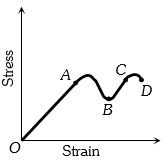
A graph is shown between stress and strain for a metal. The part in which Hooke's law holds good is
When a body is in the state of complete rest, what kind of energy does it possess?
A particle projected from ground moves at angle $45^{\circ}$ with horizontal one second after projection and speed is minimum two seconds after the projection. The angle of projection of particle is [Neglect the effect of air resistance]
Two forces $\vec{F}_1$ and $\vec{F}_2$ are acting on a body. One force has magnitude thrice that of the other force and the resultant of the two forces is equal to the force of larger magnitude. The angle between $\vec{F}_1$ and $\overrightarrow{\mathrm{F}}_2$ is $\cos ^{-1}\left(\frac{1}{\mathrm{n}}\right)$. The value of $|\mathrm{n}|$ is__________.
The efficiency of an engine will be maximum when it works:
According to law of equipartition of energy, in equilibrium the tot energy is equally distributed in all possible energy modes having an energy equal to:
If the wavelength of light in an experiment on photoelectric effect is doubled:
A ball kept in a closed box moves in the box making collisions with the walls. The box is kept on a smooth surface. The velocity of the centre of mass.
In an isothermal process $2$ water drops of radius $1 \,mm$ are combined to form a bigger drop. Find the energy (in $\mu J$) change in this process if $T =0.1\, N / m$ 
Two metal plates having charges Q, -Q face each other at some separation and are dipped into an oil tank. If the oil is pumped out, the electric field between the plates will: