MCQ
A cylinder of capacity $20$ litres is filled with ${H_2}$ gas. The total average kinetic energy of translatory motion of its molecules is $1.5 \times {10^5}\,J$. The pressure of hydrogen in the cylinder is
  • A
    $2 \times {10^6}\,N/{m^2}$
  • B
    $3 \times {10^6}\,N/{m^2}$
  • C
    $4 \times {10^6}\,N/{m^2}$
  • $5 \times {10^6}\,N/{m^2}$

Answer

Correct option: D.
$5 \times {10^6}\,N/{m^2}$
d
$E = \frac{3}{2}PV$$ \Rightarrow P = \frac{{2E}}{{3V}}$$ = \frac{2}{3} \times \frac{{1.52 \times {{10}^5}}}{{20 \times {{10}^{ - 3}}}}$

 $ = \frac{{{{10}^5}}}{{20 \times {{10}^{ - 2}}}} = 5 \times {10^6}N/{m^2}$

Need a full question paper?

Generate a complete, print-ready paper with questions like this in minutes — across 16+ boards, with answer keys.

Start Generating Free

Similar questions

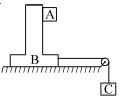
In the arrangement shown in the figure, mass of the block $B$ and $A$ is $2m$ and $m$ respectively. Surface between $B$ and floor is smooth. The block $B$ is connected to the block $C$ by means of a string pulley system. If the whole system is released, then find the minimum value of mass of block $C$ so that block $A$ remains stationary $w.r.t. B$. Coefficient of friction between $A$ and $B$ is $\mu$ 
$Assertion$ : If no external force acts on a system of particles, then the centre of mass will not move in any direction

$Reason$ : If net external force is zero, then the linear momentum of the system changes

Consider a photon of a continuous X-ray coming from a Coolidge tube. Its energy comes from:
A rod $(AB)$ is attached to a fixed point $(C)$ using a light rope $(AC)$. The other end of the rod $(B)$ is sitting on ice with negligible friction and the system is in stationary position. Which of the following can be the equilibrium configuration of this system?
Sound waves of frequency $660 \,\,Hz$ fall normally on a perfectly reflecting wall. The shortest distance from the wall at which the air particle has maximum amplitude of vibration is .... $m$ (velocity of sound in air is $330 \,\,m/s$)
If a black body is heated at a high temperature, it seems to be
Two sound sources emitting sound each of wavelength $\lambda$ are fixed at a given distance apart. A listener moves with a velocity $u$ along the line joining the two sources. The number of beats heard by him per second is:
What percentage of kinetic energy of a moving particle is transferred to a stationary particle when it strikes the stationary particle of $5$ times its mass? (Assume the collision to be head-on elastic collision)
The frequency of a sound wave is $n$ and its velocity is $v$. If the frequency is increased to $4n,$ the velocity of the wave will be
Pressure is a scalar quantity because: