MCQ
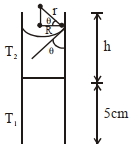
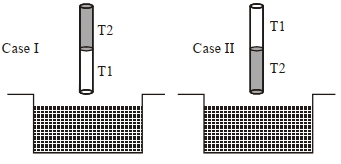
A cylindrical capillary tube of $0.2 mm$ radius is made by joining two capillaries $T 1$ and $T 2$ of different materials having water contact angles of $0^{\circ}$ and $60^{\circ}$, respectively. The capillary tube is dipped vertically in water in two different configurations, case I and II as shown in figure. Which of the following option($s$) is(are) correct?

(Surface tension of water $=0.075 N / m$, density of water $=1000 kg / m ^3$, take $g =10 m / s ^2$ )

$(1)$ The correction in the height of water column raised in the tube, due to weight of water contained in the meniscus, will be different for both cases.

$(2)$ For case I, if the capillary joint is $5 cm$ above the water surface, the height of water column raised in the tube will be more than $8.75 cm$. (Neglect the weight of the water in the meniscus)

$(3)$ For case $I$, if the joint is kept at $8 cm$ above the water surface, the height of water column in the tube will be $7.5 cm$. (Neglect the weight of the water in the meniscus)

$(4)$ For case II, if the capillary joint is $5 cm$ above the water surface, the height of water column raised in the tube will be $3.75 cm$. (Neglect the weight of the water in the meniscus)
  • A
    $1,2,3$
  • $1,3,4$
  • C
    $1,2,4$
  • D
    $1,2$

Answer

Correct option: B.
$1,3,4$
b
$h =\frac{2 T \cos \theta}{\rho g R } ; h _1=\frac{2 \times 0.075 \times \cos 0^{\circ}}{1000 \times 10 \times 0.2 \times 10^{-3}}$

$\Rightarrow h _1=75 mm$ (in $T1$) [If we assume entire tube of $T 1$ ]

$\Rightarrow h _2=\frac{2 \times 0.075 \times \cos 60^{\circ}}{1000 \times 10 \times 0.2 \times 10^{-3}}=37.5 mm$ (in $T2$) [If we assume entire tube of $T2$]

Option $(1)$ : Since contact angles are different so correction in the height of water column raised in the tube will be different in both the cases, so option $(1)$ is correct

Option $(2)$ : If joint is $5 cm$ is above water surface, then lets say water crosses the joint by height $h$, then:

$\Rightarrow  P_0-\frac{2 T}{r}+\rho g h+\rho g \times 5 \times 10^{-2}$

$=P_0$

$\Rightarrow  \cos \theta=\frac{R}{r}, r=\frac{R}{\cos \theta}$

$\Rightarrow \rho g\left( h +5 \times 10^{-2}\right)=\frac{2 T \cos \theta}{ R }$

(image)

$\Rightarrow h =\frac{2 \times 0.075 \times \cos 60}{0.2 \times 10^{-3} \times 1000 \times 10}-5 \times 10^{-2}$

$\Rightarrow h =-$ ve, not possible, so liquid will not cross the interface, but angle of contact at the interface will change, to balance the pressure,

So option $(2)$ is wrong.

Option $(3)$ : If interface is $8 cm$ above water then water will not even reach the interface, and water will rise till $7.5 cm$ only in $T 1$, so option $(3)$ is right.

Option $(4)$ : If interface is $5 cm$ above the water in vessel, then water in capillary will not even reach the interface. Water will reach only till $3.75 cm$, so option $(4)$ is right.

Need a full question paper?

Generate a complete, print-ready paper with questions like this in minutes — across 16+ boards, with answer keys.

Start Generating Free