A cylindrical conductor of radius $'R'$ carries a current $'i'$. The value of magnetic field at a point which is $R/4$ distance inside from the surface is $10\,T$. Find the value of magnetic field at point which is $4R$ distance outside from the surface
Diffcult
Download our app for free and get started
Magnetic field inside the cylindrical conductor
$\mathrm{B}_{\mathrm{in}}=\frac{\mu_{0}}{4 \pi} \cdot \frac{2 \mathrm{ir}}{\mathrm{R}^{2}} \quad(\mathrm{R}=$ Radius of cylinder $\mathrm{r}=$ distance of observation point from axis of cylinder)
or $\mathrm{r}=\mathrm{R}-\frac{\mathrm{R}}{4}$
Magnetic field out side the cylinder at a distance $\mathrm{r}^{\prime}$ from it's axis $\mathrm{B}_{\text {out }}=\frac{\mu_{0}}{4 \pi} \cdot \frac{2 \mathrm{i}}{\mathrm{r}^{\prime}}$
$\Rightarrow \frac{B_{\text {in }}}{B_{\text {out }}}=\frac{rr^{\prime}}{R^{2}} \Rightarrow \frac{10}{B_{\text {out }}}=\frac{\left(R-\frac{R}{4}\right)(R+4 R)}{R^{2}}$
$\Rightarrow \frac{10}{\mathrm{B}_{\mathrm{out}}}=\frac{\frac{3}{4} \mathrm{R} \times 5 \mathrm{R}}{\mathrm{R}^{2}} \Rightarrow \mathrm{B}_{\mathrm{out}}=\frac{8}{3}\, \mathrm{T}$

Download our appand get started for free
Experience the future of education. Simply download our apps or reach out to us for more information. Let's shape the future of learning together!No signup needed.*
Similar Questions
- 1A long solenoid has $n$ turns per meter and current $I\, A$ is flowing through it. The magnetic field at the ends of the solenoid isView Solution
- 2A thin circular wire carrying a current $I$ has a magnetic moment $M$. The shape of the wire is changed to a square and it carries the same current. It will have a magnetic momentView Solution
- 3The magnetic field at the center of current carrying circular loop is $B _{1}$. The magnetic field at a distance of $\sqrt{3}$ times radius of the given circular loop from the center on its axis is $B_{2}$. The value of $B_{1} / B_{2}$ will be.View Solution
- 4A charged particle (electron or proton) is introduced at the origin $(x=0, y=0, z=0)$ with a given initial velocity $\overrightarrow{\mathrm{v}}$. A uniform electric field $\overrightarrow{\mathrm{E}}$ and magnetic field $\vec{B}$ are given in columns $1,2$ and $3$ , respectively. The quantities $E_0, B_0$ are positive in magnitude.View Solution
column $I$
column $II$ column $III$ $(I)$ Electron with $\overrightarrow{\mathrm{v}}=2 \frac{\mathrm{E}_0}{\mathrm{~B}_0} \hat{\mathrm{x}}$ $(i)$ $\overrightarrow{\mathrm{E}}=\mathrm{E}_0^2 \hat{\mathrm{Z}}$ $(P)$ $\overrightarrow{\mathrm{B}}=-\mathrm{B}_0 \hat{\mathrm{x}}$ $(II)$ Electron with $\overrightarrow{\mathrm{v}}=\frac{\mathrm{E}_0}{\mathrm{~B}_0} \hat{\mathrm{y}}$ $(ii)$ $\overrightarrow{\mathrm{E}}=-\mathrm{E}_0 \hat{\mathrm{y}}$ $(Q)$ $\overrightarrow{\mathrm{B}}=\mathrm{B}_0 \hat{\mathrm{x}}$ $(III)$ Proton with $\overrightarrow{\mathrm{v}}=0$ $(iii)$ $\overrightarrow{\mathrm{E}}=-\mathrm{E}_0 \hat{\mathrm{x}}$ $(R)$ $\overrightarrow{\mathrm{B}}=\mathrm{B}_0 \hat{\mathrm{y}}$ $(IV)$ Proton with $\overrightarrow{\mathrm{v}}=2 \frac{\mathrm{E}_0}{\mathrm{~B}_0} \hat{\mathrm{x}}$ $(iv)$ $\overrightarrow{\mathrm{E}}=\mathrm{E}_0 \hat{\mathrm{x}}$ $(S)$ $\overrightarrow{\mathrm{B}}=\mathrm{B}_0 \hat{\mathrm{z}}$ ($1$) In which case will the particle move in a straight line with constant velocity?
$[A] (II) (iii) (S)$ $[B] (IV) (i) (S)$ $[C] (III) (ii) (R)$ $[D] (III) (iii) (P)$
($2$) In which case will the particle describe a helical path with axis along the positive $z$ direction?
$[A] (II) (ii) (R)$ $[B] (IV) (ii) (R)$ $[C] (IV) (i) (S)$ $[D] (III) (iii)(P)$
($3$) In which case would be particle move in a straight line along the negative direction of y-axis (i.e., more along $-\hat{y}$ )?
$[A] (IV) (ii) (S)$ $[B] (III) (ii) (P)$ $[C]$ (II) (iii) $(Q)$ $[D] (III) (ii) (R)$
- 5View SolutionA charged particle is projected in a plane perpendicular to a uniform magnetic field. The area bounded by the path described by the particle is proportional to
- 6View SolutionDue to the flow of current in a circular loop of radius $R$, the magnetic field produced at the centre of the loop is $B$. The magnetic moment of the loop is :-
- 7A galvenometer has a resistance of $100 \,\Omega $ and a full scale range of $50\, \mu A$ . It can be used as a voltmeter or as a high range ammeter provided a resistance is added to it. Pick the correct range and resistance combinationView Solution
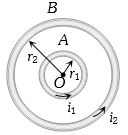
- 8$A$ and $B$ are two concentric circular conductors of centre $O$ and carrying currents ${i_1}$ and ${i_2}$ as shown in the adjacent figure. If ratio of their radii is $1 : 2$ and ratio of the flux densities at $O$ due to $A$ and $B$ is $1 : 3$, then the value of ${i_1}/{i_2}$ isView Solution
- 9Two particles $A$ and $B$ having equal charges $+6\,C$, after being accelerated through the same potential difference, enter in a region of uniform magnetic field and describe circular paths of radii $2\,cm$ and $3\,cm$ respectively. The ratio of mass of $A$ to that of $B$ isView Solution
- 10A small circular loop of conducting wire has radius $a$ and carries current $I$. It is placed in a uniform magnetic field $\mathrm{B}$ perpendicular to its plane such that when rotated slightly about its diameter and released, it starts performing simple harmonic motion of time period $T$. If the mass of the loop is $m$ thenView Solution