A cylindrical metal wire of length $l$ and cross sections area $S$, has resistance $R$, conductance $G$, conductivity $\sigma$ and resistivity $\rho$. Which one of the following expressions for $\sigma$ is valid
Medium


Download our appand get started for free
Experience the future of education. Simply download our apps or reach out to us for more information. Let's shape the future of learning together!No signup needed.*
Similar Questions
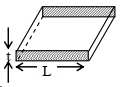
- 1Consider a thin square sheet of side $\mathrm{L}$ and thickness $\mathrm{t}$, made of a material of resistivity $\rho$. The resistance between two opposite faces, shown by the shaded areas in the figure isView Solution
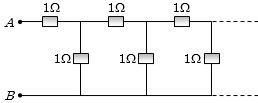
- 2The equivalent resistance between points $A$ and $B$ of an infinite network of resistances each of $1\,\Omega $ connected as shown, isView Solution
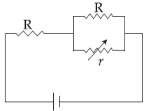
- 3In the circuit shown, the resistance $r$ is a variable resistance. If for $r = fR,$ the heat generation in $r$ is maximum then the value of $f$ isView Solution
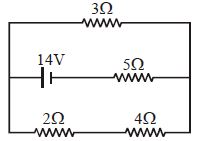
- 4Find out current in $3\,\Omega $ resistance in given circuitView Solution
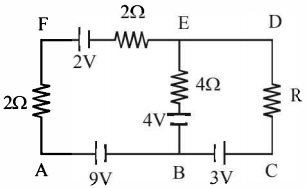
- 5In the electric network shown, when no current flows through the $4 \Omega$ resistor in the arm EB, the potential difference between the points $A$ and $D$ will be $.............\,V$View Solution
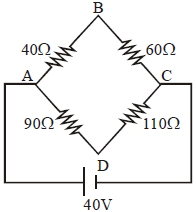
- 6Four resistances $40 \ \Omega, 60\ \Omega, 90\ \Omega$ and $110\ \Omega$ make the arms of a quadrilateral $A,B,C,D$. Across $AC$ is a battery of emf $40\, V$ and internal resistance negligible. The potential difference across $BD$ is $V$ is......View Solution
- 7If three bulbs $60\,W$, $100\,W$ and $200\,W$ are connected in parallel, thenView Solution
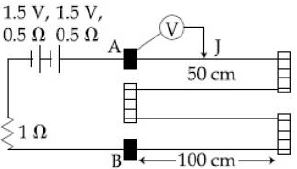
- 8In the circuit shown, a four wire potentiometer is made of a $400\, cm$ long wire, which extends between $A$ and $B$. The resistance per unit length of the potentiometer wire is $r = 0.01\, \Omega /cm$. If an ideal voltmeter is connected as shown with jockey $J$ at $50\, cm$ from end $A$, the expected reading of the voltmeter will be: ............... $V$View Solution
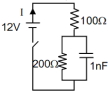
- 9Find the charge in steady state of the capacitor. (in $nC)$View Solution
- 10View SolutionAs the temperature of a conductor increases, its resistivity and conductivity change. The ratio of resistivity to conductivity