MCQ
A cylindrical solid of mass $M$ has radius $R$ and length $L$. Its moment of inertia about a generator is:
  • A
    $\text{M}\Big(\frac{1}{2\text{R}}+\frac{\text{R}^2}{4}\Big)$
  • B
    $\text{M}\Big(\frac{\text{L}}{3}+\frac{\text{R}^2}{4}\Big)$
  • C
    $\frac{1}{2}\text{MR}^2$
  • $\frac{3}{2}\text{MR}^2$

Answer

Correct option: D.
$\frac{3}{2}\text{MR}^2$
Generator is axis touching surface of cylinder and parallel to axis of cylinder. Using theorem of parallel axis,
$\text{I}=\text{I}_0+\text{MR}^2=\frac{1}{2}\text{MR}^2+\text{MR}^2$
$\text{I}=\frac{3}{2}\text{MR}^2$

Need a full question paper?

Generate a complete, print-ready paper with questions like this in minutes — across 16+ boards, with answer keys.

Start Generating Free

Similar questions

The Bernoulli's equation is given by $p +\frac{1}{2} \rho v ^{2}+ h \rho g = k$

where $p =$ pressure, $\rho =$ density, $v =$ speed, $h =$ height of the liquid column, $g=$ acceleration due to gravity and $k$ is constant. The dimensional formula for $k$ is same as that for

The end $A$ of a rod $AB$ of length $1\,m$ is maintained at $80\,^oC$ and the end $B$ at $0\,^oC.$ The temperature at a distance of  $60\,\,c.m.$  from the end $A$  is......... $^oC$
An air bubble of diameter $6\,mm$ rises steadily through a solution of density $1750\,kg / m ^3$ at the rate of $0.35\,cm / s$. The co-efficient of viscosity of the solution (neglect density of air) is $..........\,Pas$ (given, $g =10\,ms ^{-2}$)
A particle of mass $M=0.2 kg$ is initially at rest in the $x y$-plane at a point $( x =-l, y =-h)$, where $l=10 m$ and $h=1 m$. The particle is accelerated at time $t =0$ with a constant acceleration $a =10 m / s ^2$ along the positive $x$-direction. Its angular momentum and torque with respect to the origin, in SI units, are represented by $\vec{L}$ and $\vec{\tau}$, respectively. $\hat{i}, \hat{j}$ and $\hat{k}$ are unit vectors along the positive $x , y$ and $z$-directions, respectively. If $\hat{k}=\hat{i} \times \hat{j}$ then which of the following statement($s$) is(are) correct?

$(A)$ The particle arrives at the point $(x=l, y=-h)$ at time $t =2 s$.

$(B)$ $\vec{\tau}=2 \hat{ k }$ when the particle passes through the point $(x=l, y=-h)$

$(C)$ $\overrightarrow{ L }=4 \hat{ k }$ when the particle passes through the point $(x=l, y=-h)$

$(D)$ $\vec{\tau}=\hat{ k }$ when the particle passes through the point $(x=0, y=-h)$

Starting from rest, acceleration of a particle is $a = 2(t - 1).$ The velocity of the particle at $t = 5\,s$ is.........$m/sec$
For a satellite escape velocity is $11\, km/s$. If the satellite is launched at an angle of $60^°$ with the vertical, then escape velocity will be ........... $km/s$
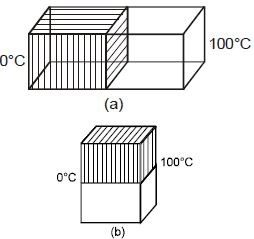
Two identical square rods of metal are welded end to end as shown in figure $(a)$. Assume that $10\, cal$ of heat flows through the rods in $2\, min$. Now the rods are welded as shown in figure, $(b)$. The time it would take for $10$ cal to flow through the rods now, is ........ $\min$
A $6 \,kg$ bomb at rest explodes into three equal pieces $P, Q$ and $R$. If $P$ flies with speed $30 \,m / s$ and $Q$ with speed $40 \,m / s$ making an angle $90^{\circ}$ with the direction of $P$. The angle between the direction of motion of $P$ and $R$ is about
A wire of length $L$ and radius $r$ is clamped rigidly at one end. When the other end of the wire is pulled by a force $F$, its length increases by $5\,cm$. Another wire of the same material of length $4 L$ and radius $4\,r$ is pulled by a force $4\,F$ under same conditions. The increase in length of this wire is $....cm$.
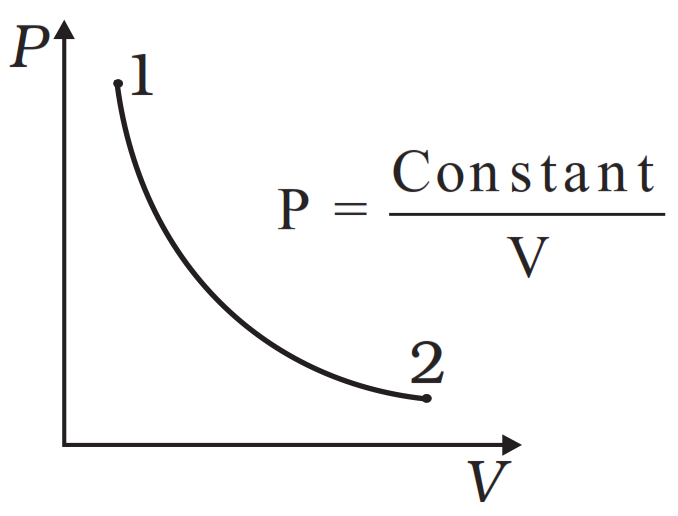
Consider $P-V$ diagram for an ideal gas shown in:

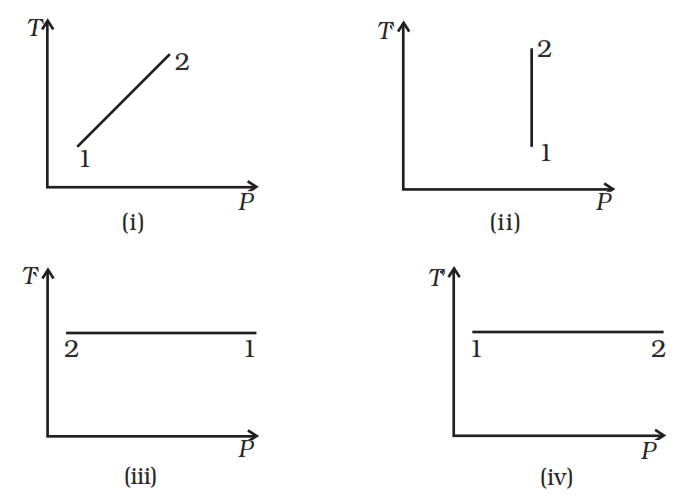
Out of the following diagrams which represents the $T-P$ diagram?