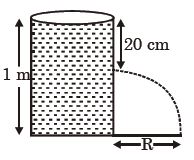
A tank is filled with water upto a height $1\,m$. A hole is made at a distance $20\, cm$ from top. Find, the horizontal distance from the base of the tank, where the water strikes the ground. ......... $cm$
Medium
Download our app for free and get started
$R=2 \sqrt{\mathrm{h}(H-h)}$
$=2 \sqrt{20(100-20)}=2 \sqrt{20 \times 80}=80 \mathrm{cm}$

Download our appand get started for free
Experience the future of education. Simply download our apps or reach out to us for more information. Let's shape the future of learning together!No signup needed.*
Similar Questions
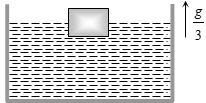
- 1A cubical block is floating in a liquid with half of its volume immersed in the liquid. When the whole system accelerates upwards with acceleration of $g/3,$ the fraction of volume immersed in the liquid will beView Solution
- 2A cylindrical vessel filled with water upto height of $H$ stands on a horizontal plane. The side wall of the vessel has a plugged circular hole touching the bottom. The coefficient of friction between the bottom of vessel and plane is $\mu$ and total mass of water plus vessel is $M$. What should be minimum diameter of hole so that the vessel begins to move on the floor if plug is removed (here density of water is $\rho$ )View Solution
- 3Two bodies having volumes $V$ and $2V $ are suspended from the two arms of a common balance and they are found to balance each other. If larger body is immersed in oil (density $d_1 $ $=$ $ 0.9$ $ gm/cm^3$) and the smaller body is immersed in an unknown liquid, then the balance remain in equilibrium. The density of unknown liquid is given by ......... $gm/cm^3$View Solution
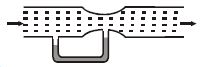
- 4Water flows through the tube shown. Area of cross-section of wide and narrow part are $5$ $cm^2$ $\&$ $2$ $cm^2$. The rate of flow is $500$ $cm^3/sec$. Find difference in mercury level of $U-$ tube .......... $cm$View Solution
- 5A cubical block of side $0.5\,m$ floats on water with $30\%$ of its volume under water. ....... $kg$ is the maximum weight that can be put on the block without fully submerging it under water ? [Take density of water $= 10^3\,kg/m^3$ ]View Solution
- 6Two identical cylindrical vessels with their bases at same level each contains a liquid of density $\rho$. The height of the liquid in one vessel is ${h_1}$ and that in the other vessel is ${h_2}$. The area of either base is $A$. The work done by gravity in equalizing the levels when the two vessels are connected, isView Solution
- 7A square plate of $0.1 \;m$ side moves parallel to a second plate with a velocity of $ 0.1\; m/s$, both plates being immersed in water. If the viscous force is $0.002\; N$ and the coefficient of viscosity is $ 0.01 $ poise, distance between the plates in $m$ isView Solution
- 8If two liquids of same volume but different densities ${\rho _1}$ and ${\rho _2}$ are mixed, then density of mixture is given byView Solution
- 9A liquid is kept in a cylindrical vessel which is being rotated about a vertical axis through the centre of the circular base. If the radius of the vessel is $ r $ and angular velocity of rotation is $\omega $, then the difference in the heights of the liquid at the centre of the vessel and the edge isView Solution
- 10View SolutionThe height to which a cylindrical vessel be filled with a homogeneous liquid, to make the average force with which the liquid presses the side of the vessel equal to the force exerted by the liquid on the bottom of the vessel, is equal to