If $W$ be the weight of a body of density $\rho $ in vacuum then its apparent weight in air of density $\sigma $ is
Easy


Download our appand get started for free
Experience the future of education. Simply download our apps or reach out to us for more information. Let's shape the future of learning together!No signup needed.*
Similar Questions
- 1A $U-$tube contains water and methylated spirit separated by mercury. The mercury columns in the two arms are in level with $10.0\; cm$ of water in one arm and $12.5\; cm $ of spirit in the other. if $15.0\; cm$ of water and spirit each are further poured into the respective arms of the tube, what is the difference in the levels (in $cm$) of mercury in the two arms?View Solution
(the specific gravity of spirit is $0.8.)$
- 2The density of the atmosphere at sea level is $1.29 \;kg / m ^{3} .$ Assume that it does not change with altitude. Then how high (in $km$) would the atmosphere extend?View Solution
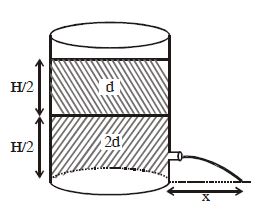
- 3A container of large uniform cross-sectional area $A$ is resting on a horizontal surface holds two immiscible, non-viscous and incompressible liquids of densities $d$ and $2d$ each of height $\frac{H}{2}$ as shown. The lower density of liquid is open to atmosphere. A small hole is made on the wall of container at height $h\left( {h < \frac{H}{2}} \right)$. The initial speed of efflux of the liquid at the hole isView Solution
- 4Two uniform solid balls of same density and of radii $r$ and $2r$ are dropped in air and fall vertically downwards. The terminal velocity of the ball with radius $r$ is $1\,cm\,s^{-1}$ , then find the terminal velocity of the ball of radius $2r$ (neglect bouyant force on the balls.) ........... $cm\,s^{-1}$View Solution
- 5$Assertion : $ Machine parts are jammed in winter.View Solution
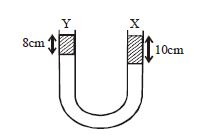
$Reason :$ The viscosity of lubricant used in machine parts increase at low temperatures. - 6A liquid $X$ of density $3.36\ g/cm^3$ is poured in a $U-$ tube, which contains $Hg$. Another liquid $Y$ is poured in left arm with height $8\ cm$, upper levels of $X$ and $Y$ are same. What is density of $Y$ .......... $g/cc$View Solution
- 7View SolutionTwo pieces of metal when immersed in a liquid have equal upthrust on them; then
- 8According to Bernoulli's equation $\frac{P}{{\rho g}} + h + \frac{1}{2}\,\frac{{{v^2}}}{g} = {\rm{constant}}$ The terms $A, B$ and $ C$ are generally called respectively:View Solution
- 9Two capillary tubes of same radius $r$ but of lengths $l_1$ and $l_2$ are fitted in parallel to the bottom of a vessel. The pressure head is $P$. What should be the length of a single tube that can replace the two tubes so that the rate of flow is same as beforeView Solution
- 10The reading of pressure metre attached with a closed pipe is $4.5 \times 10^4 \mathrm{~N} / \mathrm{m}^2$. On opening the valve, water starts flowing and the reading of pressure metre falls to $2.0 \times 10^4 \mathrm{~N} / \mathrm{m}^2$. The velocity of water is found to be $\sqrt{\mathrm{V}} \mathrm{m} / \mathrm{s}$. The value of $\mathrm{V}$ is__________View Solution