MCQ
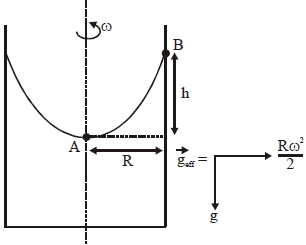
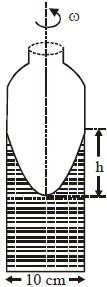
A cylindrical vessel containing a liquid is rotated about its axis so that the liquid rises at its sides as shown in the figure. The radius of vessel is $5\, cm$ and the angular speed of rotation is  $\omega\; rad \,s^{-1}$. The difference in the height, $h($ in $cm )$ of liquid at the centre of vessel and at the side will be
  • $\frac{25 \omega^{2}}{2 g}$
  • B
    $\frac{2 \omega^{2}}{5 g}$
  • C
    $\frac{5 \omega^{2}}{2 g}$
  • D
    $\frac{2 \omega^{2}}{25 g}$

Answer

Correct option: A.
$\frac{25 \omega^{2}}{2 g}$
a
Applying pressure equation from $A$ to $B$

$P_{0}+\rho \cdot \frac{R \omega^{2}}{2} \cdot R-\rho g h=P_{0}$

$\frac{\rho R ^{2} \omega^{2}}{2}=\rho gh$

$h =\frac{ R ^{2} \omega^{2}}{2 g }=(5)^{2} \frac{\omega^{2}}{2 g }=\frac{25}{2} \frac{\omega^{2}}{ g }$

Need a full question paper?

Generate a complete, print-ready paper with questions like this in minutes — across 16+ boards, with answer keys.

Start Generating Free

Similar questions

If the angular speed of the earth is doubled, the value of acceleration due to gravity (g) at the north pole
The density $\rho$ of a liquid varies with depth h from the free surface as $\rho=\text{kh.}$ A small body of density $\rho_1$ is released from the surface of liquid. The body will:
Let $\overrightarrow{\text{E}}$ and $\overrightarrow{\text{B}}$ denote electric and magnetic fields in a frame S and $\overrightarrow{\text{E}}$ and $\overrightarrow{\text{B}}$ in another frame S moving with respect to S at a velocity $\overrightarrow{\text{v}}.$ Two of the following equations are wrong. Identify them.

  1. $\text{B}_\text{y},=\text{B}_\text{y}+\frac{\text{vE}_\text{z}}{\text{c}^2}$

  2. $\text{E}_\text{y},=\text{E}_\text{y}+\frac{\text{vB}_\text{z}}{\text{c}^2}$

  3. $\text{B}'_\text{y}=\text{B}_\text{y}+\text{v}\text{E}_\text{z}$

  4. $\text{E}'_\text{y}=\text{E}_\text{y}+\text{vB}_\text{z}$

The quantity $\frac{\text{PV}}{\text{kT}}$ represents:
A particle is doing simple harmonic motion of amplitude $0.06 \mathrm{~m}$ and time period $3.14 \mathrm{~s}$. The maximum velocity of the particle is. . . . .. . $\mathrm{cm} / \mathrm{s}$.
A student of mass $M$ is $1.5 \,m$ tall and has her centre of mass $1 \,m$ above ground when standing straight. She wants to jump up vertically. To do so. she bends her knees so that her centre of mass is lowered by $0.2 \,m$ and then pushes the ground by a constant force F. As a result, she jumps up such that the maximum height of her feet is $0.3 \,m$ above ground. The ratio $F / Mg$ is
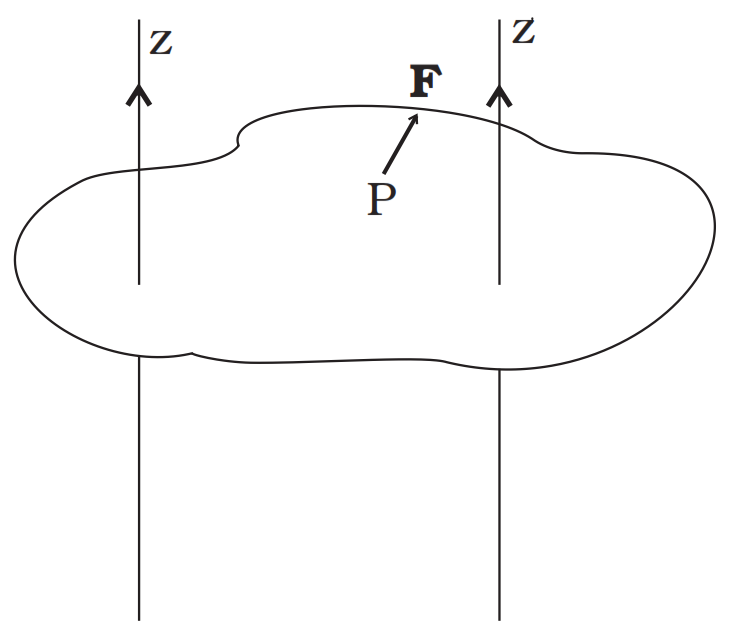
Shows a lamina in x-y plane. Two axes z and z′ pass perpendicular to its plane. A force F acts in the plane of lamina at point P as shown. Which of the following are true? (The point P is closer to z′-axis than the z-axis)

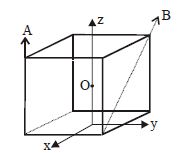
With reference to figure of a cube of edge $a$ and mass $m$, state whether the following
($O$ is the centre of the cube.) option is correct

$(a)$ The moment of inertia of cube about $z-$ axis is $I_z$ = $I_x + I_y$

$(b)$ The moment of inertia of cube about $A-$ axis is $I_A$=${I_z} + \frac{{m{a^2}}}{2}$

$(c)$ The moment of inertia of cube about $B-$ axis is $I_B$=${I_z} + \frac{{m{a^2}}}{2}$

$(d)$  $I_x$ = $I_z$

The surface tension of a liquid at its boiling point
A string in musical instrument is $50 cm$ long and its fundamental frequency is $800 Hz.$ If a frequency of $1000 Hz$ is to be produced, then required length of string is ..... $cm$