MCQ
The quantity $\frac{\text{PV}}{\text{kT}}$ represents:
  • A
    Mass of the gas.
  • B
    Kinetic energy of the gas.
  • C
    Number of moles of the gas.
  • D
    Number of molecules in the gas.

Answer

  1. Number of molecules in the gas.

Explanation:

Here,

PV = nRT ...(1)

Also,

$\text{k}=\frac{\text{R}}{\text{N}}$

$\Rightarrow\text{R}=\text{kN}\ ...(2)$

Now,

PV = nkNT [From eq. (1) and eq. (2)]

$\Rightarrow\text{nN}=\frac{\text{PV}}{\text{kT}}$

nN = Number of molecules

$\frac{\text{PV}}{\text{kT}}$ = Number of molecules.

Need a full question paper?

Generate a complete, print-ready paper with questions like this in minutes — across 16+ boards, with answer keys.

Start Generating Free

Similar questions

A ball is thrown upwards with a velocity of 25m/s. What is the time taken by the ball to return to the thrower (g = 10m/s2)
Number of molecules in a volume of $4\, cm ^{3}$ of a perfect monoatomic gas at some temperature $T$ and at a pressure of $2\, cm$ of mercury is close to $?$

(Given, mean kinetic energy of a molecule (at $T$ ) is $4 \times 10^{-14}$ erg, $g=980\, cm / s ^{2}$, density of mercury $=13.6\, g / cm ^{3}$)
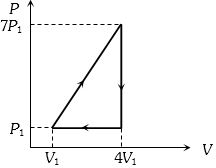
In the cyclic process shown in the figure, the work done by the gas in one cycle is
Average speed of a car between points A and B is 20m/s, between B and C is 15m/s, between C and D is 10m/s. What is the average speed between A and D, if the time taken in the mentioned sections is 20s, 10s and 5s respectively?
A gas for which $\gamma = 1.5$ is suddenly compressed to $\frac{1}{4}$ th of the initial volume. Then the ratio of the final to the initial pressure is
A particle executes simple harmonic motion between $x =- A$ and $x =+ A$. If time taken by particle to go from $x=0$ to $\frac{A}{2}$ is $2 s$; then time taken by particle in going from $x =\frac{ A }{2}$ to $A$ is $.........\,s$
A particle performs simple harmonic oscillation of period $T$ and the equation of motion is given by; 

$x = a\,\sin \,\left( {\omega t + \pi /6} \right)$

After the elapse of what fraction of the time period the velocity of the particle will be equal to half of its maximum velocity?
The lift of an air plane is based on
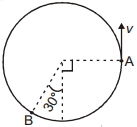
A particle of mass $m$ moves with constant speed $v$ on a circular path of radius $r$ as shown in figure. The average force on it during its motion from $A$ to $B$ is
A metal bal of mass $0.1\, kg$ is heated upto $500\,{}^oC$ and dropped into a vessel of heat capacity $800\, JK^{-1}$ and containing $0.5\, kg$ water. The initial temperature of water and vessel is $30\,{}^oC$. ........ $\%$ is the approximate percentage increment in the temperature of the water. [Specific heat Capacities of water and metal are, respectively $4200\, Jkg^{-1}K^{-1}$ and $400\, Jkg^{-1}K^{-1}$]