A cylindrical vessel open at the top is $20$ $cm $ high and $10$ $cm$ in diameter. A circular hole whose cross-sectional area $1$ $cm^2$ is cut at the centre of the bottom of the vessel. Water flows from a tube above it into the vessel at the rate $100$ $cm^3$ $s^{^{-1}}$. The height of water in the vessel under steady state is ....... $cm$ (Take $g$ $=$ $1000 $ $cm s^{^{-2}})$
Medium


Download our appand get started for free
Experience the future of education. Simply download our apps or reach out to us for more information. Let's shape the future of learning together!No signup needed.*
Similar Questions
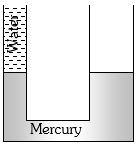
- 1A $U-$ tube in which the cross-sectional area of the limb on the left is one quarter, the limb on the right contains mercury (density $13.6 g/cm^3$). The level of mercury in the narrow limb is at a distance of $36 cm$ from the upper end of the tube. What will be the rise in the level of mercury in the right limb if the left limb is filled to the top with water ........ $cm$View Solution
- 2A jet of water with cross section of $6$ $cm^2$ strikes a wall at an angle of $60^o $ to the normal and rebounds elastically from the wall without losing energy. If the velocity of the water in the jet is $12$ $m/s$, the force acting on the wall is ....... $N$View Solution
- 3Apiece of steel has a weight $W$ in air, $W_1$ when completely immersed in water and $W_2$ when completely immersed in an unknown liquid. The relative density (specific gravity)of liquid isView Solution
- 4Water falls down a $500.0 \,m$ shaft to reach a turbine which generates electricity. ................ $m^3$ water must fall per second in order to generate $1.00 \times 10^9 \,W$ of power ? (Assume $50 \%$ efficiency of conversion and $\left.g=10 \,ms ^{-2}\right)$View Solution
- 5Air streams horizontally past an air plane. The speed over the top surface is $60 \,m / s$ and that under the bottom surface is $45 \,m / s$. The density of air is $1.293 \,kg / m ^3$, then the difference in pressure is ....... $N / m ^2$View Solution
- 6Two water pipes $P$ and $Q$ having diameters $2$$ \times 10^{-2} $ $m$ and $4$ $\times 10^{-2}$ $m$, respectively, are joined in series with the main supply line of water. The velocity of water flowing in pipe $P$ isView Solution
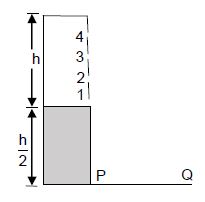
- 7A cylinder of height $h$ is filled with water and is kept on a block of height $h / 2$ . The level of water in the cylinder is kept constant. Four holes numbered $1, 2, 3$ and $4$ are at the side of the cylinder and at heights $0,\ h / 4,\ h / 2$ and $3h / 4$ respectively. When all four holes are opened together, the hole from which water will reach farthest distance on the plane $PQ$ is the hole numberView Solution
- 8Consider a solid sphere of radius $\mathrm{R}$ and mass density $\rho(\mathrm{r})=\rho_{0}\left(1-\frac{\mathrm{r}^{2}}{\mathrm{R}^{2}}\right), 0<\mathrm{r} \leq \mathrm{R} .$ The minimum density of a liquid in which it will float isView Solution
- 9Water is flowing steadily through a horizontal tube of non uniform cross-section. If the pressure of water is $4$ $\times $ $10^4$ $N/m^2$ at a point where cross-section is $0.02$ $m^2$ and velocity of flow is $2$ $m/s$, what is pressure at a point where cross-section reduces to $0.01$ $m^2$.View Solution
- 10Eight spherical rain drops of the same mass and radius are falling down with a terminal speed of $6\, cm -s^{-1}$ . If they coalesce to form one big drop, what will be the terminal speed of the bigger drop ? (Neglect the buoyancy of the air) ....... $cm -s^{-1}$View Solution