Question
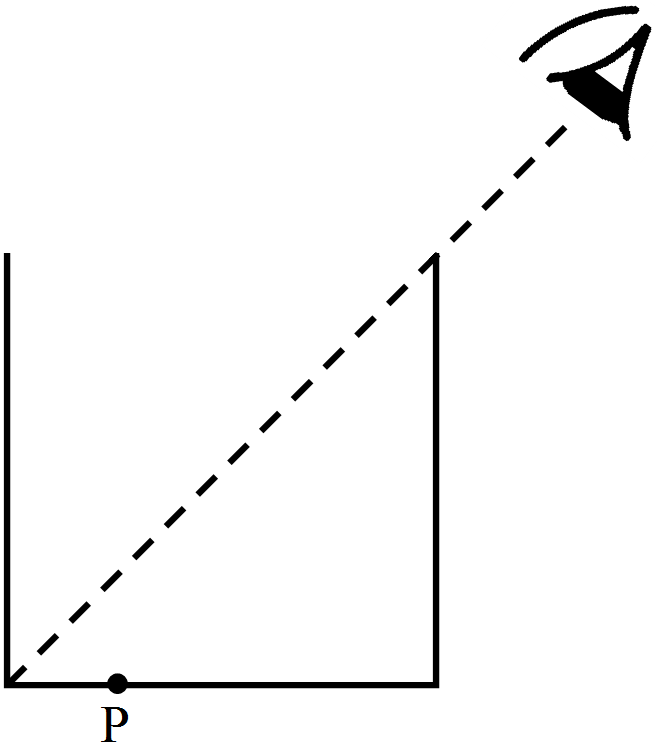
A cylindrical vessel, whose diameter and height both are equal to 30cm, is placed on a horizontal surface and a small particle P is placed in it at a distance of 5.0cm from the centre. An eye is placed at a position such that the edge of the bottom is just visible. The particle P is in the plane of drawing. Up to what minimum height should water be poured in the vessel to make the particle P visible?
Answer

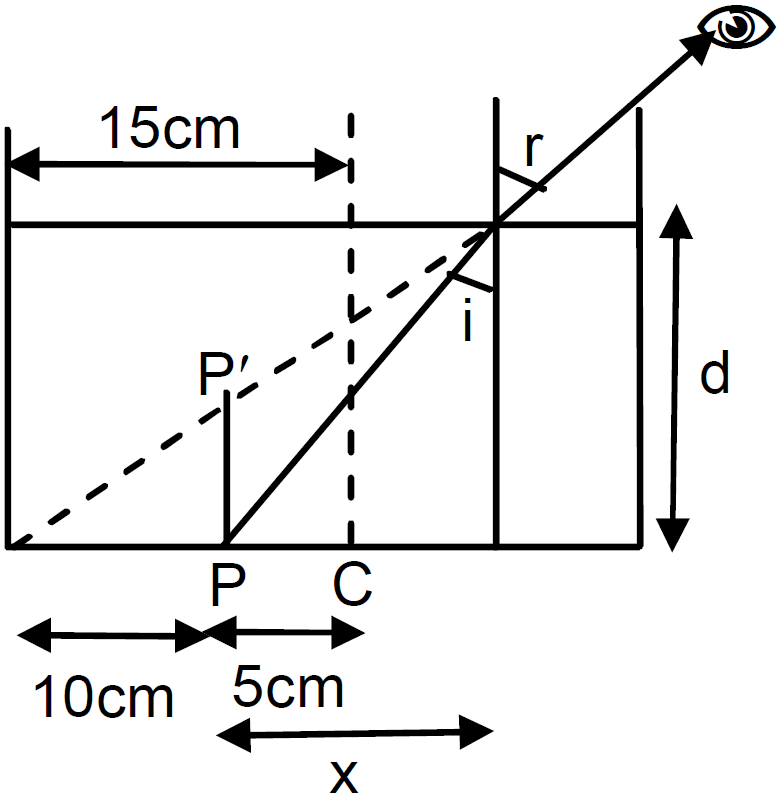
For the given cylindrical vessel, dimetre = 30cm ⇒ r = 15cm and h = 30cm Now, $\frac{\sin\text{i}}{\sin\text{r}}=\frac{3}{4}\Big[\mu_{\text{w}}=1.33=\frac{4}{3}\Big]$$\Rightarrow\sin\text{i}=\frac{3}{4\sqrt{2}} \ \big[\because \text{r}=45^{\circ}\big]$
The point P will be visible when the refracted ray makes angle 45° at point of refraction. Let x = distance of point P from X. Now, $\tan45^{\circ}=\frac{\text{x}+10}{\text{d}}$$\Rightarrow\text{d}=\text{x}+10 \ ...(1)$
Again, $\tan\text{i}=\frac{\text{x}}{\text{d}}$$\Rightarrow\frac{3}{\sqrt{23}}=\frac{\text{d}-10}{\text{d}} \ \Big[\text{Since,} \ \sin\text{i}=\frac{3}{4\sqrt{2}}\Rightarrow\tan\text{i}=\frac{3}{4\sqrt{2}}\Big]$
$\Rightarrow\frac{3}{\sqrt{23}}-1=-\frac{10}{\text{d}}\Rightarrow\text{d}=\frac{\sqrt{23}\times10}{\sqrt{23}-3}=26.7\text{cm}$

Need a full question paper?

Generate a complete, print-ready paper with questions like this in minutes — across 16+ boards, with answer keys.

Start Generating Free

Similar questions

Write in detail the important results related to conductive electrostatics.
A given coin has a mass of 3.0 g. Calculate the nuclear energy that would be required to separate all the neutrons and protons from each other. For simplicity assume that the coin is made entirely of ${ }_{29}^{63} Cu$ atoms (of mass 62.92960 u).
Two charges $2.0 \times 10^{-6}C$ and $1.0 \times 10^{-6}C$ are placed at a separation of $10\ cm.$ Where should a third charge be placed such that it experiences no net force due to these charges?
Lenses are constructed by a material of refractive index $1.50.$ The magnitude of the radii of curvature are $20\ cm$ and $30\ cm$. Find the focal lengths of the possible lenses with the above specifications.
Give a brief description of the basic elementary process involved in the photoelectric emission in Einstein’s picture.
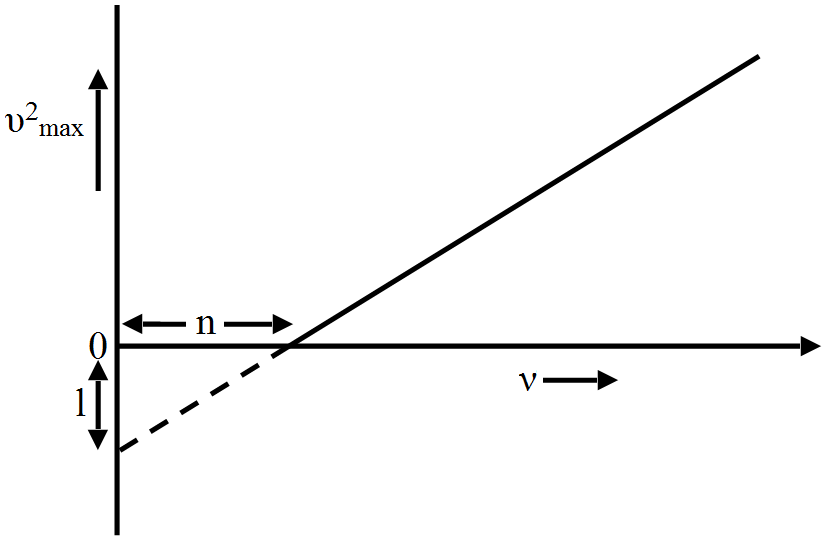
When a photosensitive material is irradiated with the light of frequency $v$, the maximum speed of electrons is given by $v_{max}.$ A plot of $v_{2max}$ is found to vary with frequency $ν$ as shown in the figure.

Use Einstein’s photoelectric equation to find the expressions for:
  1. Planck’s constant.
  2. Work function of the given photosensitive material, in terms of the parameters $l, n$ and mass $m$ of the electron.
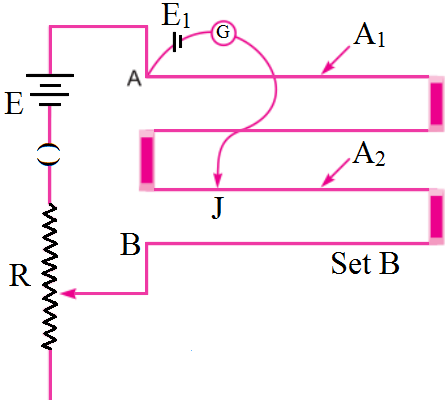
You are given two sets of potentiometer circuits to measure the emf $E_1$ of a cell. Set $A$: consists of a potentiometer wire of a material of resistivity $\rho_1$, area of cross $-$ section $A_1$ and length $l$. Set $B$: consists of a potentiometer of two composite wire of equal lengths $\frac{\text{l}}{2}$ each, of resistivity $\rho_1,\rho_2$ and area of cross $-$ section $A_1, A_2$ respectively.
Find the relation between resistivity of the two wires with respect to their area of cross section, if the current flowing in the two sets is same. Compare the balancing length obtained in the two sets.
What do you understand by a solenoid? Obtain an expression for magnetic field of a solenoid of infinite length.###Establish a formula for magnetic field on the axis inside of a straight and long solenoid. Show the direction of magnetic field inside it and what is the magnitude of magnetic field outside the solenoid.###Establish a formula for magnetic field inside a long solenoid. Represent produced force lines by diagram.###Write Ampere's circuital law. Obtain an expression for magnetic field on the axis of a very long current carrying solenoid. Draw necessary diagram also.
A charge Q is uniformly distributed on a thin spherical shell. What is the field at the centre of the shell? If a point charge is brought close to the shell, will the field at the centre change? Does your answer depend on whether the shell is conducting or nonconducting?
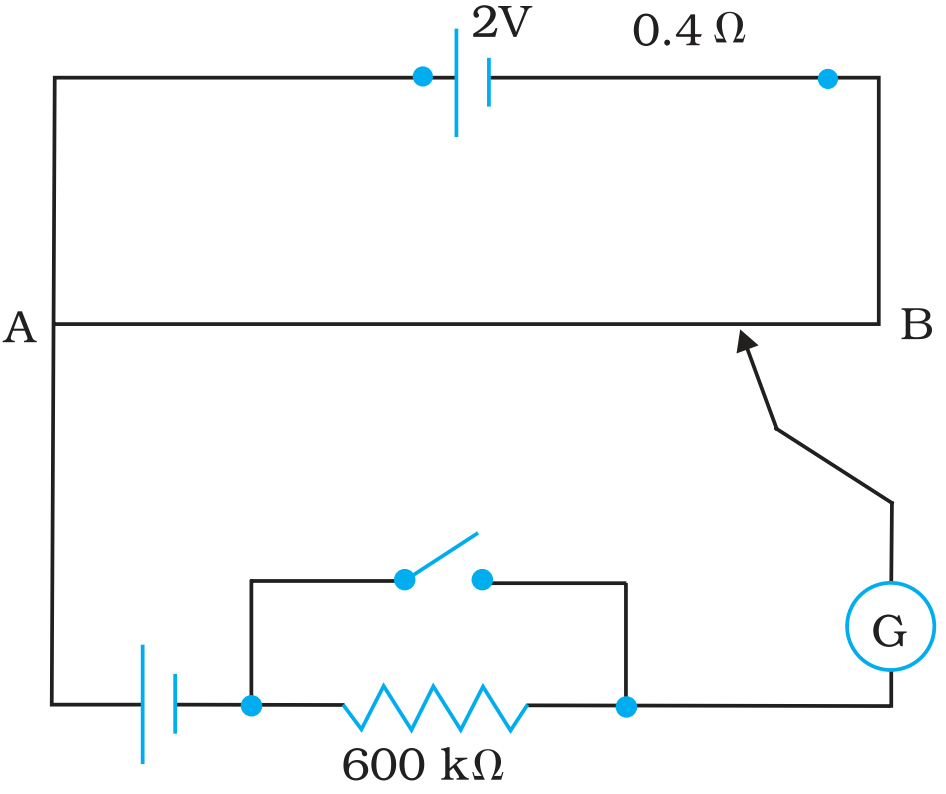
Figure shows a potentiometer with a cell of $2.0 V$ and internal resistance $0.04\ \Omega$ maintaining a potential drop across the resistor wire $AB$. A standard cell which maintains a constant emf of $1.02 V ($for very moderate currents upto a few $mA)$ gives a balance point at $67.3 \ cm$ length of the wire. To ensure very low currents drawn from the standard cell, a very high resistance of $600\ \text{k}\Omega$ is put in series with it, which is shorted close to the balance point. The standard cell is then replaced by a cell of unknown emf $\varepsilon$ and the balance point found similarly, turns out to be at $82.3 \ cm$ length of the wire.
  1. What is the value $\varepsilon?$
  2. What purpose does the high resistance of $600\ \text{k}\Omega$ have?
  3. Is the balance point affected by this high resistance?
  4. Is the balance point affected by the internal resistance of the driver cell?
  5. Would the method work in the above situation if the driver cell of the potentiometer had an emf of $1.0 V$ instead of $2.0 V$?
  6. Would the circuit work well for determining an extremely small emf, say of the order of a few $mV ($such as the typical emf of a thermo$-$couple$)$? If not, how will you modify the circuit?
A rod, when suspended in a magnetic field, stays in the east-west direction. Can we be sure that the field is in the east-west direction? Can it be in the north-south direction?