Question
Write in detail the important results related to conductive electrostatics.

Answer

SELF

Need a full question paper?

Generate a complete, print-ready paper with questions like this in minutes — across 16+ boards, with answer keys.
Start Generating Free

Similar questions

Explain what would happn if in the capacitor given in Q. 2.8, a 3 mm thick mica sheet (of dielectric constant = 6) were inserted between the plates.
(a) while the voltage supply remained connectd.
(b) after the supply was disconncted.
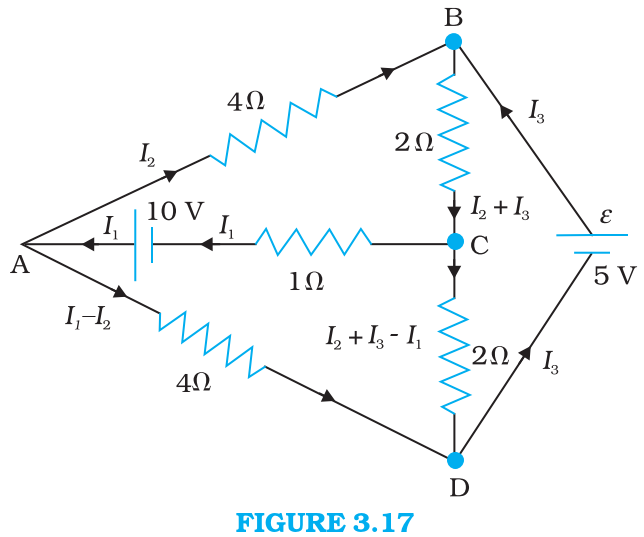
Determine the current in each branch of the network shown in Fig. $3.17$.
Image
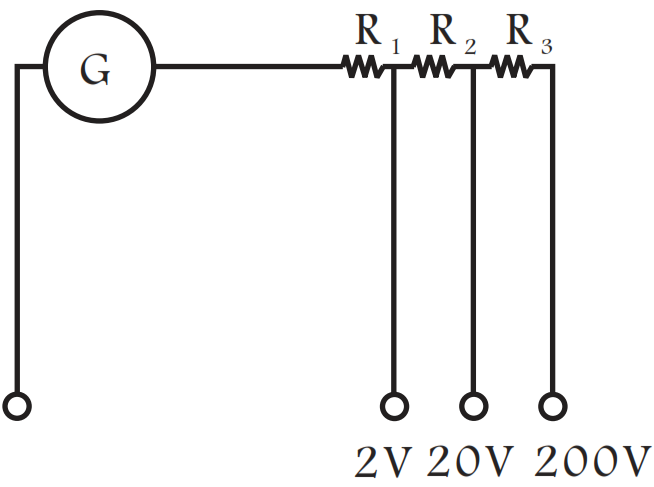
A multirange voltmeter can be constructed by using a galvanometer circuit as shown in Fig. We want to construct a voltmeter that can measure $2V, 20V$ and $200V$ using a galvanometer of resistance $10\Omega$ and that produces maximum deflection for current of $1mA$. Find $R_1, R_2$ and $R_3$ that have to be used.
The temperature and pressure at Simla are $15.0^\circ C$ and $72.0\ cm$ of mercury and at Kalka these are $35.0^\circ C$ and $76.0\ cm$ of mercury. Find the ratio of air density at Kalka to the air density at Simla.
What are circular and elliptically polarized light?
$i$. Describe, with the help of a suitable diagram, the working principle of a step $-$ up transformer. Obtain the relation between input and output voltages in terms of the number of turns of primary and secondary windings and the currents in the input and output circuits.
$i$. Given the input current $15 A$ and the input voltage of $100 V$ for a step $-$ up transformer having $90\%$ efficiency, find the output power and the voltage in the secondary if the output current is $3 A$.
Given the resistances of $1\ \Omega,\ 2\ \Omega,\ 3\ \Omega,$ how will be combine them to get an equivalent resistance of,
  1. $(11/3)\ \Omega$
  2. $(11/5)\ \Omega$
  3. $6\ \Omega$
  4. $(6/11)\ \Omega?$
Assume that a tunnel is dug along a chord of the earth, at a perpendicular distance $\frac{\text{R}}{2}$ from the earth's centre where R is the radius of the earth. The wall of the tunnel is frictionless.
  1. Find the gravitational force exerted by the earth on a particle of mass m placed in the tunnel at a distance x from the centre of the tunnel.
  2. Find the component of this force along the tunnel and perpendicular to the tunnel.
  3. Find the normal force exerted by the wall on the particle.
  4. Find the resultant force on the particle.
  5. Show that the motion of the particle in the tunnel is simple harmonic and find the time period.
In a Young's double slit experiment, the separation between the slits $= 2.0\ mm,$ the wavelength of the light $= 600\ nm$ and the distance of the screen from the slits $= 2.0m$. If the intensity at the centre of the central maximum is $0.20\ W/ m^2,$ what will be the intensity at a point $0.5\ cm$ away from this centre along the width of the fringes?
The inverse square law in electrostatics is $|\text{F}|=\frac{\text{e}^2}{(4\pi\epsilon_0)\text{r}^2}$ for the force between an electron and a proton. The $\Big(\frac{1}{\text{r}}\Big)$ dependence of $|F|$ can be understood in quantum theory as being due to the fact that the 'particle' of light $($photon$)$ is massless. If photons had a mass $m_p$, force would be modified to $|\text{F}|=\frac{\text{e}^2}{(4\pi\epsilon_0)\text{r}^2}\Big[\frac{1}{\text{r}^2}+\frac{\lambda}{\text{r}}\Big].\text{e}\times\text{p}(-\lambda\text{r})$ where $\lambda=\frac{\text{m}_\text{p}\text{c}}{\text{h}}$ and $\text{h}=\frac{\text{h}}{2\pi}$. Estimate the change in the ground state energy of a $H-$ atom if $m_p$ were $10^{-6}$ times the mass of an electron.