Question
Give a brief description of the basic elementary process involved in the photoelectric emission in Einstein’s picture.
When a photosensitive material is irradiated with the light of frequency $v$, the maximum speed of electrons is given by $v_{max}.$ A plot of $v_{2max}$ is found to vary with frequency $ν$ as shown in the figure.
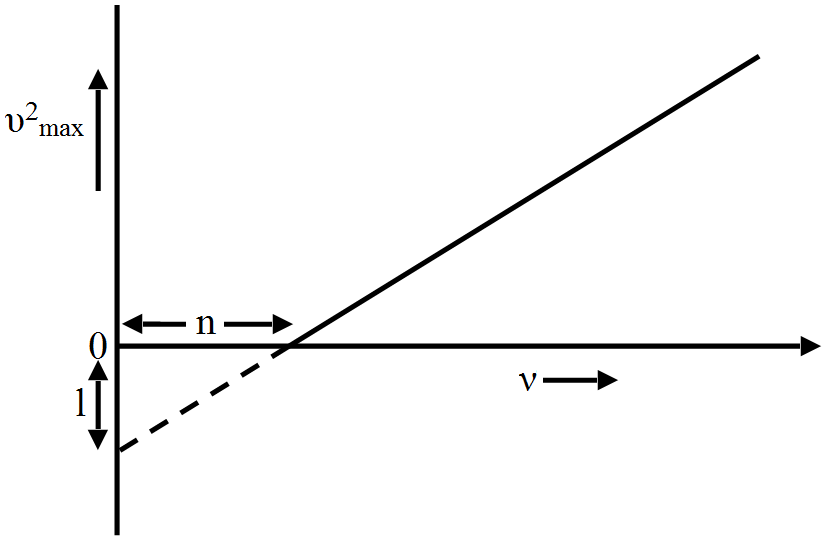
Use Einstein’s photoelectric equation to find the expressions for:
  1. Planck’s constant.
  2. Work function of the given photosensitive material, in terms of the parameters $l, n$ and mass $m$ of the electron.
Answer

  1. Planck’s constant: $\text{h}=\frac{\text{lm}}{2\text{n}}$
  2. $\nu_1^2$ and $\nu_2^2$ are the velocities of the emitted electrons for radiations of frequencies $v_1 > v$ and $v_2 > v$ respectively. 
$\text{h}\nu_1=\text{h}\nu+\frac{1}{2}\text{mv}^2_1\dots(\text{i})$
and $\text{h}\nu_2=\text{h}\nu+\frac{1}{2}\text{mv}^2_2\dots(\text{ii})$
From equation $(i)$ and $(ii),$ we get
$\text{h}(\nu_2-\nu_1)=\frac{1}{2}\text{m}(\text{v}^2_2-\text{v}^2_1)$
$\therefore\ \text{h}=\frac{\frac{1}{2}\text{m}(\text{v}^2_2-\text{v}^2_1)}{(\nu_2-\nu_1)}$
Slope of $\text{v}^2_\text{max} v_s$ frequency graph is,
$\tan\theta=\frac{\text{v}^2_2-\text{v}^2_1}{(\nu_2-\nu_1)}$
$\therefore\ \text{h}=\frac{1}{2}\text{m}.\tan\theta$
From graph $\tan\theta=\frac{1}{\text{n}}$
So, $\text{h}=\frac{1}{2}\text{m}\Big(\frac{\text{l}}{\text{n}}\Big)\dots(\text{iii})$
  • From graph, the work function of the material is,
$w = hn ...(iv)$
From equations $(iii)$ and $(iv),$ we get
$\text{w}=\frac{1}{2}\text{m}\Big(\frac{\text{l}}{\text{n}}\Big)\times\text{n}=\frac{1}{2}\text{ml}$

Need a full question paper?

Generate a complete, print-ready paper with questions like this in minutes — across 16+ boards, with answer keys.

Start Generating Free

Similar questions

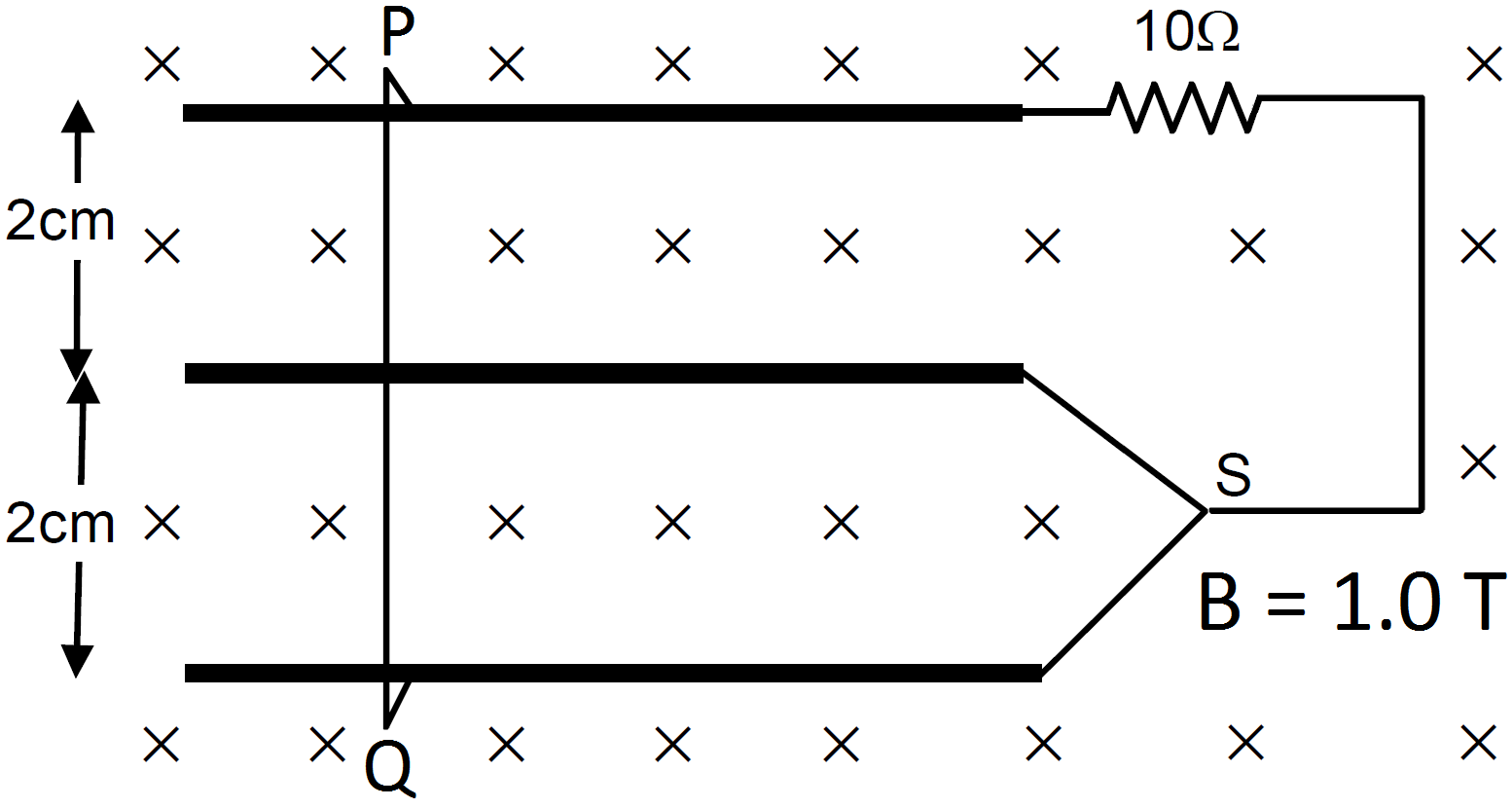
Consider the situation shown in figure. The wire PQ has a negligible resistance and is made to slide on the three rails with a constant speed of 5cm/s. Find the current in the $10\Omega$ resistor when the switch S is thrown to:
  1. The middle rail.
  2. The bottom rail.
A source emitting sound at frequency 4000Hz, is moving along the Y-axis with a speed of 22m/s. A listener is situated on the ground at the position (660m, 0). Find the frequency of the sound received by the listener at the instant the source the origin. Speed of sound in air = 330m/s.
Let $\text{X}=\overline{\text{ABC}}+\overline{\text{BCA}}+\overline{\text{CAB}}.$ Evaluate X for:
  1. $\text{A}=1,\text{B}=0,\text{C}=1$
  2. $\text{A}=\text{B}=\text{C}=1$
  3. $\text{A}=\text{B}=\text{C}=0$
Total charge $-Q$ is uniformly spread along length of a ring of radius $R. A$. small test charge $+q$ of mass $m$ is kept at the centre of the ring and is given a gentle push along the axis of the ring.
  1. Show that the particle executes a simple harmonic oscillation.
  2. Obtain its time period.
​​​​​
Suppose the space between the two inner shells of the previous problem is filled with a dielectric of dielectric coastant K. Find the capacitance of the system between A and B.
A group of hydrogen atoms are prepared in n = 4 states. List the wavelength that are emitted as the atoms make transitions and return to n = 2 states.
Write the mathematical relation for the resistivity of a material in terms of relaxation time, number density, mass and charge of charge carriers in it. Explain using this relation, why the resistivity of a metal increases and that of a semiconductor decreases with rise in temperature.
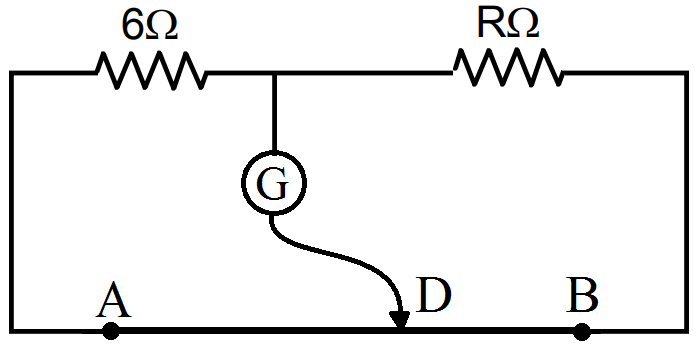
The potentiometer wire AB shown in figure. is 50cm long. When AD = 30cm, no deflection occurs in the galvanometer. Find R.
A turn of radius 20m is banked for the vehicles going at a speed of 36 km/h. If the coefficient of static friction between the road and the tyre is 0.4, what are the possible speeds of a vehicle so that it neither slips down nor skids up?
A bicycle is resting on its stand in the east$-$west direction and the rear wheel is rotated at an angular speed of $100$ revolutions per minute. If the length of each spoke is $30.0\ cm$ and the horizontal component of the earth's magnetic field is $2.0 \times 10^{-5} T,$ find the emf induced between the axis and the outer end of a spoke. Neglect centripetal force acting on the free electrons of the spoke.