A cylindrical wire of radius $1\,\, mm$, length $1 m$, Young’s modulus $= 2 × 10^{11} N/m^2$, poisson’s ratio $\mu = \pi /10$ is stretched by a force of $100 N$. Its radius will become
Diffcult


Download our appand get started for free
Experience the future of education. Simply download our apps or reach out to us for more information. Let's shape the future of learning together!No signup needed.*
Similar Questions
- 1A $2 \,m$ long rod of radius $1 \,cm$ which is fixed from one end is given a twist of $0.8$ radians. The shear strain developed will beView Solution
- 2View SolutionThe isothermal bulk modulus of a gas at atmospheric pressure is
- 3If the breaking force for a given wire is $F$, then the breaking force of two wires of same magnitude will beView Solution
- 4View SolutionIn suspended type moving coil galvanometer, quartz suspension is used because
- 5View SolutionUnder elastic limit the stress is
- 6An increases in pressure required to decreases the $200\,litres$ volume of a liquid by $0.004\%$ in container is ............ $kPa$ (Bulk modulus of the liquid $= 2100\,MPa$ )View Solution
- 7An iron rod of length $2m$ and cross section area of $50\,m{m^2}$, stretched by $0.5\, mm$, when a mass of $250\, kg$ is hung from its lower end. Young's modulus of the iron rod isView Solution
- 8View SolutionWhy the spring is made up of steel in comparison of copper
- 9If a spring is extended to length $l,$ then according to Hook's lawView Solution
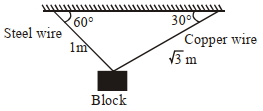
- 10A block of weight $100 N$ is suspended by copper and steel wires of same cross sectional area $0.5 cm ^2$ and, length $\sqrt{3} m$ and $1 m$, respectively. Their other ends are fixed on a ceiling as shown in figure. The angles subtended by copper and steel wires with ceiling are $30^{\circ}$ and $60^{\circ}$, respectively. If elongation in copper wire is $\left(\Delta \ell_{ C }\right)$ and elongation in steel wire is $\left(\Delta \ell_{ s }\right)$, then the ratio $\frac{\Delta \ell_{ C }}{\Delta \ell_{ S }}$ is. . . . . .View Solution
[Young's modulus for copper and steel are $1 \times 10^{11} N / m ^2$ and $2 \times 10^{11} N / m ^2$ respectively]