If a spring is extended to length $l,$ then according to Hook's law
Easy
Download our app for free and get started
(a) $\frac{\text { stress }}{\text { sbrain }}=k=E$
$\frac{F L}{A l}=E$
$\frac{E A}{L}=k$
$F=\frac{E A}{L} \times l$
$F=k l$

Download our appand get started for free
Experience the future of education. Simply download our apps or reach out to us for more information. Let's shape the future of learning together!No signup needed.*
Similar Questions
- 1View SolutionThe breaking stress of a wire depends upon
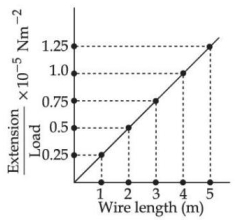
- 2In an experiment to determine the Young's modulus, steel wires of five different lengths $(1,2,3,4$ and $5\,m )$ but of same cross section $\left(2\,mm ^{2}\right)$ were taken and curves between extension and load were obtained. The slope (extension/load) of the curves were plotted with the wire length and the following graph is obtained. If the Young's modulus of given steel wires is $x \times 10^{11}\,Nm ^{-2}$, then the value of $x$ isView Solution
- 3A uniform cube is subjected to volume compression. If each side is decreased by $1\%,$ then bulk strain isView Solution
- 4If the interatomic spacing in a steel wire is $3.0Å$ and ${Y_{steel}}$= $20 \times {10^{10}}N/{m^2}$ then force constant isView Solution
- 5Two wires $A$ and $B$ of same length, same area of cross-section having the same Young's modulus are heated to the same range of temperature. If the coefficient of linear expansion of $A$ is $3/2$ times of that of wire $B$. The ratio of the forces produced in two wires will beView Solution
- 6View SolutionA light rod acted upon by three forces, is in equilibrium. Which of the following diagram shows the possible position and direction of the forces?
- 7An object is taken $1.0\,km$ deep in sea. Density of sea $= 1.025 \times 10^3\,kg/m^3$ , Bulk modulus of object $= 1.6 \times 10^6\, KPa$ Find out percentage change in density of object....... $\%$View Solution
- 8The compressibility of water is $4 \times {10^{ - 5}}$ per unit atmospheric pressure. The decrease in volume of $100$ cubic centimeter of water under a pressure of $100$ atmosphere will be ......... $cc$View Solution
- 9If a load of $9$ $kg$ is suspended on a wire, the increase in length is $4.5\, mm$. The force constant of the wire isView Solution
- 10The Young's modulus of the material of a wire is $6 \times {10^{12}}\,N/{m^2}$ and there is no transverse strain in it, then its modulus of rigidity will beView Solution