A Daniel cell is balanced on $125\,cm$ length of a potentiometer wire. Now the cell is short-circuited by a resistance $2\, ohm$ and the balance is obtained at $100\,cm$. The internal resistance of the Daniel cell is .............. $ohm$
Medium


Download our appand get started for free
Experience the future of education. Simply download our apps or reach out to us for more information. Let's shape the future of learning together!No signup needed.*
Similar Questions
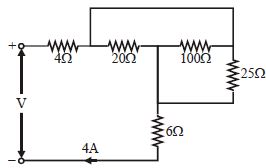
- 1In given circuit find value of ................... $V$View Solution
- 2The electromotive force of a primary cell is $2\, volts$. When it is short-circuited it gives a current of $4$ amperes. Its internal resistance in $ohms$ isView Solution
- 3In previous problem, if the cell had been connected in parallel (instead of in series) which of the above graphs would have shown the relationship between total current $I$ and $n$?View Solution
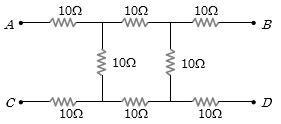
- 4What will be the equivalent resistance between the two points $A$ and $D$ ............. $\Omega$View Solution
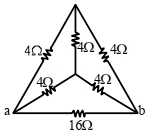
- 5The equivalent resistance of the circuit shown below between points $a$ and $b$ is $..........\Omega$View Solution
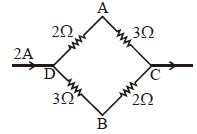
- 6A current of $2\, A$ flows in a system of conductors as shown. The potential difference $(V_A -V_B)$ will be ................ $\mathrm{V}$View Solution
- 7$(1)$ The product of a volt and a coulomb is a joule.View Solution
$(2)$ The product of a volt and an ampere is a joule/second.
$(3)$ The product of volt and watt is horse power.
$(4)$ Watt-hour can be measured in terms of electron volt.
State if
- 8View SolutionElectric current has both magnitude and direction. It is a
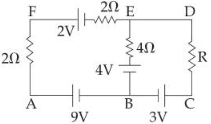
- 9In the electric network shown, when no current flows through the $4\, \Omega $ resistor in the arm $EB$, the potential difference between the points $A$ and $D$ will be ............... $V$View Solution
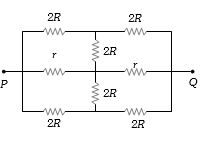
- 10The effective resistance between points $P$ and $Q$ of the electrical circuit shown in the figure isView Solution