The electromotive force of a primary cell is $2\, volts$. When it is short-circuited it gives a current of $4$ amperes. Its internal resistance in $ohms$ is
Easy
Download our app for free and get started
(a) $E = V + ir$
After short-circuiting, $V = 0;$ $ \Rightarrow $ $r = \frac{E}{i} = \frac{2}{4} = 0.5\,\Omega $

Download our appand get started for free
Experience the future of education. Simply download our apps or reach out to us for more information. Let's shape the future of learning together!No signup needed.*
Similar Questions
- 1View SolutionThe resistivity of a wire
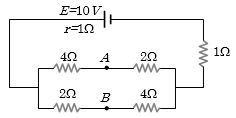
- 2In the circuit shown below, the cell has an $e.m.f.$ of $10\,V$ and internal resistance of $1\, ohm$. The other resistances are shown in the figure. The potential difference ${V_A} - {V_B}$ is ................ $V$View Solution
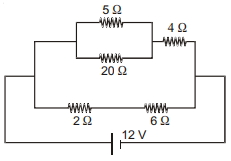
- 3A circuit containing five resistors is connected to a battery with a $12 \,V$ emf as shown in figure. The potential difference across $4 \,\Omega$ resistor is ........... $V$View Solution
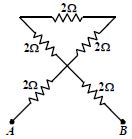
- 4For the circuit shown in the figure , the equivalent resistance between $A$ and $B$ is ............. $\Omega$View Solution
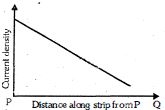
- 5An electric current flows along an insulated strip $PQ$ of a metallic conductor. The current density in the strip varies as shown in graph of figure. Which one of the following statements could explain this variation ?View Solution
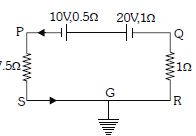
- 6View SolutionIn the circuit shown in the figure below, which of the following statement is incorrect ?
- 7For a cell of $e.m.f.$ $2\,V$, a balance is obtained for $50\, cm$ of the potentiometer wire. If the cell is shunted by a $2\,\Omega $ resistor and the balance is obtained across $40\, cm$ of the wire, then the internal resistance of the cell is ............. $\Omega $View Solution
- 8The length of a potentiometer wire is $l$. $A$ cell of $\mathrm{emf}$ $E$ is balanced at a length $l/3$ from the positive end of the wire. If the length of the wire is increased by $l/2$. At what distance will the same cell give a balance point.View Solution
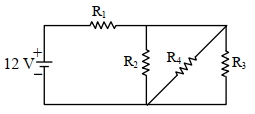
- 9In the given figure $R_1=10 \Omega, R_2=8 \Omega, R_3=4 \Omega$ and $R_4=8 \Omega$. Battery is ideal with emf $12 \mathrm{~V}$. Equivalent resistant of the circuit and current supplied by battery are respectively.View Solution
- 10In the given potentiometer circuit length of the wire $AB$ is $3\,m$ and resistance is $R = 4.5 \,\Omega.$ The length $AC$ for no deflection in galvanometer is ................ $\mathrm{m}$View Solution