A circular current carrying coil has a radius $R$. The distance from the centre of the coil on the axis where the magnetic induction will be $\frac{1}{8}^{th}$ to its value at the centre of the coil, is
Diffcult


Download our appand get started for free
Experience the future of education. Simply download our apps or reach out to us for more information. Let's shape the future of learning together!No signup needed.*
Similar Questions
- 1View SolutionAn electron is travelling in east direction and a magnetic field is applied in upward direction then electron will deflect in
- 2One metre length of wire carries a constant current. The wire is bent to form a circular loop. The magnetic field at the centre of this loop is $B$. The same is now bent to form a circular loop of smaller radius to have four turns in the loop. The magnetic field at the centre of this new loop isView Solution
- 3Two straight parallel wires, both carrying $10$ $ampere$ in the same direction attract each other with a force of $1 \times {10^{ - 3}}\,N$. If both currents are doubled, the force of attraction will beView Solution
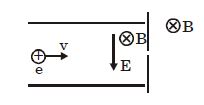
- 4Consider the mass-spectrometer as shown in figure. The electric field between plates is $\vec E\ V/m$ , and the magnetic field in both the velocity selector and in the deflection chamber has magnitude $B$ . Find the radius $'r'$ for a singly charged ion of mass $'m'$ in the deflection chamberView Solution
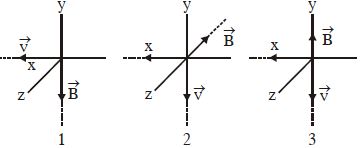
- 5The figure shows three situations when an electron moves with velocity $\vec v$ travels through a uniform magnetic field $\vec B$. In each case, what is the direction of magnetic force on the electronView Solution
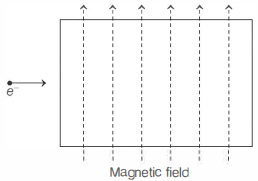
- 6View SolutionAn electron enters a chamber in which a uniform magnetic field is present as shown below. An electric field of appropriate magnitude is also applied, so that the electron travels undeviated without any change in its speed through the chamber. We are ignoring gravity. Then, the direction of the electric field is
- 7View SolutionMagnetic dipole moment of a rectangular loop is
- 8An electron is moving along positive $x$-axis. To get it moving on an anticlockwise circular path in $x-y$ plane, a magnetic filed is appliedView Solution
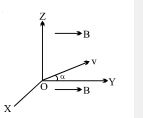
- 9In a region of space, a uniform magnetic field $B$ exists in the $y-$direction.Aproton is fired from the origin, with its initial velocity $v$ making a small angle $\alpha$ with the $y-$ direction in the $yz$ plane. In the subsequent motion of the proton,View Solution
- 10View SolutionMark the correct statement