One metre length of wire carries a constant current. The wire is bent to form a circular loop. The magnetic field at the centre of this loop is $B$. The same is now bent to form a circular loop of smaller radius to have four turns in the loop. The magnetic field at the centre of this new loop is
Medium


Download our appand get started for free
Experience the future of education. Simply download our apps or reach out to us for more information. Let's shape the future of learning together!No signup needed.*
Similar Questions
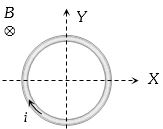
- 1A conducting loop carrying a current $I$ is placed in a uniform magnetic field pointing into the plane of the paper as shown. The loop will have a tendency toView Solution
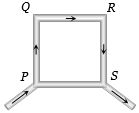
- 2$PQRS$ is a square loop made of uniform conducting wire the current enters the loop at $P$ and leaves at $S$. Then the magnetic field will beView Solution
- 3Assertion : A proton and an alpha particle having the same kinetic energy are moving in circular paths in a uniform magnetic field. The radii of their circular paths will be equal.View Solution
Reason : Any two charged particles having equal kinetic energies and entering a region of uniform magnetic field $\overrightarrow B $ in a direction perpendicular to $\overrightarrow B $, will describe circular trajectories of equal radii.
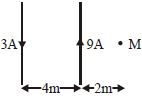
- 4Magnetic field at point $'M'$ of given current distributionView Solution
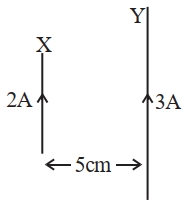
- 5A wire $X$ of length $50\; cm$ carrying a current of $2\,A$ is placed parallel to a long wire $Y$ of length $5\,m$. The wire $Y$ carries a current of $3\,A$. The distance between two wires is $5\,cm$ and currents flow in the same direction. The force acting on the wire $Y$ is.View Solution
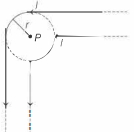
- 6Two infinitely long wires each carrying current $I$ along the same direction are made into the geometry as shown in the figure below. The magnetic field at the point $P$ isView Solution
- 7A charge having $q/m$ equal to $10^8\, C/kg$ and with velocity $3 \times 10^5\, m/s$ enters into a uniform magnetic field $0.3\, tesla$ at an angle $30^o$ with direction of field. The radius of curvature will be ......$cm$View Solution
- 8The coil of a galvanometer consists of $100$ $turns$ and effective area of $1\, square-cm$. The restoring couple is ${10^{ - 8}}\,N - m/radian$. The magnetic field between the pole pieces is $5\, T$. The current sensitivity of this galvanometer will beView Solution
- 9A particle of mass $m$ and charge $q$ moves with a constant velocity $v$ along the positive $x$ direction. It enters a region containing a uniform magnetic field $B$ directed along the negative $z$ direction, extending from $x = a$ to $x = b$. The minimum value of $v$ required so that the particle can just enter the region $x > b$ isView Solution
- 10The radius of a circular loop is $r$ and a current $i$ is flowing in it. The equivalent magnetic moment will beView Solution