Question
A circular loop is kept in that vertical plane which contains the north-south direction. It carries a current that is towards north at the topmost point. Let A be a point on the axis of the circle to the east of it and B a point on this axis to the west of it. The magnetic field due to the loop
  1. Is towards east at A and towards west at B.
  2. Is towards west at A and towards east at B.
  3. Is towards east at both A and B.
  4. Is towards west at both A and B.

Answer

  1. Is towards west at both A and B.
Explanation:
According to the right-hand thumb rule, if we curl the fingers of our right hand in the direction of the current flowing, then the stretching of the thumb will show the direction of the magnetic field developed due to it and vice versa.
Let north-south is along x axis and east-west is along y axis. Circular wire is in xz plane. Then point A will lie on positive y axis and B on negative y axis. On looking from point B, current is flowing in anticlockwise direction so the magnetic field will point from right to left. Hence, the magnetic field due to the loop will be towards west at both A and B.

Need a full question paper?

Generate a complete, print-ready paper with questions like this in minutes — across 16+ boards, with answer keys.

Start Generating Free

Similar questions

A diminished image of an object is to be obtained on a screen 1.0 m from it. This can be achieved by appropriately placing(a) A convex mirror of suitable focal length(b) A concave mirror of suitable focal length(c) A concave lens of suitable focal length(d) A convex lens of suitable focal length less than 0.25 m


If the magnetic dipole moment of an atom of diamagnetic material, paramagnetic material and ferromagnetic material denoted by $\mu_d, \mu_p, \mu_f$ respectively then
Stopping potential for photoelectrons(a) Does not depend on the frequency of the incident light(b) Does not depend upon the nature of the cathode material(c) Depends on both the frequency of the incident light and nature of the cathode material(d) Depends upon the intensity of the incident light


Among the following properties describing diamagnetism identify  the property that is wrongly stated(a) Diamagnetic material do not have permanent magnetic moment(b) Diamagnetism is explained in terms of electromagnetic induction(c) Diamagnetic materials have a small positive susceptibility(d) The magnetic moment of individual electrons neutralize each other


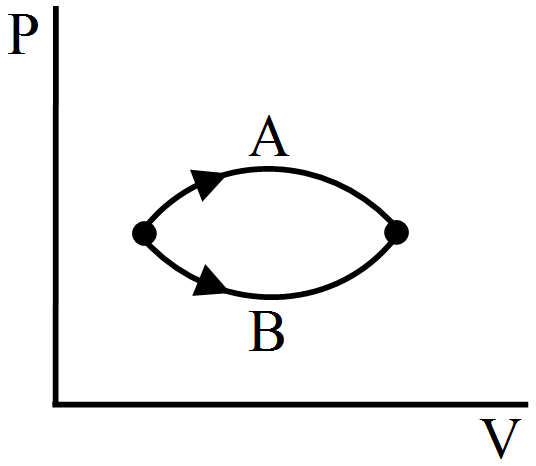
Figure. shows two processes A and B on a system. Let $\Delta\text{Q}_1$ and $\Delta\text{Q}_2$ be the heat given to the system in processes A and B respectively. Then,
  1. $\Delta\text{Q}_1>\Delta\text{Q}_2$
  2. $\Delta\text{Q}_1=\Delta\text{Q}_2$
  3. $\Delta\text{Q}_1<\Delta\text{Q}_2$
  4. $\Delta\text{Q}_1\le\Delta\text{Q}_2$
Absorption of X-ray is maximum in which of the following different sheets(a) Copper(b) Gold(c) Beryllium(d) Lead
       
Energy of the electron in $n^{th}$ orbit of hydrogen atom is given by $E_n=-\frac{13.6}{n^2}\ eV$. The amount of energy needed to transfer electron from first orbit to third orbit is
The force which a magnet exerts on iron and steel is called the:
Two charges of $10C$ and $-15C$ are separated in air by $1m.$The ratio of force exerted by one on the other is:
Photon and electron are given same energy $(\left.10^{-20} \mathrm{~J}\right).$ Wavelength associated with photon and electron are $\lambda_{\text {ph }}$ and $\lambda_{\mathrm{el}}$ then correct statement will be