Question
A circular loop of string rotates about its axis on a frictionless horizontal plane at a uniform rate so that the tangential speed of any particle of the string is v. If a small transverse disturbance is produced at. a point of the loop, with what speed (relative to the string) will this disturbance travel on the string?
Answer

m = mass per unit length of the string

R = Radius of the loop
$\omega=$ angular velocity, V = linear velocity of the string

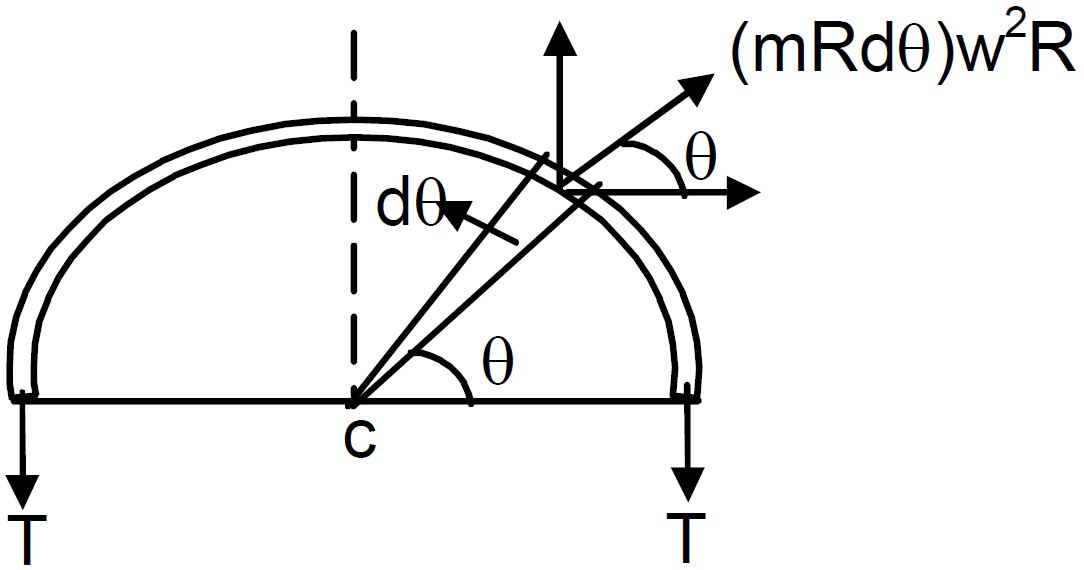
Consider one half of the string as shown in figure.

The half loop experiences cetrifugal force at every point, away from centre, which is balanced by tension 2T.

Consider an element of angular part $\text{d}\theta$ at angle $\theta.$ Consider another element symmetric to this centrifugal force experienced by the element $=(\text{mRd}\theta)\omega^2\text{R}.$

$\big($Length of element $=\text{Rd}\theta,\ \text{mass}=\text{mRd}\theta\big)$

Resolving into rectangular components net force on the two symmetric elements,

$\text{DF}=2\text{mR}^2\text{d}\theta\omega^2\sin\theta$ [horizontal components cancels each other]

So, total $\text{F}=\int\limits_0^{\frac{\pi}{2}}2\text{mR}^2\omega^2\sin\theta\text{d}\theta=2\text{mR}^2\omega^2[-\cos]\Rightarrow2\text{mR}^2\omega^2$

Again, $2\text{T}=2\text{mR}^2\omega^2\ \Rightarrow\text{T}=\text{mR}^2\omega^2$

Velocity of transverse vibration $\text{v}=\sqrt{\frac{\text{T}}{\text{m}}}=\omega\text{R}=\text{v}$

Need a full question paper?

Generate a complete, print-ready paper with questions like this in minutes — across 16+ boards, with answer keys.

Start Generating Free

Similar questions

State first law of thermodynamics. On the basis of this establish the relation between two molar specific heats for an ideal gas.
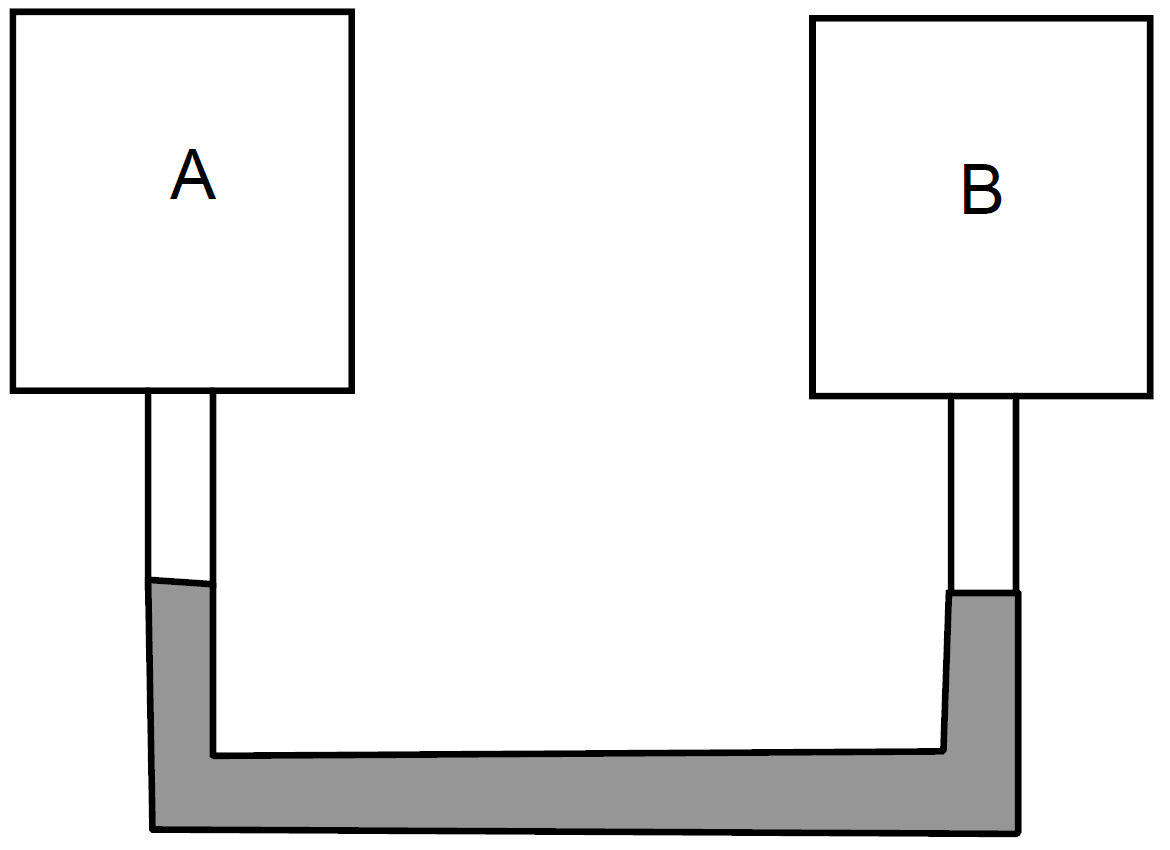
Figure shows two rigid vessels A and B, each of volume 200cm3, containing an ideal gas (Cv = 12.5JK-1mol-1). The vessels are connected to a manometer tube containing mercury. The pressure in both the vessels is 75cm of mercury and the temperature is 300K.
  1. Find the number of moles of the gas in each vessel.
  2. 5.0J of heat is supplied to the gas in vessel A and 10J to the gas in vessel B. Assuming there's no appreciable transfer of heat from A to B, calculate the difference in the heights of mercury in the two sides of the manometer. Gas constant, R = 8.3JK-1mol-1.

A ‘thermacole’ icebox is a cheap and an efficient method for storing small quantities of cooked food in summer in particular. A cubical icebox of side 30cm has a thickness of 5.0cm. If 4.0kg of ice is put in the box, estimate the amount of ice remaining after 6h. The outside temperature is 45°C, and co-efficient of thermal conductivity of thermacole is 0.01 J s–1 m–1 K–1. [Heat of fusion of water = 335 × 103J kg–1].
The motion of a particle executing simple harmonic motion is described by the displacement function, $x ( t )= A \cos (\omega t$ $+\phi)$ If the initial $(t=0)$ position of the particle is 1 cm and its initial velocity is $\omega cm / s$, then what are its amplitude and initial phase angle? The angular frequency of the particle is $\pi s ^{-1}$. If instead of the cosine function, we choose the sine function to describe the $SHM , x = B \sin (\omega t +\phi)$, then what are the amplitude and initial phase of the particle with the above initial conditions?
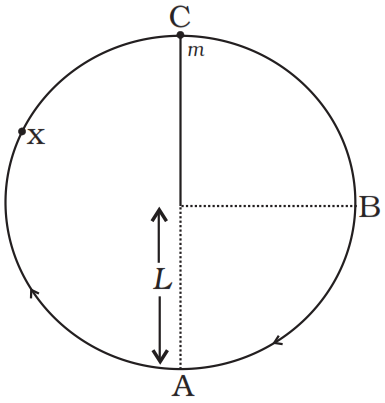
A bob of mass m suspended by a light string of length L is whirled into a vertical circle as shown in what will be the trajectory of the particle if the string is cut at:

  1. Point B?
  2. Point C?P
  3. oint X?
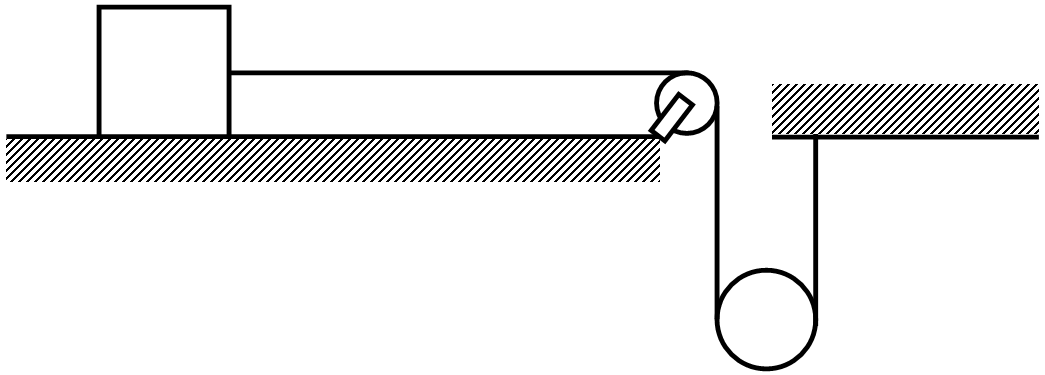
The descending pulley shown in figure has a radius 20cm and moment of inertia 0.20kg-m2. The fixed pulley is light and the horizontal plane frictionless. Find the acceleration of the block if its mass is 1.0kg.

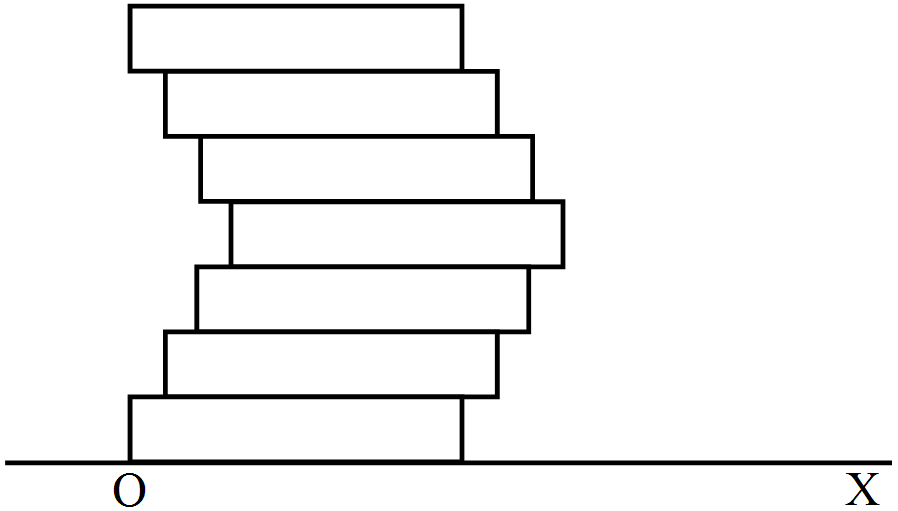
Seven homogeneous bricks, each of length L, are arranged as shown in figure. Each brick is displaced with respect to the one in contact by $\frac{\text{L}}{10}.$ Find the x-coordinate of the centre of mass relative to the origin shown.

A concave mirror forms an image of 20cm high object on a screen placed 5.0m away from the mirror. The height of the image is 50cm. Find the focal length of the mirror and the distance between the mirror and the object.
Find the centre of mass of a uniform:
  1. Half-disc.
  2. Quarter-disc.
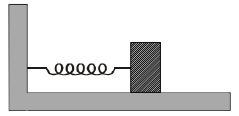
A spring having with a spring constant $1200 N m ^{-1}$ is mounted on a horizontal table as shown in Fig. A mass of 3 kg is attached to the free end of the spring. The mass is then pulled sideways to a distance of 2.0 cm and released.
Image
Determine (i) the frequency of oscillations, (ii) maximum acceleration of the mass. and (iii) the maximum speed of the mass.