MCQ
A circular loop ofradius $0.3\ cm$ lies parallel to amuch bigger circular loop ofradius $20\ cm$. The centre of the small loop is on the axis of the bigger loop. The distance between their centres is $15\ cm$. If a current of $2.0\ A$ flows through the smaller loop, then the flux linked with bigger loop is
  • A
    $6.6 \times 10^{-9}$ $ weber$
  • $9.1 \times 10^{-11} $ $weber$
  • C
    $6.0 \times 10^{-11} $ $weber$
  • D
    $3.3 \times 10^{-11} $ $weber$

Answer

Correct option: B.
$9.1 \times 10^{-11} $ $weber$
b
Aswe know, Magnetic flux, $\phi=B . A$

$\frac{\mu_{0}(2)\left(20 \times 10^{-2}\right)^{2}}{2\left[(0.2)^{2}+(0.15)^{2}\right]} \times \pi\left(0.3 \times 10^{-2}\right)^{2}$

On solving

$=9.216 \times 10^{-11}=9.2 \times 10^{-11}$ $ weber$

Need a full question paper?

Generate a complete, print-ready paper with questions like this in minutes — across 16+ boards, with answer keys.

Start Generating Free

Similar questions

A cylinder of radius $R$ and length $L$ is placed in a uniform electric field $E$ parallel to the cylinder axis. The total flux for the surface of the cylinder is given by
A single slit of width $b$ is illuminated by a coherent monochromatic light of wavelength $\lambda $. If the second and fourth minima in the diffraction pattern at a distance $1\,m$ from the slit are at $3\, cm$ and $6\, cm$ respectively from the central maximum, what is the width of the central maximum ?......$cm$ (i.e. distance between first minimum on either side of the central maximum)
Consider a long, straight wire of cross$-$sectional area A carrying a current i. Let there be n free electrons per unit volume. An observer places himself on a trolley moving in the direction opposite to the current with a speed $\text{v}=\frac{\text{i}}{\text{nAe}}$ and separated from the wire by a distance r. The magnetic field seen by the observer is very nearly:
Colours of thin soap bubbles are due to
A $p-n$ photodiode is made of a material with a band gap of $2.0\, eV$. The minimum frequency of the radiation that can be absorbed by the material is nearly
A battery of e.m.f. 10 V and internal resistance 0.5 ohm is connected across a variable resistance R. The value of R for which the power delivered in it is maximum is given by
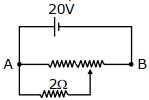
the given potentiometer has its wire of resistance $10\, \Omega$. When the sliding contact is in the middle of the potentiometer wire, the potential drop across $2\, \Omega$ resistor is -
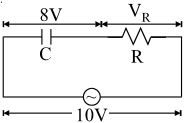
In a series $CR$ circuit shown in figure, the applied voltage is $10\, V$ and the voltage across capacitor is found to be $8V$. Then the voltage across $R$, and the phase difference between current and the applied voltage will respectively be
Lenz's law is consequence of the law of conservation of
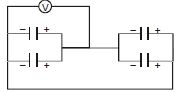
The four capacitors, each of $25\,\mu \,F$ are connected as shown in fig. The $dc$ voltmeter reads $200\,V$. The charge on each plate of capacitor is