Question
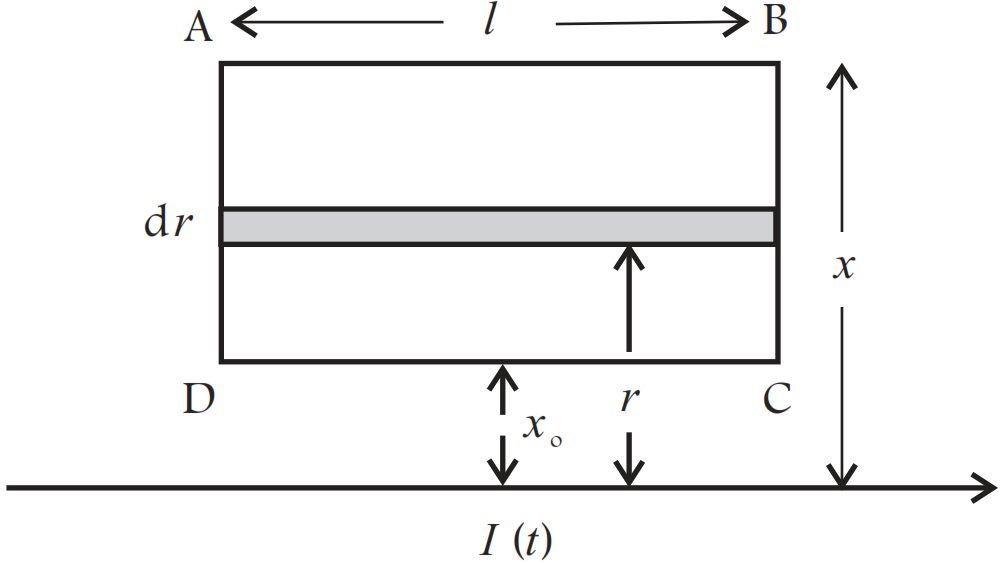
Consider an infinitely long wire carrying a current I (t), with $\frac{\text{dI}}{\text{dt}}=\lambda=\text{constant}$. Find the current produced in the rectangular loop of wire ABCD if its resistance is R (Fig).
Answer

To approach these types of problems integration is very useful to find the total magnetic flux linked with the loop.
Let us first consider an elementary strip of length l and width dr at a distance r from an infinite long current carrying wire. The magnetic field at strip due to current carrying wire is given by,
$\vec{\text{B}}\text{(r)}=\frac{\mu_0\text{I}}{2\pi\text{r}}$ (out of paper)
Area of the elementary strip is, dA = l.dr
So, total flux through the loop is
$\phi_\text{m}=\vec{\text{B}}.\vec{\text{A}}=\frac{\mu_0\text{I}}{2\pi}\text{I}\int_{\text{x}_0}^{\text{x}}\frac{\text{dr}}{\text{r}}=\frac{\mu_0\text{Il}}{2\pi}\text{ln}\frac{\text{x}}{\text{x}_0}\ .....(\text{i})$
The emf induced can be obtained by differentiating the eq. (i) w.r.t. t and then applying Ohm's law
$\text{I}=\frac{\in}{\text{R}}$
And $|\in|=\frac{\text{d}\phi}{\text{dt}}$
We have, indueced current
$\text{I}=\frac{1}{\text{R}}\frac{\text{d}\phi}{\text{dt}}=\frac{\mu_0\text{l}}{2\pi}\frac{\lambda}{\text{R}}\text{in}\frac{\text{x}}{\text{x}_0}\ \ \bigg(\because\frac{\text{dI}}{\text{dt}}=\lambda\bigg)$

Need a full question paper?

Generate a complete, print-ready paper with questions like this in minutes — across 16+ boards, with answer keys.
Start Generating Free

Similar questions

An electron makes $3 \times 10^5$ revolutions per second in a circle of radius 0.5 angstrom. Find the magnetic field B at the centre of the circle.
Explain "Electron Theory of Electric Charge".
The volume of a glass vessel is 1000 cc at $20^{\circ} \mathrm{C}$. What volume of mercury should be poured into it at this temperature so that the volume of the remaining space does not change with temperature? Coefficients of cubical expansion of mercury and glass are $1.8 \times 10^{-4}{ }^{\circ} \mathrm{C}$ and $9.0 \times 10^{-6}{ }^{\circ} \mathrm{C}^{-1}$ respectively.
Repeat part (a) of problem 6 if the push is applied horizontally and not parallel to the incline.
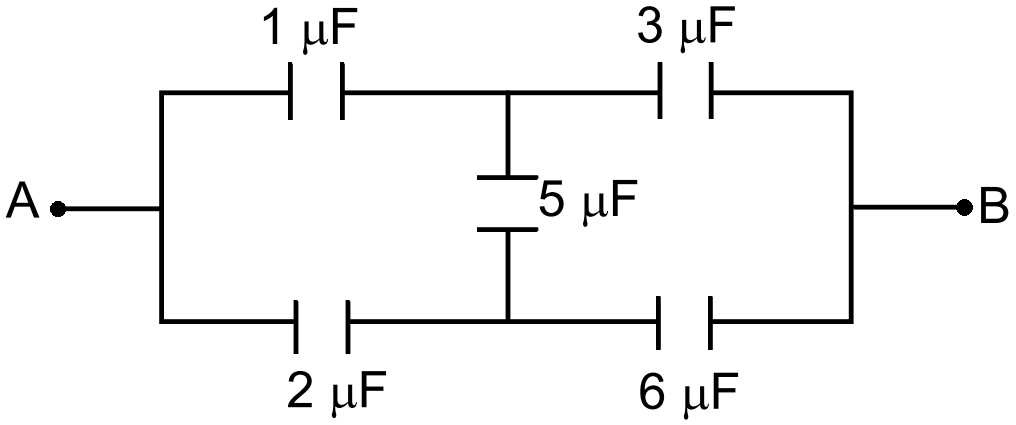
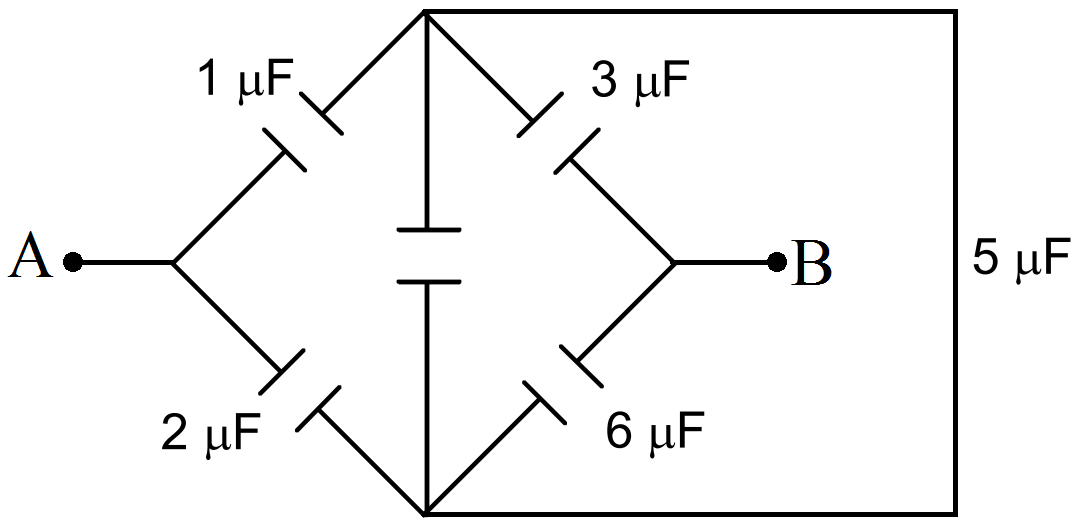
Convince yourself that parts (a), (b) and (c) of figure are identical. Find the capacitance between the points A and B of the assembly.


An atom is in its excited state. Does the probability of its coming to ground state depend on whether the radiation is already present or not? If yes, does it also depend on the wavelength of the radiation present?
Consider the potentiometer circuit as arranged in the figure. The potentiometer wire is 600cm long. (a) At what distance from the point A should the jockey touch the wire to get zero deflection in the galvanometer? (b) If the jockey touches the wire at a distance of 560cm from A, what will be the current in the galvanometer?
  1. Write the expression for the force, $\overrightarrow{\text{F}}$, acting on a charged particle of charge 'q', moving with a velocity$\overrightarrow{\text{v}}$ in the presence of both electric field $\overrightarrow{\text{E}}$and magnetic field $\overrightarrow{\text{B}}.$ Obtain the condition under which the particle moves undeflected through the fields.
  2. A rectangular loop of size l x b carrying a steady current I is placed in a uniform magnetic field $\overrightarrow{\text{B}}.$ Prove that the torque$\overrightarrow{\tau}$ acting on the loop is given by $\overrightarrow{\tau} =\overrightarrow{\text{m}}\times\overrightarrow{\text{B},}$were $\overrightarrow{\text{m}}$is the magnetic moment of the loop.
Consider a solid sphere of radius r and mass m that has a charge q distributed uniformly over its volume. The sphere is rotated about its diameter with an angular speed $\omega.$ Show that the magnetic moment $\mu$ and the angular momentum l of the sphere are related as $\mu=\frac{\text{q}}{2\text{m}}\text{l}.$
Figure. shows a part of a circuit. If a current of 12mA exists in the $5\text{k}\Omega$ resistor, find the currents in the other three resistors. What is the potential difference between the points A and B?