Question
$a$. Derive the expression for the current flowing in an ideal capacitor and its reactance when connected to an ac source of voltage $V = V _{ o } \sin \omega t$.
$b$. Draw its phasor diagram.
$c$. If resistance is added in series to capacitor what changes will occur in the current flowing in the circuit and phase angle between voltage and current.

Answer

$a$. We have $V = V _{ o } \sin \omega t$.
Also, $v =\frac{q}{c} ; q =$ charge on capacitor
$v _0 \sin \omega t=\frac{q}{c}$
or, $q = cv _0 \sin \omega t$
$\therefore I =\frac{d q}{d t}=\frac{d}{d t}\left( CV _0 \sin \omega t\right)= cv _0 \sin \omega t \cdot \omega$
$\therefore I =\frac{ v _0}{\frac{1}{\omega t}} \sin \left(\omega t+\frac{\pi}{2}\right)$
Max. current, $I _{ o }=\frac{ v _o}{1} \times 1$ when $\sin \left(\omega t+\frac{\pi}{2}\right)=1$
Comparing with ohm's law: $I =\frac{V}{R}$ to equation $I _{ o }=\frac{ v _o}{\frac{1}{ uc }}$
We have, capacitive reactance, $x _{ C }=\frac{1}{\omega c}$
$b$. Phasor diagram:
Image
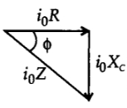
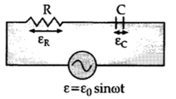
$c$. A resistor is now connected with the capacitor in series:
Image
Peak voltage drop across $R$ is $i_0 R$
Peak voltage drop across $C$ is $i_0 X_C$.
Voltage a cross $R$ is in phase with the current.
Voltage across $C$ lags the current by $90^{\circ}$.
So, the voltage drops across $R$ and across $C$ are not in phase.
They are out of phase by $90^{\circ}$.
So $, \varepsilon_0=\sqrt{\left(i_0 R\right)^2+\left(i_0 X_C\right)^2}$
$\therefore i _0=\frac{V_0}{\sqrt{R^2+X_C^2}}$
The phase angle is
Image

Phase Angle $=\phi=\tan ^{-1} \frac{X_C}{R}$

Need a full question paper?

Generate a complete, print-ready paper with questions like this in minutes — across 16+ boards, with answer keys.

Start Generating Free

Similar questions

Explain electric charge. Verify by experiment that there is repulsion between like charges and attraction between unlike charges.
The current in a conductor and the potential difference across its ends are measured by an ammeter and a voltmeter. The meters draw negligible currents. The ammeter is accurate but the voltmeter has a zero error (that is, it does not read zero when no potential difference is applied). Calculate the zero error if the readings for two different conditions are 1.75A, 14.4V and 2.75A, 22.4V.
If neutrons exert only attractive force, why don't we have a nucleus containing neutrons alone?
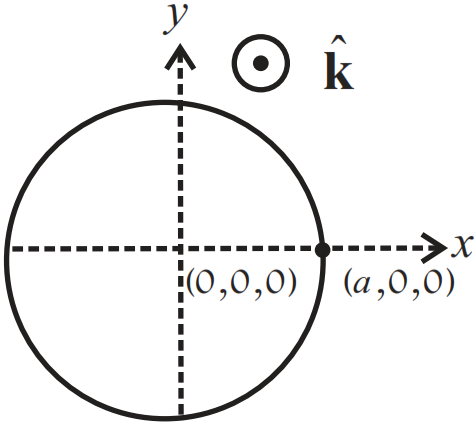
A magnetic field in a certain region is given by $\text{B}=\text{B}_0\cos(\omega\text{t})\hat{\text{k}}$ and a coil of radius a with resistance R is placed in the x-y plane with its centre at the origin in the magnetic field (see Fig). Find the magnitude and the direction of the current at (a, 0, 0) at $\text{t}=\frac{\pi}{2\omega},\text{t}=\frac{\pi}{\omega} \text{ and }\text{t}=\frac{3\pi}{2\omega}$.
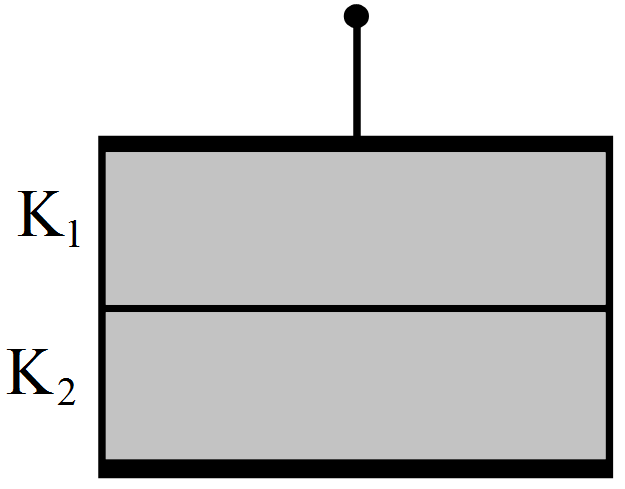
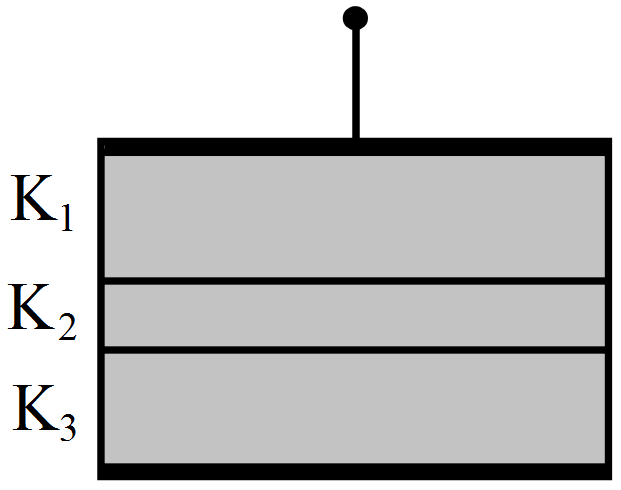
Find the capacitances of the capacitors shown in figure. The plate area is A and the separation between the plates is d. Different dielectric slabs in a particular part of the figure are of the same thickness and the entire gap between the plates is filled with the dielectric slabs.


A hydrogen atom initially in the ground level absorbs a photon, which excites it to the n = 4 level. Determine the wavelength and frequency of photon.
Suppose the $19\Omega$ resistor of the previous problem is disconnected. Find the current through $P_2Q_2$ in the two situations:
  1. Both the wires move towards right.
  2. If $P_1Q_1$ moves towards left but $P_2Q_2$ moves towards right.
Is the formula you employ in (a) valid for calculating radius of the path of a 20 MeV electron beam? If not, in what way is it modified?
What is Gauss theorem? With its help, obtain an expression for the electric field intensity at any point near a uniformly charged linear conductor of infinite length.###Make the necessary diagram and with the help of Gauss law, calculate the electric field intensity at any point due to a charged wire of infinite length. Plot the change in intensity with distance.###Define Gauss' law. With its help, find the value of electric field intensity at a distance from a uniformly charged linear conductor of infinite extension. Make the necessary diagram and also make a graph of the change of electric field with distance.
A resistance thermometer reads R =$20.0\Omega$, $27.5\Omega$, and $50.0\Omega$ at the ice point $(0^\circ C),$ the steam point $(100^\circ C)$ and the zinc point $(420^\circ C)$ respectively. Assuming that the resistance varies with temperature as$\text{R}_\theta=\text{R}_0(1+\alpha\theta+\beta\theta^2)$, find the values of $\text{R}_0,$ $\alpha \ \text{and}\ \beta.$ Here $\theta$ represents the temperature on Celsius scale.