Question
A hydrogen atom initially in the ground level absorbs a photon, which excites it to the n = 4 level. Determine the wavelength and frequency of photon.

Answer

For ground level, $n_1 = 1$
Let $E_1$ be the energy of this level. It ls known that $E_1$ Is related with $n_1$ as:
$\text{E}_1=\frac{-13.6}{\text{n}^2_1}\text{ eV}$
$=\frac{-13.6}{1^2}=-13.6\text{ eV}$
The atom is excited to a higher level, $n_2 = 4.$
Let $E_2​​​​​​​$​​​​​​​ be the energy of this level.
$\therefore\ \text{E}_2=\frac{-13.6}{\text{n}^2_2}\text{ eV}$
$=\frac{-13.6}{4^2}=-\frac{13.6}{16}\text{ eV}$
The amount of energy absorbed by the photon is given as:
$E = E_2 - E_1$​​​​​​​
$=\frac{-13.6}{16}-\Big(-\frac{13.6}{1}\Big)$
$=\frac{13.6\times15}{16}\text{ eV}$
$=\frac{13.6\times15}{16}\times1.6\times10^{-19}=2.04\times10^{-18}\text{ J}$
For a photon of wavelenqtha. the expression of energy Is written as:
$\text{E}=\frac{\text{hc}}{\lambda}$
Where,
$h =$ Planck's constant $= 6.6 x 10^{-34} Js$
$c =$ Speed of light $= 3 x 10^8m/s$
$\therefore\ \lambda=\frac{\text{hc}}{\text{E}}$
$=\frac{6.6\times10^{-34}\times3\times10^8}{2.04\times10^{-18}}$
$=9.7\times10^{-8}\text{ m}=97\text{ nm}$
And, frequency of a photon is given by the relation,
$\text{v}=\frac{\text{c}}{\lambda}$
$=\frac{3\times10^8}{9.710^{-8}}\approx3.1\times10^{15}\text{ Hz}$
Hence, the wavelength of the photon is 97 nm while the frequency is $3.1\times 10^{15}​​​​​​​$​​​​​​​ Hz.

Need a full question paper?

Generate a complete, print-ready paper with questions like this in minutes — across 16+ boards, with answer keys.
Start Generating Free

Similar questions

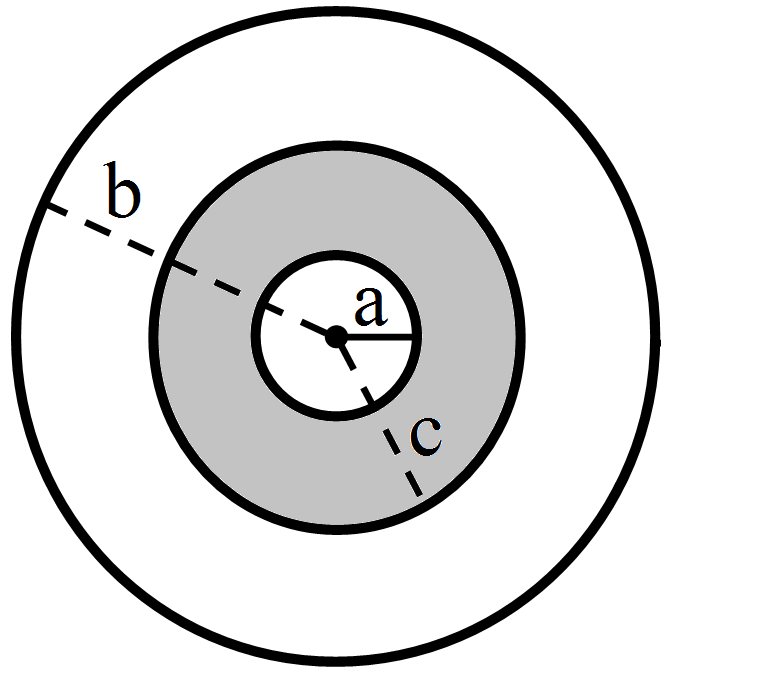
A sphercial capacitor is made of two conducting spherical shells of radii a and b. The space between the shells is filled with a dielectric of dielectric constant K up to a radius c as shown in figure. Calculate the capacitance.
A proton projected in a magnetic field of 0.020T travels along a helical path of radius 5.0cm and pitch 20cm. Find the components of the velocity of the proton along and perpendicular to the magnetic field. Take the mass of the proton $= 1.6 \times 10^{-27}kg$
An optical instrument used for angular magnification has a 25D objective and a 20D eyepiece. The tube length is 25cm when the eye is least strained.
  1. Whether it is a microscope or a telescope?
  2. What is the angular magnification produced?
Consider the situation of the previous problem. Consider the fastest electron emitted parallel to the large metal plate. Find the displacement of this electron parallel to its initial velocity before it strikes the large metal plate.
A capacitor of capacitance $8.0\mu\text{F}$ is connected to a battery of emf 6.0V through a resistance of $24\Omega.$ Find the current in the circuit (a) just after the connections are made and (b) one time constant after the connections are made.
A vessel of volume $V_0$ contains an ideal gas at pressure $P_0$ and temperature T. Gas is continuously pumped out of this vessel at a constant volume-rate dV I dt = r keeping the temperature constant. The pressure of the gas being taken out equals the pressure inside the vessel. Find, (1) the pressure of the gas as a function of time. (2) the time taken before half the original gas is pumped out.
  1. Draw a ray diagram to show refraction of a ray of monochromatic light passing through a glass prism.
Deduce the expression for the refractive index of glass in terms of angle of prism and angle of minimum deviation.
  1. Explain briefly how the phenomenon of total internal reflection is used in fibre optics.
The magnetic field in a region is given by $\vec{\text{B}}=\vec{\text{k}}\frac{\text{B}_0}{\text{L}}\text{y}$ where L is a fixed length. A conductihg rod of of length lies along the Y-axis between the origin and the point (0, L, 0). If the rod moves with a velocity $\text{v}=\text{v}_0\vec{\text{i}},$ find the emf induced between the ends of the rod.
A circular coil of 200 turns has a radius of 10cm and carries a current of 2.0A.
  1. Find the magnitude of the magnetic field. B at the centre of the coil.
  2. At what distance from the centre along the axis of the coil will the field B drop to half its value at the centre? $\big(\sqrt[3]{4}=1.5874\ ...\big)$
A compound microscope consists of an objective lens of focal length 2.0 cm and an eyepiece of focal length 6.25 cm separated by a distance of 15 cm. How far from the objective should an object be placed in order to obtain the final image at (a) the least distance of distinct vision (25 cm), and (b) at infinity? What is the magnifying power of the microscope in each case?