The length of a steel wire is $L$ and its magnetic moment is $M$. On bending it into the shape of a semicircle, its’ magnetic moment will be
Medium


Download our appand get started for free
Experience the future of education. Simply download our apps or reach out to us for more information. Let's shape the future of learning together!No signup needed.*
Similar Questions
- 1View SolutionThe resistance of an ideal voltmeter is
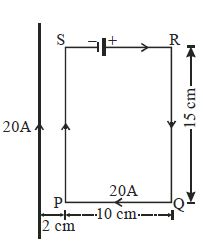
- 2The resultant force on the current loop $PQRS$ due to a long current carrying conductor will beView Solution
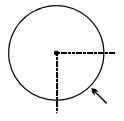
- 3A long thin walled pipe of radius $R$ carries a current $I$ along its length. The current density is uniform over the circumference of the pipe. The magnetic field at the center of the pipe due to quarter portion of the pipe shown, isView Solution
- 4A current $i$ is flowing in a conductor of length $l$. When it is bent in the form of a circular loop then its magnetic moment will be-View Solution
- 5The resistance of a galvanometer is $50\, ohm$ and the maximum current which can be passed through it is $0.002\, A$. What resistance must be connected to it in order to convert it into an ammeter of range $0 -0.5\, A$ ?....$ohm$View Solution
- 6A current $I$ flows in an infinitely long wire with cross-section in the form of a semicircular ring of radius $R$ . The magnitude of the magnetic induction along its axis isView Solution
- 7Two very long, straight and parallel wires carry steady currents $I$ and $I$ respectively. The distance between the wires is $d$. At a certain instant of time, a point charge $q$ is at a point equidistant from the two wires in the plane of the wires. Its instantaneous velocity $v$ is perpendicular to this plane. The magnitude of the force due to the magnetic field acting on the charge at this instant isView Solution
- 8A particle of charge $q$ and mass $m$ moves in a circular orbit of radius $r$ with angular speed $\omega $. The ratio of the magnitude of its magnetic moment to that of its angular momentum depends onView Solution
- 9Two very long, straight, parallel wires carry steady currents $I$ and $-I$ respectively. The distance etween the wires is $d$. At a certain instant of time, a point charge $q$ is at a point equidistant from the two wires, in the plane of the wires. Its instantaneous velocity $v$ is perpendicular to the plane of wires. The magnitude of the force due to the magnetic field acting on the charge at this instant isView Solution
- 10An iron rod of length $L$ and magnetic moment $M$ is bent in the form of a semicircle. Now its magnetic moment will beView Solution