Question
A particle on a stretched string supporting a travelling wave, takes 5.0ms to move from its mean position to the extreme position. The distance between two consecutive particles, which are at their mean positions, is 2.0cm. Find the frequency, the wavelength and the wave speed.
Answer

Time period, $\text{T}=4\times5\text{ms}$$=20\times10^{-3}$
$=2\times10^{-2}\text{s}$
$\Rightarrow\lambda=2\times2\text{cm}$
$=4\text{cm}$
Frequency, $\text{f}=\frac{1}{\text{T}}$$=\frac{1}{(2\times10^{-2})}=50\text{s}^{-1}$
$=50\text{Hz}$
Wave speed = $\lambda\text{f}=4\times50\text{m/s}$$=2000\text{m/s}$
$=2\text{m/s}$

Need a full question paper?

Generate a complete, print-ready paper with questions like this in minutes — across 16+ boards, with answer keys.

Start Generating Free

Similar questions

There are two current carrying planar coils made each from identical wires of length L. $C_1$ is circular (radius R ) and $C_2$ is square (side a). They are so constructed that they have same frequency of oscillation when they are placed in the same uniform B and carry the same current. Find a in terms of R.
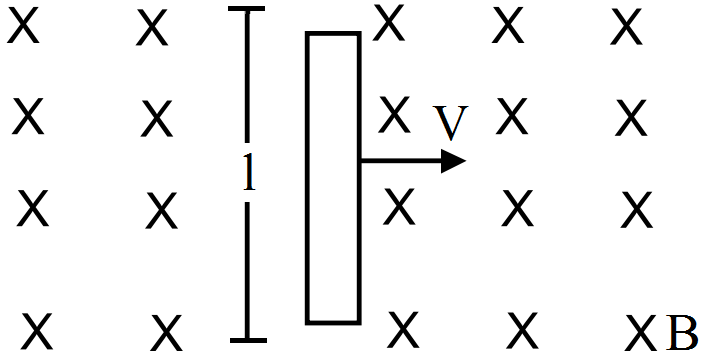
A conducting wire of length l, lying normal to a magnetic field B, moves with a velocity v, as shown in the figure.
  1. Find the average magnetic force on a free electron of the wire.
  2. Due to this magnetic force, electrons concentrate at one end, resulting in an electric field inside the wire. The redistribution stops when the electric force on the free electrons balances the magnetic force. Find the electric field developed inside the wire when the redistribution stops.
  3. What potential difference is developed between the ends of the wire?
A heater coil is to be constructed with a nichrome wire $(\rho=1.0\times10^{-6}\Omega-\text{m})$which can operate at 500W when connected to a 250V supply.
  1. What would be the resistance of the coil?
  2. If the cross-sectional area of the wire $0.5mm^2, $ what length of the wire will be needed?
  3. If the radius of each turn is 4.0mm, how many turns will be there in the coil?
  1. Explain briefly the principle on which a transistor-amplifier works as an oscillator. Draw the necessary circuit diagram and explain its working.
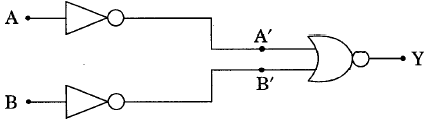
  2. Identify the equivalent gate for the following circuit and write its truth table.
What is a moving coil galvanometer? Write its working by drawing its diagram and its principle. Prove that current in it is proportional to the produced deflection.###What is a galvanometer? Explain construction, working and principle of a moving coil galvanometer.
A hydrogen atom initially in the ground level absorbs a photon, which excites it to the n = 4 level. Determine the wavelength and frequency of photon.
What is a transformer? It is of how many types? Explain the principle, construction and working of any transformer.
A travelling wave is produced on a long horizontal string by vibrating an end up and down sinusoidally. The amplitude of vibration is 1.0cm and the displacement becomes zero 200 times per second. The linear mass density of the string is 0.10kg/m and it is kept under a tension of 90N.
  1. Find the speed and the wavelength of the wave.
  2. Assume that the wave moves in the positive x-direction and at t = 0, the end x = 0 is at its positive extreme position. Write the wave equation.
  3. Find the velocity and acceleration of the particle at x - 50cm at time t = 10ms.
Two bodies of masses $\mathrm{m}_1$ and $\mathrm{m}_2$ and specific heat capacities $\mathrm{s}_1$ and $\mathrm{s}_2$ are connected by a rod of length I , cross-sectional area A, thermal conductivity K and negligible heat capacity. The whole system is thermally insulated. At time $\mathrm{t}=0$, the temperature of the first body is $T_1$ and the temperature of the second body is $T_2\left(T_2 > T_1\right)$. Find the temperature difference between the two bodies at time t .
A convex lens of focal length 20cm and a concave lens of focal length 10cm are placed 10cm apart with their principal axes coinciding. A beam of light travelling parallel to the principal axis and having a beam diameter 5.0mm, is incident on the combination. Show that the emergent beam is parallel to the incident one. Find the beam diameter of the emergent beam.