MCQ
A diatomic gas, having $C_{p}=\frac{7}{2} R$ and $C _{ v }=\frac{5}{2} R ,$ is heated at constant pressure. The ratio $dU : dQ : dW :$
  • A
    $5: 7: 3$
  • $5: 7: 2$
  • C
    $3: 7: 2$
  • D
    $3: 5: 2$

Answer

Correct option: B.
$5: 7: 2$
b
$d U = n C _{ v } dT$

$dQ = nC _{ p } dT$

$dW = PdV = nRdT$ (isobaric process)

$d U : dQ : dW : C _{ v }: C _{ p }: R$

$=\frac{5 R }{2}: \frac{7 R }{2} \cdot R =5: 7: 2$

Need a full question paper?

Generate a complete, print-ready paper with questions like this in minutes — across 16+ boards, with answer keys.
Start Generating Free

Similar questions

A boy pushes a box of mass $2\, kg$ with a force $\overrightarrow{ F }=(20 \hat{ i }+10 \hat{ j }) N$ on a frictionless surface. If the box was initially at rest, then ...........  $m$ is displacement along the $x-$axis after $10\, s$.
The molecular weight of a gas is $44$. The volume occupied by $2.2\, g$ of this gas at $0^\circ C$ and $2\, atm.$ pressure will be ....... $lit$
A man weighs $80\,kg.$ He stands on a weighing scale in a lift which is moving upwards with a uniform acceleration of $5m/{s^2}.$ What would be the reading on the scale. $(g = 10m/{s^2})$  ............ $N$
A thin rod of length $L$ is bent to form a semicircle. The mass of rod is $M$. What will be  the gravitational potential at the centre of the circle?
The value of Stefan’s constant is
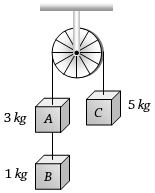
Three weight $A, B$ and $C$ are connected by string as shown in the figure. The system moves over a frictionless pulley. The tension in the string connecting $A$ and $B$ is (where $g$ is acceleration due to gravity)
In an experiment of determine the Young's modulus of wire of a length exactly $1\; m$, the extension in the length of the wire is measured as $0.4\,mm$ with an uncertainty of $\pm 0.02\,mm$ when a load of $1\,kg$ is applied. The diameter of the wire is measured as $0.4\,mm$ with an uncertainty of $\pm 0.01\,mm$. The error in the measurement of Young's modulus $(\Delta Y)$ is found to be $x \times 10^{10}\,Nm ^{-2}$. The value of $x$ is

$\left[\right.$ Take $\left.g =10\,m / s ^{2}\right]$

The value of $C_V$ for solids is:
The magnitude of pairs of displacement vectors are given. Which pair of displacement  vectors cannot be added to give a resultant vector of magnitude $13\, cm$?
The quantity of heat which crosses unit area of a metal plate during conduction depends upon