MCQ
The molecular weight of a gas is $44$. The volume occupied by $2.2\, g$ of this gas at $0^\circ C$ and $2\, atm.$ pressure will be ....... $lit$
  • $0.56$
  • B
    $1.2$
  • C
    $2.4$
  • D
    $5.6$

Answer

Correct option: A.
$0.56$
a
$PV = mrT$$ = m\left( {\frac{R}{M}} \right)T$

$\Rightarrow$  $V = \left( {\frac{m}{M}} \right)\frac{{RT}}{P}$=$\left( {\frac{{2.2}}{{44}}} \right) \times \frac{{8.31 \times (273 + 0)}}{{2 \times (1 \times {{10}^5})}}$

= $5.67 \times {10^{ - 4}}{m^3}$ $= 0.56 \; liter$

Need a full question paper?

Generate a complete, print-ready paper with questions like this in minutes — across 16+ boards, with answer keys.
Start Generating Free

Similar questions

A cylindrical piston of mass $M$ slides smoothly inside a long cylinder closed at one end, enclosing a certain mass of gas. The cylinder is kept with its axis horizontal. If the piston is disturbed from its equilibrium position, it oscillates simple harmonically. The period of oscillation will be
Two samples $A$ and $B$ are initially kept in the same state. Sample $A$ is expanded through an adiabatic process and the sample $B$ through an isothermal process. The final volumes of the samples are the same. The final pressures in $A$ and $B$ are $p_A$ and $p_B$ respectively.
The velocity and acceleration vectors of a particle undergoing circular motion are $\overrightarrow{ v }=2 \hat{ i } m / s$ and $\overrightarrow{ a }=2 \hat{ i }+4 \hat{ j } m / s ^2$ respectively at an instant of time. The radius of the circle is $........\,m$
A particle of mass $0.01 \;kg$ travels with velocity given by $4 \hat{ i }+16 \hat{ k } \;ms ^{-1}$. After sometime, its velocity becomes $8 \hat{ i }+20 \hat{ j }\;ms ^{-1}$. The work done on particle during this interval of time is ...... $J$
With what velocity a ball be projected vertically so that the distance covered by it in $5^{th}$ second is twice the distance it covers in its $6^{th}$ second.........$m/s$ $(g = 10\,m/{s^2})$
A body moves on a frictionless plane starting from rest. If $\mathrm{S}_{\mathrm{n}}$ is distance moved between $\mathrm{t}=\mathrm{n}-1$ and $\mathrm{t}$ $=\mathrm{n}$ and $\mathrm{S}_{\mathrm{n}-1}$ is distance moved between $\mathrm{t}=\mathrm{n}-2$ and $t=n-1$, then the ratio $\frac{S_{n-1}}{S_n}$ is $\left(1-\frac{2}{x}\right)$ for $n$ $=10$. The value of $x$ is
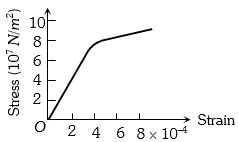
Which one of the following is the Young’s modulus $($in $N/m^2)$ for the wire having the stress-strain curve shown in the figure
The Bulk Modulus for an incompressible liquid is
A thin circular ring of mass M and radius r is rotating about its axis with an angular speed $\omega.$ Two particles having mass m each are now attached at diametrically opposite points. The angular speed of the ring will become:
Moment of inertia $(M.I.)$ of four bodies, having same mass and radius, are reported as;

$I _{1}= M$. of thin circular ring about its diameter.

$I _{2}=$ $M.I.$ of circular disc about an axis perpendicular to the disc and going through the centre,

$I _{3}=$ $M.I.$ of solid cylinder about its axis and

$I _{4}= M . I.$ of solid sphere about its diameter. Then