Question
A dimensionless quantity:
  1. Never has a unit.
  2. Always has a unit
  3. May have a unit.
  4. Does not exist.

Answer

  1. May have a unit.

Explanation:

Dimensionless quantities may have units.

Need a full question paper?

Generate a complete, print-ready paper with questions like this in minutes — across 16+ boards, with answer keys.

Start Generating Free

Similar questions

In two different experiments, an object of mass $5\; kg$ moving with a speed of $25\; ms ^{-1}$ hits two different walls and comes to rest within

$(i)$ $3$ second, $(ii)$ $5$ seconds, respectively.

Choose the correct option out of the following :
An open pipe of length $33\,cm$ resonates to a frequency of $1000\,Hz$ . The mode of vibration is: (velocity of sound $= 330\,m/s$ )
The displacement of a particle starting from rest (at $t = 0$) is given by $s = 6{t^2} - {t^3}$. The time in seconds at which the particle will attain zero velocity again, is ..... $\sec$
The dimensional formula for the modulus of rigidity is
A particle moves in a circular path with decreasing speed. Choose the correct statement.
A uniform sphere is placed on a smooth horizontal surface and a horizontal force F is applied on it at a distance h above the surface. The acceleration of the centre:
  1. Is maximum when h = 0.
  2. Is maximum when h = R.
  3. Is maximum when h = 2R.
  4. Is independent of h.
A tank is filled with water of density $1\,g$ per $cm^3$ and oil of density $0.9\,g$ per $cm^3$ . The height of water layer is $100\,cm$ and of the oil layer is $400\,cm.$ If $g = 980\,cm/sec^2,$ then the velocity of efflux from an opening in the bottom of the tank is
Acceleration due to gravity at surface of a planet is equal to that at surface of earth and density is $1.5$ times that of earth. If radius of earth is $R$, radius of planet is .................
A planet of mass $m$ moves around the sun of mass $M$ in an elliptical orbit. The maximum and minimum distances of the planet from the sun are $r_1$ and $r_2$ respectively. The time period of the planet is proportional to ..........
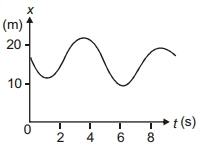
Figure shows the position of a particle moving on the $x$-axis as a function of time