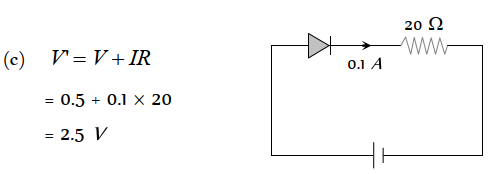
A diode having potential difference $0.5 V$ across its junction which does not depend on current, is connected in series with resistance of $20 \Omega$ across source. If $0.1 A$ passes through resistance then what is the voltage of the source
[DCE 2005]


Download our appand get started for free
Experience the future of education. Simply download our apps or reach out to us for more information. Let's shape the future of learning together!No signup needed.*
Similar Questions
- 1In the middle of the depletion layer of a reverse-biased $P N$ junction, theView Solution
- 2The relation between the number of free electrons in semiconductors $(n)$ and its temperature $(T)$ isView Solution
- 3View SolutionIn semiconductors at a room temperature
- 4In an experiment, the saturation in the plate current in a diode is observed at $240 V$. But a student still wants to increase the plate current. It can be done, ifView Solution
- 5In an NPN transistor circuit, the collector current is $10 mA$. If $90 \%$ of the electrons emitted reach the collector, the emitter current ( $i$ ) and base current $(i)$ are given byView Solution
- 6View SolutionThe voltage gain of a triode depends upon
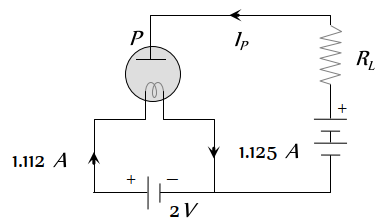
- 7View SolutionThe value of plate current in the given circuit diagram will be
- 8Resistance of semiconductor at $0^{\circ} K$ isView Solution
- 9View SolutionZener breakdown in a semi-conductor diode occurs when
- 10View SolutionA transistor is used in common emitter mode as an amplifier. Then