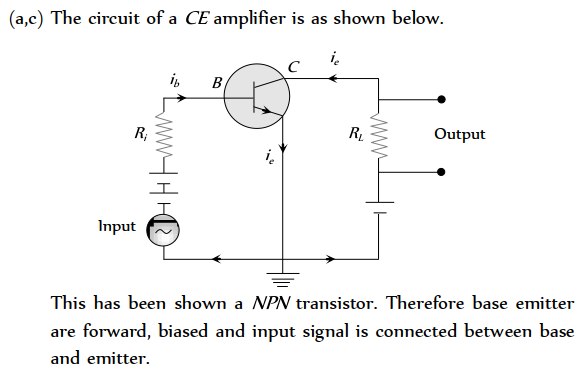
A transistor is used in common emitter mode as an amplifier. Then
Download our app for free and get started

Download our appand get started for free
Experience the future of education. Simply download our apps or reach out to us for more information. Let's shape the future of learning together!No signup needed.*
Similar Questions
- 1View SolutionSelect the correct statement
- 2View SolutionThe triode constant is out of the following
- 3In a $P N$-junction diode not connected to any circuitView Solution
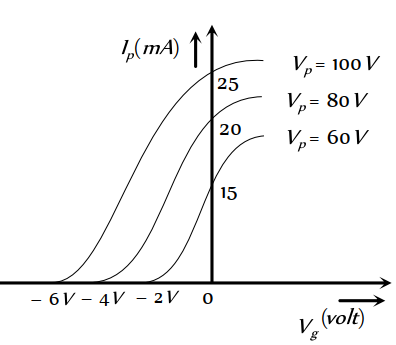
- 4View SolutionThe variation of anode current in a triode corresponding to a change in grid potential at three different values of the plate potential is shown in the diagram. The mutual conductance of the triode is
- 5The plate resistance of a triode is $2.5 \times 10^4 \Omega$ and mutual conductance is $2 \times 10^{-3} mho$. What will be the value of amplification factorView Solution
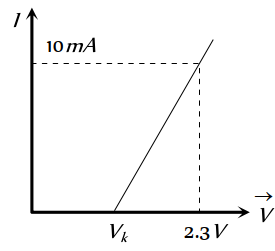
- 6The resistance of a germanium junction diode whose $V-I$ is shown in figure is $\left(V_k=0.3 V \right)$View Solution
- 7Consider the following statements $A$ and $B$ and identify the correct choice of the given answers$A$ : The width of the depletion layer in a $P-N$ junction diode increases in forwards bias$B$ : In an intrinsic semiconductor the fermi energy level is exactly in the middle of the forbidden gapView Solution
- 8$P$-type semiconductors are made by adding impurity elementView Solution
- 9View SolutionThe energy band gap is maximum in
- 10Consider an NPN transistor amplifier in common-emitter configuration. The current gain of the transistor is $100.$ If the collector current changes by $1\ mA$, what will be the change in emitter currentView Solution