MCQ
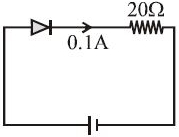
A diode having potential difference $0.5\,V$ across its junction which does not depend on  current, is connected in series with resistance of $20\,\Omega $ across source. If $0.1\, A$ passes through resistance then what is the voltage of the source.....$V$
  • A
    $1.5$
  • B
    $2$
  • $2.5$
  • D
    $5$

Answer

Correct option: C.
$2.5$
c
$\mathrm{V}^{\prime}=\mathrm{V}+\mathrm{IR}$

$=0.5+0.1 \times 20$

$=2.5 \mathrm{\,V}$

Need a full question paper?

Generate a complete, print-ready paper with questions like this in minutes — across 16+ boards, with answer keys.

Start Generating Free

Similar questions

A particle experiences a constant acceleration for $20 \,sec$ after starting from rest. If it travels a distance ${S_1}$ in the first $10\, sec$ and a distance ${S_2}$ in the next $10 \,sec$, then
$A$ particle of mass $m$ is rotating in a plane is $a$ circular path of radius $r$, its angular momentum is $L$. The centripital force acting on the particle is :
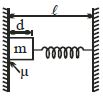
A block of mass $m$ is pressed against a vertical surface by a spring of unstretched length $l$ . If the coefficient of friction between the block and the surface is $\mu $. Choose the correct statement.
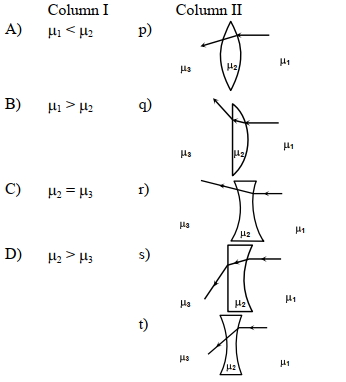
Two transparent media of refractive indices $\mu_1$ and $\mu_3$ have a solid lens shaped transparent material of refractive index $\mu_2$ between them as shown in figures in Column $II$. A ray traversing these media is also shown in the figures. In Column $I$ different relationships between $\mu_1, \mu_2$ and $\mu_3$ are given. Match them to the ray diagram shown in Column $II$.

$Image$

For constructive interference to take place between two monochromatic light waves of wavelength $\lambda$, the path difference should be
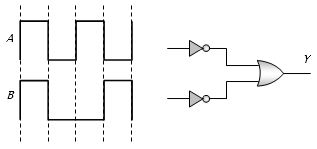
In a given circuit as shown the two input waveform $A$ and $B$ are applied simultaneously. The resultant waveform $Y$ is
A current carrying loop is placed in a uniform magnetic field. The torque acting on it does not depend upon
A particle oscillates along the $x$-axis according to the law, $x(t)=x_0 \sin ^2\left(\frac{t}{2}\right)$ where $x_0=1 m$. The kinetic energy ( K ) of the particle as a function of $x$ is correctly represented by the graph.
A physical quantity $A$ is dependent on other four physical quantities $p, q, r$ and $s$ as given below $A=\frac{\sqrt{pq}}{r^2s^3} .$ The percentage error of measurement in $p, q, r$ and $s$  $1\%,$ $3\%,\,\, 0.5\%$ and $0.33\%$ respectively, then the maximum percentage error in $A$ is .......... $\%$
The isotope ${ }_5^{12} \mathrm{~B}$ having a mass $12.014 \mathrm{u}$ undergoes $\beta$-decay to ${ }_6^{12} \mathrm{C} .{ }_6^{12 .}$ has an excited state of the nucleus $\left({ }_6^{12} \mathrm{C}^*\right)$ at $4.041 \mathrm{MeV}$ above its ground state. If ${ }_5^{12} \mathrm{~F}$ decays to ${ }_6^{12} \mathrm{C}^*$, the maximum kinetic energy of the $\beta$-particle in units of $\mathrm{MeV}$ is ( $1 \mathrm{u}=931.5 \mathrm{MeV} / c^2$, where $c$ is the speed of light in vacuum).