MCQ
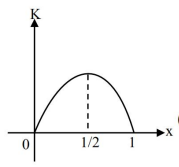
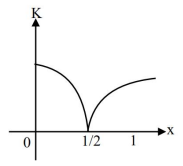
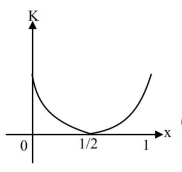
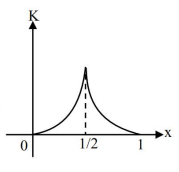
A particle oscillates along the $x$-axis according to the law, $x(t)=x_0 \sin ^2\left(\frac{t}{2}\right)$ where $x_0=1 m$. The kinetic energy ( K ) of the particle as a function of $x$ is correctly represented by the graph.

  • Image
  • B

    Image
  • C

    Image
  • D

    Image

Answer

Correct option: A.

Image
(A) Image
Sol. $\quad x = x _0 \sin ^2 \frac{ t }{2}= x _0\left(\frac{1-\cos t }{2}\right)$
$
x-\frac{x_0}{2}=\frac{-\cos t}{2}
$
where $x_0=1$
$
x-\frac{1}{2}=\frac{-\cos t}{2}
$
Particle is oscillating between $x =0$ to $x =1$

Need a full question paper?

Generate a complete, print-ready paper with questions like this in minutes — across 16+ boards, with answer keys.
Start Generating Free

Similar questions

Highly energetic electrons are bombarded on a target of an element containing $30$ neutrons. The ratio of radii of nucleus to that of Helium nucleus is ${14^{1/3}}$. The atomic number of nucleus will be
On colliding in a closed container the gas molecules
A quantity measured repeatedly many times with an instrument. The readings are shown in figure where $T$ represent true value of the measurement. Which of the following measurement is imprecise but accurate ?
The rotation period of an earth satellite close to the surface of the earth is $83$ minutes. The time period of another earth satellite in an orbit at a distance of three earth radii from its surface will be .......... $\min$
Consider a spherical shell of radius $R$ at temperature $T$. The black body radiation inside it can be considered as an ideal gas of photons with internal energy per unit volume$E=$ $\frac{U}{V} \propto {T^4}$ and pressure $P = \frac{1}{3}\left( {\frac{U}{V}} \right)$ If the shell now undergoes an adiabatic expansion the relation between $T$ and $R$ is
An element $\Delta l=\Delta \mathrm{xi}$ is placed at the origin and carries a large current $\mathrm{I}=10 \mathrm{~A}$. The magnetic field on the $y$-axis at a distance of $0.5 \mathrm{~m}$ from the elements $\Delta \mathrm{x}$ of $1 \mathrm{~cm}$ length is:
The stopping potential in the context of photoelectric effect depends on the following property of incident electromagnetic radiation
A galvanometer having a coil resistance of $30\,\Omega $ shows full scale deflection when a current of $2\,A$ passes through it. It can be converted into an ammeter to read currents upto $10\,A$ by
The gas which obeys Boyle's law for maximum range of temperature is
That gas cannot be liquified