MCQ
A disc is rotating with an angular velocity $\omega _0. $  A constant retrarding torque is applied on it to stop the disc. The angular velocity becomes $(\omega _0/2)$  after $n$ rotations. How many more rotations will it make before coming to rest ?
  • A
    $n$
  • B
    $2n$
  • C
    $\frac {n}{2}$
  • $\frac {n}{3}$

Answer

Correct option: D.
$\frac {n}{3}$
d
$w^{2}=w_{0}^{2}-2 \alpha \theta$

$\left(w_{0} / 2\right)^{2}=w_{0}^{2}-2\alpha Q$

$\left(w_{0} / 2\right)^{2}=w_{0}^{2}-2 \alpha Q_{1}$                  

$0=\left(w_{0} / 2\right)^{2}-2 \alpha Q_{2}$

$Q_{2}=\frac{Q_{1}}{3}$

$\Rightarrow \frac {n}{3}$

Need a full question paper?

Generate a complete, print-ready paper with questions like this in minutes — across 16+ boards, with answer keys.

Start Generating Free

Similar questions

An aeroplane of mass $3 \times 10^4\,kg$ and total wing area of $120\,m^2$ is in a level flight at some height. The difference in pressure between the upper and lower surfaces of its wings in kilopascals is........... $kPa$ $(g=10\,m/s^2)$
A drop of liquid of diameter $2.8\, mm$ breaks up into $125$ identical drops. The change in energy is nearly ........ $erg$ (S.T. of liquid = $75\, dynes/cm$)
The unit of potential energy is
A flywheel of moment of inertia $0.32\ kg-m^2$ is rotated steadily at $120\,rad/\sec $ by a $50\,W$ electric motor. The kinetic energy of the flywheel is.......... $J$
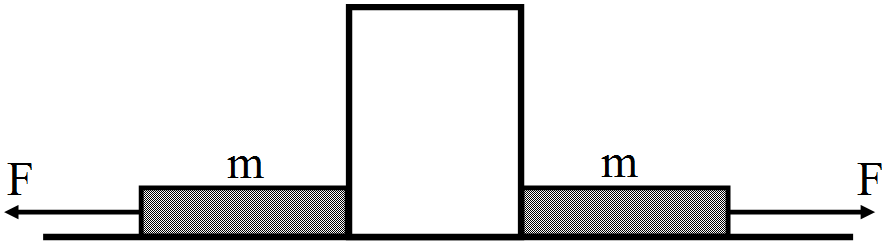
Figure shows a heavy block kept on a frictionless surface and being pulled by two ropes of equal mass $m.$ At $t = 0$, the force on the left rope is withdrawn but the
force on the right end continues to act. Let $F_1$ and $F_2$ be the magnitudes of the forces by the right rope and the left rope on the block respectively:
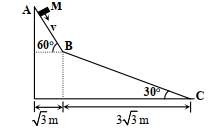
A small block of mass $M$ moves on a frictionless surface of an inclined plane, as shown in figure. The angle of the incline suddenly changes from $60^{\circ}$ to $30^{\circ}$ at point $\mathrm{B}$. The block is initially at rest at $A$. Assume that collisions between the block and the incline are totally inelastic $\left(\mathrm{g}=10 \mathrm{~m} / \mathrm{s}^2\right)$.

Figure: $Image$

$1.$ The speed of the block at point $B$ immediately after it strikes the second incline is

$(A)$ $\sqrt{60} \mathrm{~m} / \mathrm{s}$ $(B)$ $\sqrt{45} \mathrm{~m} / \mathrm{s}$

$(C)$ $\sqrt{30} \mathrm{~m} / \mathrm{s}$ $(D)$ $\sqrt{15} \mathrm{~m} / \mathrm{s}$

$2.$ The speed of the block at point $\mathrm{C}$, immediately before it leaves the second incline is

$(A)$ $\sqrt{120} \mathrm{~m} / \mathrm{s}$ $(B)$ $\sqrt{105} \mathrm{~m} / \mathrm{s}$

$(C)$ $\sqrt{90} \mathrm{~m} / \mathrm{s}$ $(D)$ $\sqrt{75} \mathrm{~m} / \mathrm{s}$

$3.$ If collision between the block and the incline is completely elastic, then the vertical (upward) component of the velocity of the block at point $B$, immediately after it strikes the second incline is

$(A)$ $\sqrt{30} \mathrm{~m} / \mathrm{s}$ $(B)$ $\sqrt{15} \mathrm{~m} / \mathrm{s}$

$(C)$ 0 $(D)$ $-\sqrt{15} \mathrm{~m} / \mathrm{s}$

Give the answer question $1,2$ and $3.$
A car, moving with a speed of $50 \,km/hr$, can be stopped by brakes after at least $6\,m$. If the same car is moving at a speed of $100 \,km/hr$, the minimum stopping distance is..........$m$
A body is projected at $t = 0$ with a velocity $10\,ms^{-1}$ at an angle of $60^o$ with the horizontal. The radius of curvature of its trajectory at $t=1\,s$ is $R.$ Neglecting air resistance and taking acceleration due to gravity $g = 10\,ms^{-2},$ the radius of $R$ is   ........ $m$
The excess pressure inside a soap bubble is twice the excess pressure inside a second soap bubble. The volume of the first bubble is n times the volume of the second where n is:
A stationary horizontal disc is free to rotate about its axis. When a torque is applied on it, its kinetic energy as a function of $\theta ,$ where $\theta $ is the angle by which it has rotated, is given as $k\theta ^2.$ If its moment of inertia is $I$ then the angular acceleration of the disc is