Question
A disc of radius R is rotating with an angular speed $\omega_\text{o}$ about a horizontal axis. It is placed on a horizontal table. The coefficient of kinetic friction is $\mu_\text{k}{:}$
  1. What was the velocity of its centre of mass before being brought in contact with the table?
  2. What happens to the linear velocity of a point on its rim when placed in contact with the table?
  3. What happens to the linear speed of the centre of mass when disc is placed in contact with the table?
  4. Which force is responsible for the effects in (b) and (c).
  5. What condition should be satisfied for rolling to begin?
  6. Calculate the time taken for the rolling to begin.
Answer

  1. Before the disc is brought in contact with table, it is only rotating about its horizontal axis. So, its centre of mass is at rest i.e. vcm = 0.
  2. (M) When rim is placed in contact with the table then its linear velocity at any point on the rim of disc will reduce due to kinetic friction.
  3. If rotating disc is placed in contact with the table, its centre of mass acquires some velocity (which was zero before contact) due to kinetic friction. So linear velocity of CM will increase.
  4. Kinetic friction.
  5. Rolling will begin when vCM = R(x).
  6. Acceleration produced in centre of mass due to friction,

$\text{a}_{\text{cm}}=\frac{\text{F}}{\text{m}}=\frac{\text{u}_\text{k}\text{mg}}{\text{m}}=\mu_\text{k}\text{g}$

Angular acceleration produced by the torque dur to friction.

$\alpha=\frac{\tau}{\text{I}}=\frac{\mu_\text{k}\text{mgR}}{\text{I}}$

$\therefore\ \nu_\text{cm}=\upsilon_\text{cm}+\text{a}_\text{cm}\text{t}$

$\Rightarrow\ \nu_\text{cm}=\mu_\text{k}\text{gt}$

and $\omega=\omega_0+\alpha\text{t}$

$\Rightarrow\omega=\omega_0-\frac{\mu_\text{k}\text{mgR}}{\text{I}}\text{t}$

For rolling without slipping,

$\frac{\nu_\text{cm}}{\text{R}}=\omega_0-\frac{\mu_\text{k}\text{mgR}}{\text{I}}\text{t}$

$\Rightarrow\ \frac{\mu_\text{k}\text{gt}}{\text{R}}=\omega_{\circ}-\frac{\mu_\text{k}\text{mgR}_\text{t}}{\text{I}}$

$\Rightarrow\text{t}=\frac{\text{R}\omega_0}{\mu_\text{k}\text{g}\big(1+\frac{\text{mR}^2}{\text{I}}\big)}$

Need a full question paper?

Generate a complete, print-ready paper with questions like this in minutes — across 16+ boards, with answer keys.

Start Generating Free

Similar questions

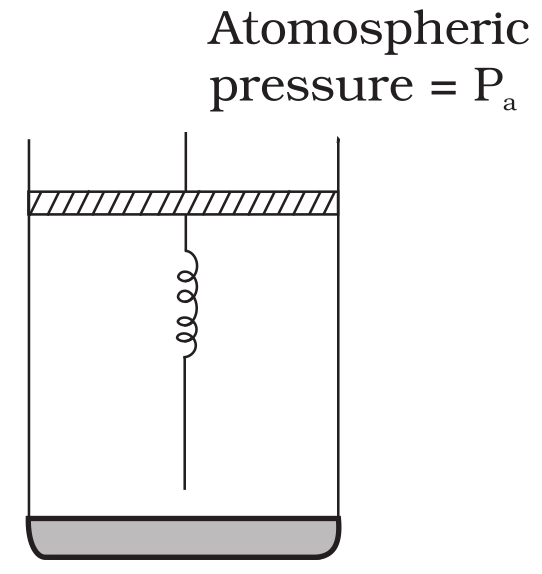
Consider one mole of perfect gas in a cylinder of unit cross section with a piston attached (Fig.) A spring (spring constant k) is attached (unstretched length L) to the piston and to the bottom of the cylinder. Initially the spring is unstretched and the gas is in equilibrium. A certain amount of heat Q is supplied to the gas causing an increase of volume from Vo to V1.

  1. What is the initial pressure of the system.
  2. What is the final pressure of the system.
  3. Uing the first law of thermodynamics, write down a relation between Q, Pa, V, Vo and k.
Two cylindrical hollow drums of radii R and 2R, and of a common height h, are rotating with angular velocities $\omega$ (anti-clockwise) and $\omega$ (clockwise), respectively. Their axes, fixed are parallel and in a horizontal plane separated by $(3\text{R}+\delta).$ They are now brought in contact $(\delta\rightarrow0){:}$
  1. Show the frictional forces just after contact.
  2. Identify forces and torques external to the system just after contact.
  3. What would be the ratio of final angular velocities when friction ceases?
Calculate the electric field in a copper wire of cross-sectional area 2.0mm2 carrying a current of 1A.
The resistivity of copper $=1.7\times10^{-8}\Omega\text{-m}.$
Two bodies of masses m1 and m2 and specific heat capacities s1 and s2 are connected by a rod of length l, cross-sectional area A, thermal conductivity K and negligible heat capacity. The whole system is thermally insulated. At time t = 0, the temperature of the first body is T1 and the temperature of the second body is T2 (T2 > T1). Find the temperature difference between the two bodies at time t.
A proton goes undeflected in a crossed electric and magnetic field (the fields are perpendicular to each other) at a speed of 2.0 × 10⁵ms-1. The velocity is perpendicular to both the fields. When the electric field is switched off, the proton moves along a circle of radius 4.0cm. Find the magnitudes of the electric and magnetic fields. Take the mass of the proton = 1.6 × 10⁻²⁷kg
Find the minimum colatitude which can directly receive a signal from a geostationary satellite.
A satellite is in an elliptic orbit around the earth with aphelion of 6R and perihelion of 2R where R = 6400km is the radius of the earth. Find eccentricity of the orbit. Find the velocity of the satellite at apogee and perigee. What should be done if this satellite has to be transferred to a circular orbit of radius 6R?

[G = 6.67 × 10⁻¹¹ SI units and M = 6 × 1024kg]

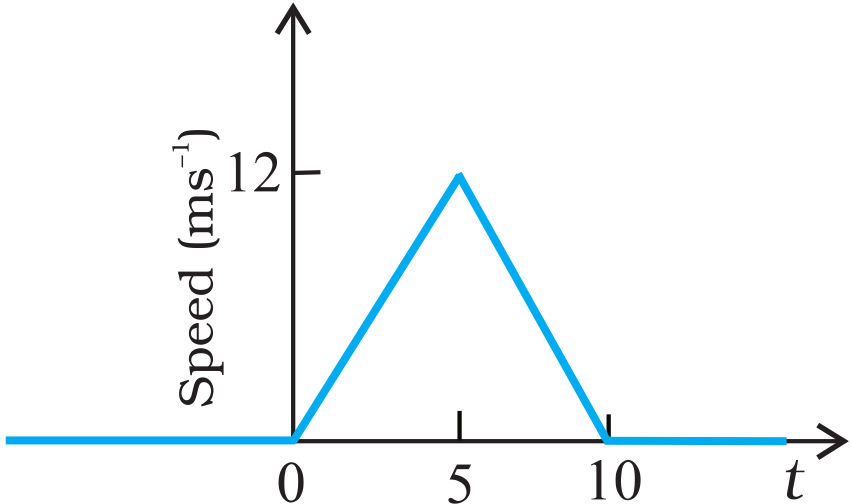
The speed-time graph of a particle moving along a fixed direction is shown in. Obtain the distance traversed by the particle between.
  1. t = 0s to 10s,
  2. t = 2s to 6s.

What is the average speed of the particle over the intervals in (a) and (b)?
The temperature and humidity of air are 27°C and 50% on a particular day. Calculate the amount of vapour that should be added to 1 cubic metre of air to saturate it. The saturation vapour pressure at 27°C = 3600Pa.
A neutron initially at rest, decays into a proton, an electron and an antineutrino. The ejected electron has a momentum of 1.4 × 10⁻²⁶kg-m/s and the antineutrino 6.4 × 10⁻²⁷kg-m/s. Find the recoil speed of the proton:
  1. If the electron and the antineutrino are ejected along the same direction.
  2. If they are ejected along perpendicular directions. Mass of the proton = 1.67 × 10⁻²⁷kg.