Question
A disc rotates about its axis with a constant angular acceleration of $4\ \text{rad/s}^2.$ Find the radial and tangential accelerations of a particle at a distance of $1\ cm$ from the axis at the end of the first second after the disc starts rotating.
Answer

$\text{t}=1\text{ sec},\ \text{r}=1\text{ cm}=0.01\text{m}$
$\alpha=4\text{ rad/s}^2$
Therefore $\omega=\alpha\text{t}=4\text{ rad/s}$
Therefore radial acceleration,
$\text{A}_{\text{n}}=\omega^2\text{r}=0.16\text{ m/s}^2=16\text{ cm/s}^2$
Therefore tangential acceleration,
$\text{a}_{\text{r}}=0.04\text{ m/s}^2=4\text{ cm/s}^2.$

Need a full question paper?

Generate a complete, print-ready paper with questions like this in minutes — across 16+ boards, with answer keys.

Start Generating Free

Similar questions

Draw a labelled ray diagram to show the image formation in a refracting type astronomical telescope. Why should the diameter of the objective of a telescope be large?
A compound microscope forms an inverted image of an object. In which of the following cases it is kely to create difficulties?
  1. Looking at small germs.
  2. Looking at circular spots.
  3. Looking at a vertical tube containing some water.
The electric current existing in a discharge tube is $2.0\mu\text{A}.$ How much charge is transferred across a cross-section of the tube in 5 minutes?
Two cells of emf 10V and 2V and internal resistance $10\Omega$ and $5\Omega$ respectively, are connected in parallel as shown. Find the effective voltage across R. 
Out of electric field vector $\vec{E}$ and magnetic field vector $\vec{B}$ in an electromagnetic wave, which is more effective and why ?
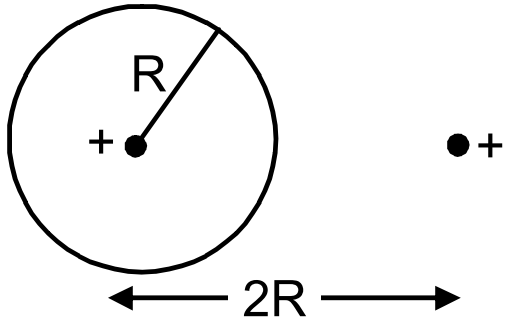
Find the flux of the electric field through a spherical surface of radius $R$ due to a charge of $10^{-7}C$ at the centre and another equal charge at a point $2R$ away from the centre.
Due to diffraction effects, the beam of ray gets focused as a spot of radius of approximately what value?
A uniform vertical tube of circular cross$-$section contains a liquid. The contact angle is $90^\circ$ . Consider a diameter of the tube lying in the surface of the liquid. The surface to the right of this diameter pulls the surface on the left of it. What keeps the surface on the left in equilibrium?
When an electron in hydrogen atom jumps from the third excited state to the ground state, how would the de Broglie wavelength associated with the electron change? Justify your answer.
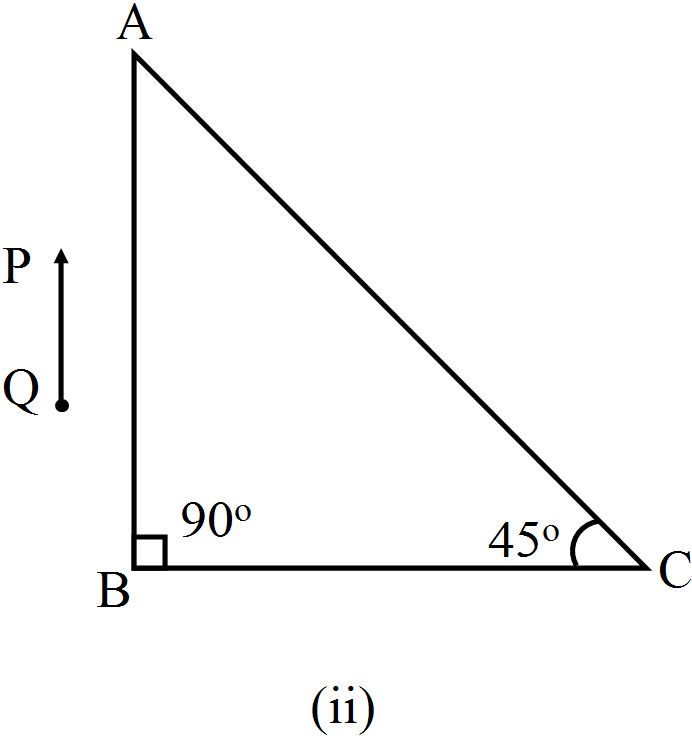
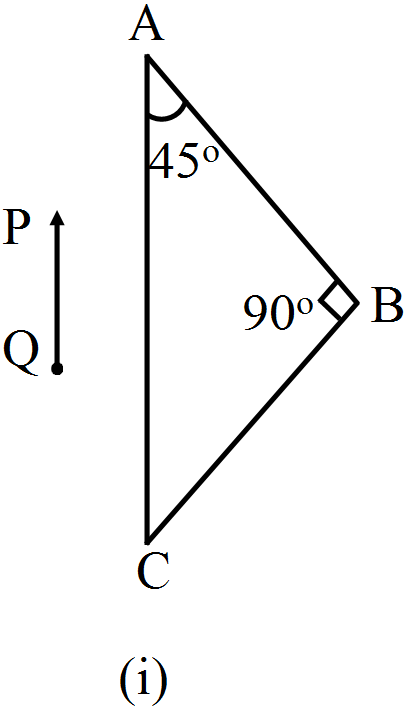
A right-angled crown glass prism with critical angle 41° is placed before an object, PQ in two positions as shown in the figures (i) and (ii). Trace the paths of the rays from P and Q passing through the prisms in the two cases.