Question
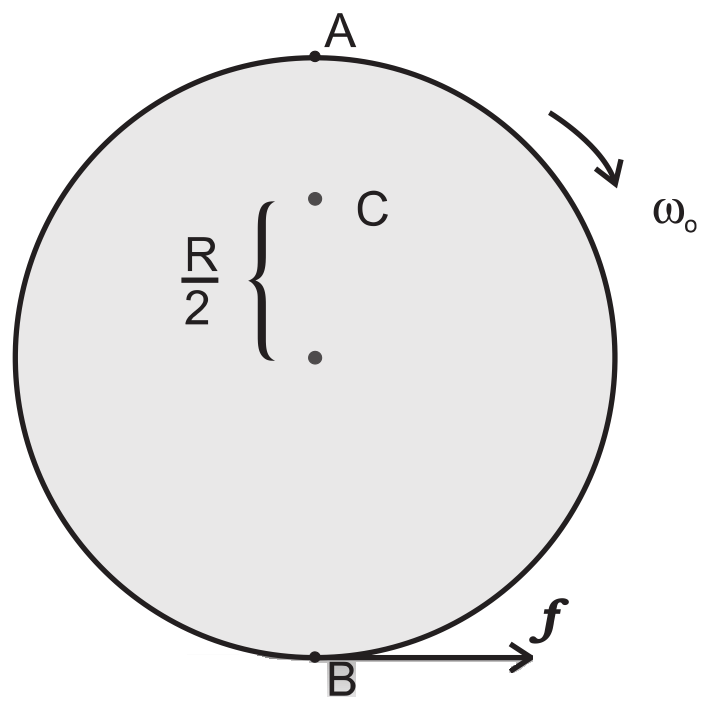
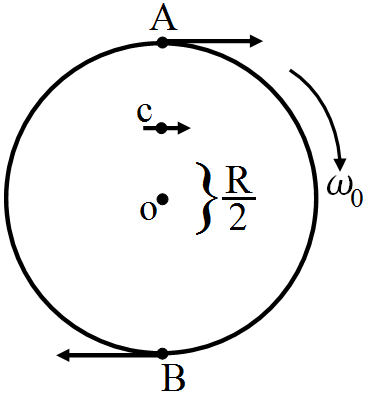
A disc rotating about its axis with angular speed $\omega_0$ is placed lightly (without any translational push) on a perfectly frictionless table. The radius of the disc is R. What are the linear velocities of the points A, B and C on the disc shown in will the disc roll in the direction indicated?
Answer

$\text{v}_{\text{A}}=\text{R}\omega_0,\text{ v}_\text{B}=\text{R}\omega_0,\text{ v}_\text{C}=\Big(\frac{\text{R}}{2}\Big)\omega_0$
The disc will not roll,
Angular speed of the disc $=\omega_0$
Radius of the disc = R
Using the relation for linear velocity, $\text{v}=\omega_0\text{R}$
For point A:
$\text{v}_{\text{A}}=\text{R}\omega_0,$ in the direction tangential to the right.
For point B:
$\text{v}_{\text{B}}=\text{R}\omega_0,$ in the direction tangential to the left.
For point C:
$\Big(\frac{\text{R}}{2}\Big)\omega_0$ in the direction same as that of vA.
The directions of motion of points A, B, and C on the disc are shown in the following figure:

Since the disc is placed on a frictionless table, it will not roll. This is because the presence of friction is essential for the rolling of a body.

Need a full question paper?

Generate a complete, print-ready paper with questions like this in minutes — across 16+ boards, with answer keys.

Start Generating Free

Similar questions

The edge of an aluminium cube is 10cm long. One face of the cube is firmly fixed to a vertical wall. A mass of 100kg is then attached to the opposite face of the cube. The shear modulus of aluminium is 25G Pa. What is the vertical deflection of this face?
An object is first sliding down an inclined plane of inclination with $\theta$ same constant velocity. It is next projected up the plane with an initial velocity u. Calculate the distance upto which it will rise before coming to rest. What will happen to the object after it come to rest?
Which of the following functions of time represent (a) periodic and (b) non-periodic motion? Give the period for each case of periodic motion [ $\omega$ is any positive constant].
(i) $\sin \omega t+\cos \omega t$
(ii) $\sin \omega t+\cos 2 \omega t+\sin 4 \omega t$
(iii) $e ^{-\omega t}$
(iv) $\log (\omega t)$
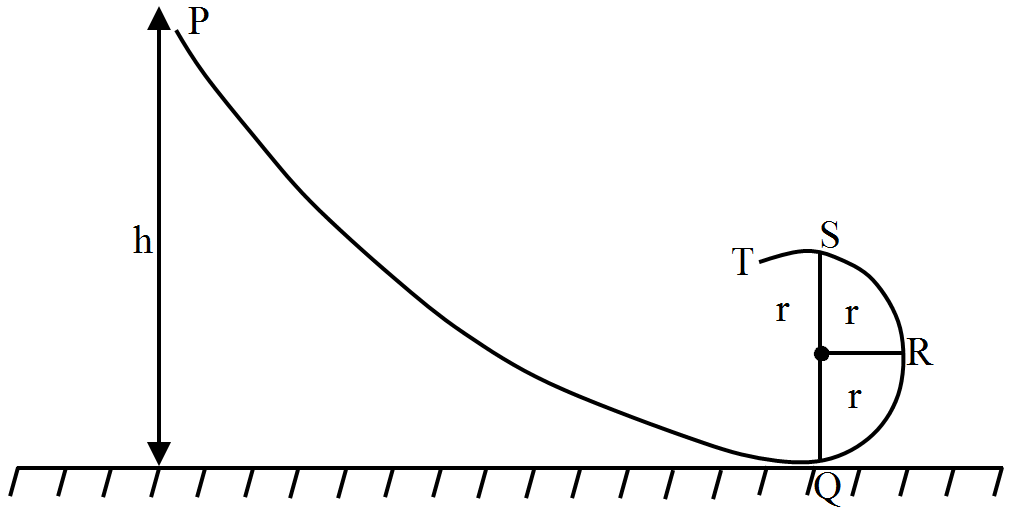
Given in figure PQRST is a channel in the vertical plane, part QRST being circular arc of radius r. A ball is released from P, and slides without friction and without rolling. Show that it will complete the loop path if h is greater than $\frac{5\text{r}}{2}.$

A piston is fitted in a cylindrical tube of small cross-section with the other end of the tube open. The tube resonates with a tuning fork of frequency 512Hz. The piston is gradually pulled out of the tube and it is found that a second resonance occurs when the piston is pulled out through a distance of 32.0cm. Calculate the speed of sound in the air of the tube.
A helicopter lifts a 72kg astronaut 15m vertically from the ocean by means of a cable. The acceleration of the astronaut is $\frac{\text{g}}{10}$.

How much work is done on the astronaut by:

  1. The force from the helicopter and
  2. The gravitational force on him?
  3. What are the kinetic energy and
  4. The speed of the astronaut just before he reaches the helicopter?(Take, g = 10ms‑2)
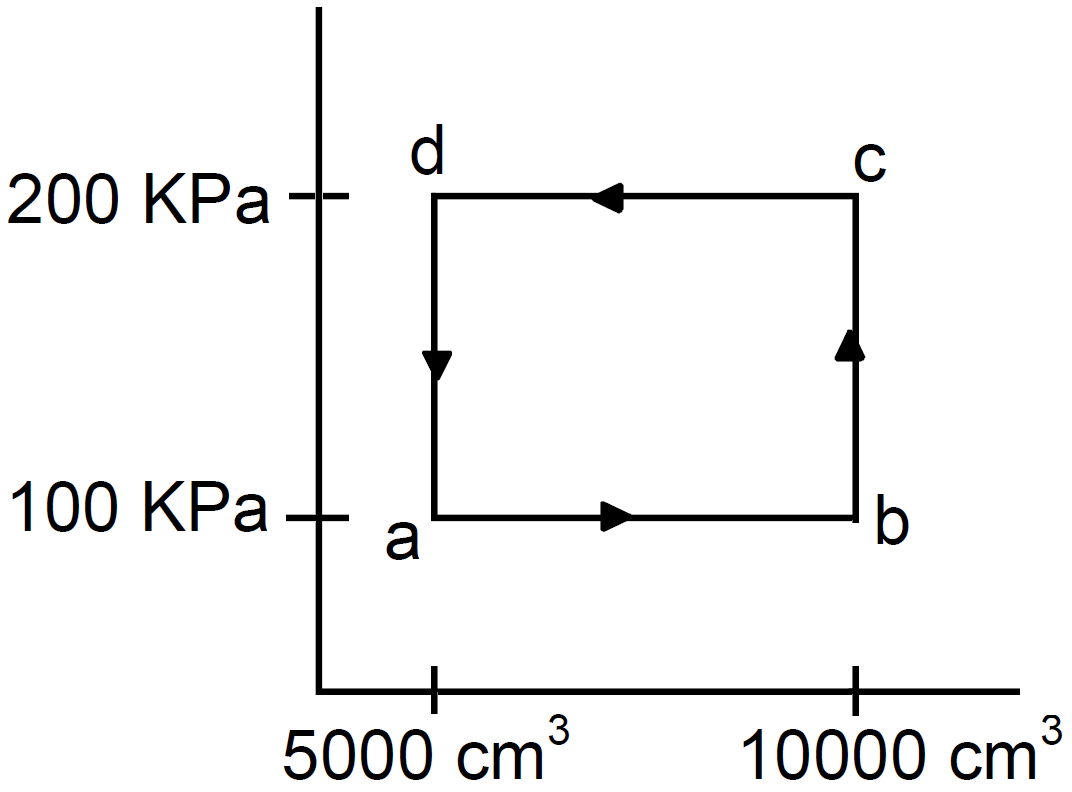
Half mole of an ideal gas $\Big(\gamma=\frac{5}{3}\Big)$ is taken through the cycle abcda, as shown in the figure. Take $\text{R}=\frac{25}{3}\text{JK}^{-1}\text{mol}^{-1}.$
  1. Find the temperature of the gas in the states a, b, c and d.
  2. Find the amount of heat supplied in the processes ab and bc.
  3. Find the amount of heat liberated in the processes cd and da.

The separation between the objective and the eyepiece of a compound microscope can be adjusted between 9.8cm to 11.8cm. If the focal lengths of the objective and the eyepiece are 1.0cm and 6cm respectively, find the range of the magnifying power if the image is always needed at 24cm from the eye.
An LR circuit having a time constant of 50ms is connected with an ideal battery of emf $\in.$ Find the time elapsed before:
  1. The current reaches half its maximum value.
  2. The power dissipated in heat reaches half its maximum value.
  3. The magnetic field energy stored in the circuit reaches half its maximum value.
One end of a long string of linear mass density 8.0 × 10⁻³kg m–1 is connected to an electrically driven tuning fork of frequency 256Hz. The other end passes over a pulley and is tied to a pan containing a mass of 90kg. The pulley end absorbs all the incoming energy so that reflected waves at this end have negligible amplitude. At t = 0, the left end (fork end) of the string x = 0 has zero transverse displacement (y = 0) and is moving along positive y-direction. The amplitude of the wave is 5.0cm. Write down the transverse displacement y as function of x and t that describes the wave on the string.