Question
The separation between the objective and the eyepiece of a compound microscope can be adjusted between 9.8cm to 11.8cm. If the focal lengths of the objective and the eyepiece are 1.0cm and 6cm respectively, find the range of the magnifying power if the image is always needed at 24cm from the eye.

Answer

For the given compound microscope

f0 = 1cm, fe = 6cm, D = 24cm

For the eye piece, ve = -24cm, fe = 6cm

Now, $\frac{1}{\text{v}_\text{e}}-\frac{1}{\text{u}_\text{e}}=\frac{1}{\text{f}_\text{e}}$

$\Rightarrow\frac{1}{\text{u}_\text{e}}=\frac{1}{\text{v}_\text{e}}-\frac{1}{\text{f}_\text{e}}\Rightarrow-\Big[\frac{1}{24}+\frac{1}{6}\Big]=-\frac{5}{24}$

$\Rightarrow \text{u}_\text{e}=-4.8\text{cm}$

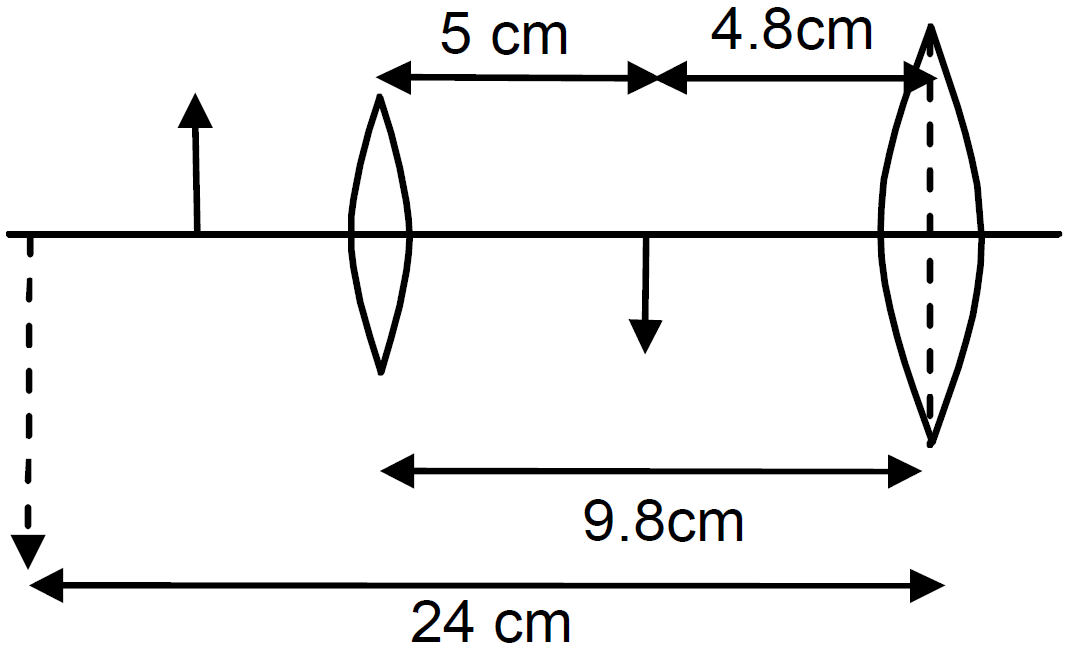
  1. When the separation between objective and eye piece is 9.8cm, the image distance for the objective lens must be (9.8) - (4.8) = 5.0cm

Now, $\frac{1}{\text{v}_0}-\frac{1}{\text{u}_0}=\frac{1}{\text{f}_0}$

$\Rightarrow\frac{1}{\text{u}_0}=\frac{1}{\text{v}_0}-\frac{1}{\text{f}_0}=\frac{1}{5}-\frac{1}{1}=-\frac{4}{5}$

$\Rightarrow\text{u}_0=-\frac{5}{4}=-1.25\text{cm}$

So, the magnifying power is given by,

$\text{m}=\frac{\text{v}_0}{\text{u}_\text{0}}\Big[1+\frac{\text{D}}{\text{f}}\Big]=\frac{-5}{-1.25}\Big[1+\frac{24}{6}\Big]=4\times5=20$
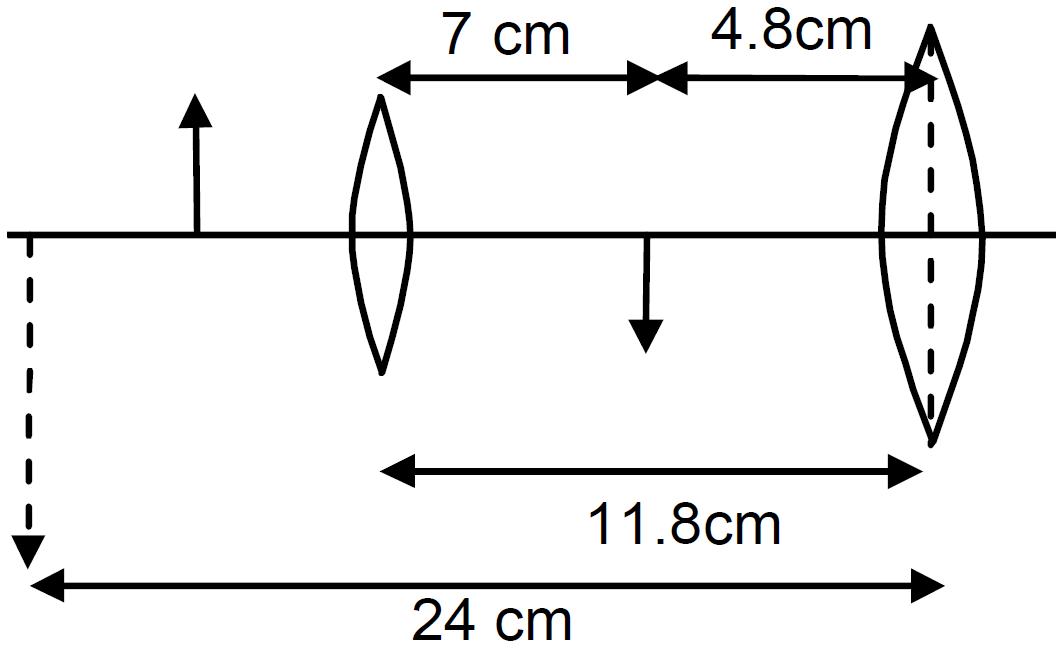
  1.  When the separation is 11.8cm,

v0 = 11.8 - 4.8 = 7.0cm, f0 = 1cm

$\Rightarrow\frac{1}{\text{u}_0}=\frac{1}{\text{v}_0}-\frac{1}{\text{f}_0}=\frac{1}{7}-\frac{1}{1}=-\frac{6}{7}$

So, $\text{m}=-\frac{\text{v}_0}{\text{u}_\text{o}}\Big[1+\frac{\text{D}}{\text{f}}\Big]=\frac{-7}{-\Big(\frac{7}{6}\Big)}\Big[1+\frac{24}{6}\Big]=6\times5=30$

So, the range of magnifying power will be 20 to 30.
Need a full question paper?

Generate a complete, print-ready paper with questions like this in minutes — across 16+ boards, with answer keys.

Start Generating Free

Similar questions

Ten one-rupee coins are put on top of each other on a table. Each coin has a mass m. Give the magnitude and direction of:
  1. The force on the 7th coin (counted from the bottom) due to all the coins on its top.
  2. The force on the 7th coin by the eighth coin.
  3. The reaction of the 6th coin on the 7th coin.
Calculate the frequency of beats produced in air when two sources of sound are activated, one emitting a wavelength of 32cm and the other of 32.2cm. The speed of sound in air is 350m/s.
An air-filled parallel-plate capacitor is to be constructed which can store $12\mu\text{C}$ of charge when operated at 1200V. What can be the minimum plate area of the capacitor? The dielectric strength of air is 3 × 10⁶Vm-1.
A man runs across the roof-top of a tall building and jumps horizontally with the hope of landing on the roof of the next building which is of a lower height than the first. If his speed is 9m/s, the (horizontal) distance between the two buildings is 10m and the height difference is 9m, will he be able to land on the next building? (take g = 10m/s2).
What should be the power of an engine required to lift 90 metric tonnes of coal per hour from a depth of 200m?
We would like to prepare a scale whose length does not change with temperature. It is proposed to prepare a unit scale of this type whose length remains, say 10cm. We can use a bimetallic strip made of brass and iron each of different length whose length (both components) would change in such a way that difference between their lengths remain constant. If airon = 1.2 × 10-5/ K and abrass = 1.8 × 10-5/ K, what should we take as length of each strip?
A steel tape 1m long is correctly calibrated for a temperature of 27.0°C. The length of a steel rod measured by this tape is found to be 63.0cm on a hot day when the temperature is 450°C. What is the actual length of the steel rod on that day? What is the length of the same steel rod on a day when the temperatures 27.0°C? Coefficient of linear expansion of steel = 1.20 × 10⁻⁵ K–1.
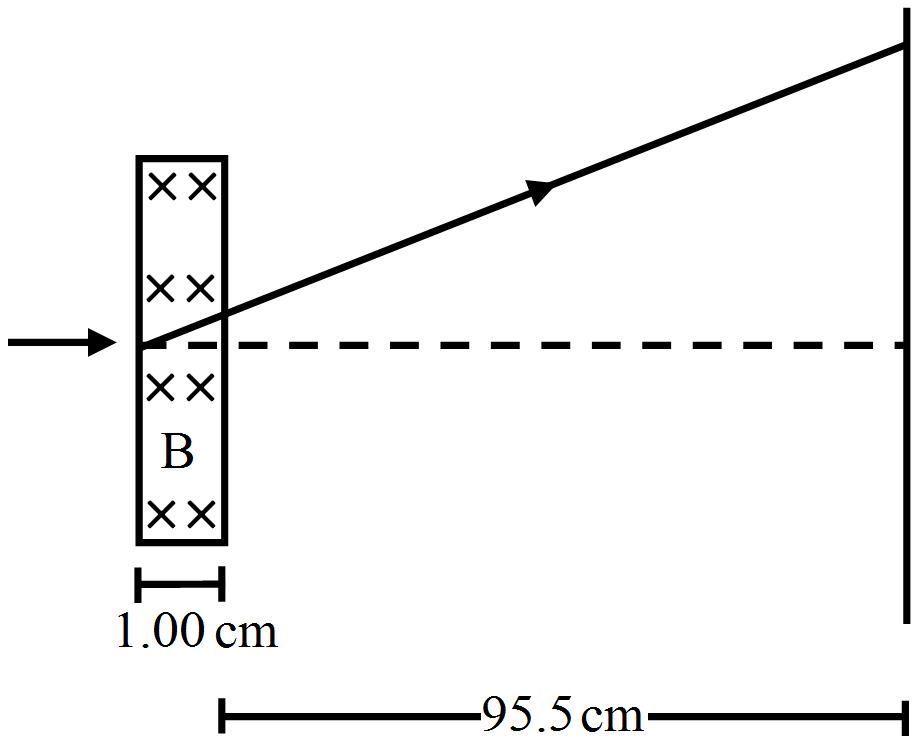
A narrow beam of singly charged potassium ions of kinetic energy 32keV is injected into a region of width 1.00cm with a magnetic field of strength 0.500T, as shown in the figure. The ions are collected at a screen 95.5cm away from the field region. If the beam contains isotopes of atomic weights 39 and 41, find the separation between the points where these isotopes strike the screen. Take the mass of a potassium ion = A (1.6 × 10⁻²⁷)kg, where A is the mass number.

A body cools from $80^{\circ} C$ to $50^{\circ} C$ in 5 minutes. Calculate the time it takes from $60^{\circ} C$ to 30 ${ }^{\circ} C$. The temperature of the surroundings is $20^{\circ} C$.
Three bulbs, each with a resistance of $180\Omega,$ are connected in parallel to an ideal battery of emf 60V. Find the current delivered by the battery when.
(a) all the bulbs are switched on, (b) two of the bulbs are switched on and (c) only one bulb is switched on.