Question
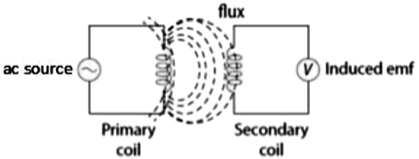
$a$. Draw the diagram of a device which is used to decrease high $ac$ voltage into a low $ac$ voltage and state its working principle. Write four sources of energy loss in this device.
$b$. A small town with a demand of $1200 kW$ of electric power at $220 V$ is situated $20 \ km$ away from an electric plant generating power at $440 V$ . The resistance of the two wire line carrying power is $0.5 \Omega \ \text{per} \ \ km$. The town gets the power from the line through a $4000-220 V$ step $-$ down transformer at a sub $-$ station in the town. Estimate the line power loss in the form of heat
Answer

$a$. The device used to decrease high $ac$ voltage into a low $ac$ voltage is called transformer $($step $-$ down transformer$)$.
Working principle:
Transformer works on the principle of Faraday’s law of electromagnetic induction.
The law of electromagnetic induction states that when magnetic flux linked with a coil changes, an emf is induced in the coil.
Transformer consists of two coils called primary coil and secondary coil.
The ac current in primary coil changes magnetic flux linked with the secondary coil and thus an emf is induced in the secondary coil.
Image

Sources of energy loss in transformer
$i$. Copper loss: The coils of transformer $($made of copper$)$ have a finite resistance due to which some energy in lost as heat.
$ii$. Iron loss: Due to induced eddy currents in the iron core, some energy is lost in the bulk.
$iii.$ Magnetic loss: Since all magnetic flux in primary coil does not pass through the secondary coil, there is some loss of energy due to leakage of flux.
$iv$. Hysteresis loss: alternating magnetization and demagnetization of the iron core cause some loss of energy in form of heat
$b$. Demand of electric power $= 1200 kW$
Distance of town from power station $= 20 \ km$ Two wire $= 20 \times 2 = 40 \ km$
Total resistance of line $= 40 \times 0.5 = 200$
The town gets a power of $4000$ volts
Power $=$ voltage current
$I=\frac{1200 \times 10^3}{4000}=\frac{1200}{4}=300 A$
The line power loss in the form of heat $= I ^2 \times R$
$=(300)^2 \times 2$
$=9000 \times 20=1800 kW$

Need a full question paper?

Generate a complete, print-ready paper with questions like this in minutes — across 16+ boards, with answer keys.

Start Generating Free

Similar questions

An electric field is uniform, and in the positive $x$ direction for positive $x$, and uniform with the same magnitude but in the negative $x$ direction for negative $x$. It is given that $E =200 \hat{ i } N / C$ for $x>0$ and $E =-200 \hat{ i } N / C$ for $x<0$. A right circular cylinder of length $20 \ cm$ and radius $5 \ cm$ has its centre at the origin and its axis along the $x-$ axis so that one face is at $x=+10 \ cm$ and the other is at $x=-10 \ cm\  ($Fig. $1.25).\ (a)$ What is the net outward flux through each flat face? $(b)$ What is the flux through the side of the cylinder? $(c)$ What is the net outward flux through the cylinder? $(d)$ What is the net charge inside the cylinder?
A current of 1.0A exists in a copper wire of cross-section $1.0mm^2$. Assuming one free electron per atom, calculate the drift speed of the free electrons in the wire. The density of copper is $9000kg/m^{-3}.$
The work function of caesium metal is 2.14 eV. When light of frequency $6 \times 10^{14}$Hz is incident on the metal surface, photoemission of electrons occurs. What is the
  1. Maximum kinetic energy of the emitted electrons,
  2. Stopping potential, and
  3. Maximum speed of the emitted photoelectrons?
Find the current in the sliding rod AB (resistance = R) for the arrangement shown in Fig. B is constant and is out of the paper. Parallel wires have no resistance. v is constant. Switch S is closed at time t = 0.
$a$. Derive the expression for the current flowing in an ideal capacitor and its reactance when connected to an ac source of voltage $V = V _{ o } \sin \omega t$.
$b$. Draw its phasor diagram.
$c$. If resistance is added in series to capacitor what changes will occur in the current flowing in the circuit and phase angle between voltage and current.
A capacitance C, a resistance R and an emf $\in$ are connected in series at t = 0. What is the maximum value of (a) the potential difference across the resistor (b) the current in the circuit (c) the potential difference across the capacitor (d) the energy stored in the capacitor (e) the power delivered by the battery and (f) the power converted into heat?
A vessel of volume $125cm^3$ contains tritium $\big(\text{ }^3\text{H,t}_{\frac{1}{2}}=12.3\text{y}\big)$ at 500 kPa and 300K. Calculate the activity of the gas.
Consider the situation of the previous problem. Consider the fastest electron emitted parallel to the large metal plate. Find the displacement of this electron parallel to its initial velocity before it strikes the large metal plate.
A voltmeter coil has resistance $50.0\Omega$ and a resistor of $1.15\text{k}\Omega$ is connected in series. It can read potential differences up to 12 volts. If this same coil is used to construct an ammeter that can measure currents up to 2.0A, what should be the resistance of the shunt used?
Two fixed, identical conducting plates $(\alpha\ \&\ \beta)$, each of surface area S are charged to -Q and q, respectively, where Q > q > 0. A third identical plate $(\gamma)$, free to move is located on the other side of the plate with charge q at a distance d (Fig.). The third plate is released and collides with the plate $\beta$. Assume the collision is elastic and the time of collision is sufficient to redistribute charge amongst $\beta\ \&\ \gamma$.

Find the electric field acting on the plate $\gamma$ before collision.