Question
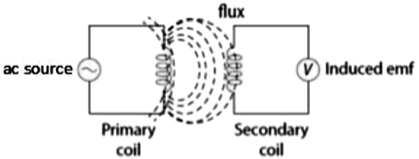
$a.$ Draw the diagram of a device which is used to decrease high ac voltage into a low ac voltage and state its working principle. Write four sources of energy loss in this device.
$b.$ A small town with a demand of $1200 \ kW$ of electric power at $220 \ V$ is situated $20 \ km$ away from an electric plant generating power at $440 \ V$ . The resistance of the two wire line carrying power is $0.5 \Omega\text{ per \ km}$. The town gets the power from the line through a $4000-220 V$ step $-$ down transformer at a sub$-$station in the town. Estimate the line power loss in the form of heat
Answer

$a.$ The device used to decrease high ac voltage into a low ac voltage is called transformer $($step$-$down transformer$).$
Working principle:
Transformer works on the principle of Faraday’s law of electromagnetic induction. The law of electromagnetic induction states that when magnetic flux linked with a coil changes, an emf is induced in the coil. Transformer consists of two coils called primary coil and secondary coil. The ac current in primary coil changes magnetic flux linked with the secondary coil and thus an emf is induced in the secondary coil.
Image

Sources of energy loss in transformer
$i.$ Copper loss: The coils of transformer $($made of copper$)$ have a finite resistance due to which some energy in lost as heat.
$ii.$ Iron loss: Due to induced eddy currents in the iron core, some energy is lost in the bulk.
$iii.$ Magnetic loss: Since all magnetic flux in primary coil does not pass through the secondary coil, there is some loss of energy due to leakage of flux.
$iv.$ Hysteresis loss: alternating magnetization and demagnetization of the iron core cause some loss of energy in form of heat
$b.$ Demand of electric power $= 1200 \ kW$
Distance of town from power station $= 20 \ km $ Two wire $= 20 \times 2 = 40 \ km$
Total resistance of line $= 40 \times 0.5 = 200$
The town gets a power of $4000$ volts
Power $=$ voltage current
$I=\frac{1200 \times 10^3}{4000}=\frac{1200}{4}=300 A$
The line power loss in the form of heat $= I ^2 \times R$
$=(300)^2 \times 2$
$=9000 \times 20=1800 \ kW$

Need a full question paper?

Generate a complete, print-ready paper with questions like this in minutes — across 16+ boards, with answer keys.

Start Generating Free

Similar questions

Two convex lenses, each of focal length $10\ cm$, are placed at a separation of $15\ cm$ with their principal axes coinciding,
  1. Show that a light beam coming parallel to the principal axis diverges as it comes out of the lens system.
  2. Find the location of the virtual image formed by the lens system of an object placed far away.
  3. Find the focal length of the equivalent lens.
$($Note that the sign of the focal length is positive although the lens system actually diverges a parallel beam incident on it$).$
Light is incident from glass $(\mu=1.50)$ to water $(\mu=1.33).$ Find the range of the angle of deviation for which there are two angles of incidence.
Find the currents through the resistances in the circuits shown in figure.
Two long, straight wires, each carrying a current of $5A,$ are placed along the $X$ and $Y-$axes respectively. The currents point along the positive directions of the axes. Find the magnetic fields at the points $(a)\  (1m, 1m),\  (b) \ (-1m, 1m), \ (c) \ (-1m,-1m)$ and $(d) \ (1m, -1m),$
A circuit containing a $80\ mH$ inductor and a $60 \mu\  F$ capacitor in series is connected to a $230\ V, 50 \ Hz$ supply. The resistance of the circuit is negligible.
$a.$ Obtain the current amplitude and rms values.
$b.$ Obtain the rms values of potential drops across each element.
$c.$ What is the average power transferred to the inductor?
$d.$ What is the average power transferred to the capacitor?
$e.$ What is the total average power absorbed by the circuit? $[$‘Average’ implies ‘averaged over one cycle’.$]$
Using Huygens’ Principle, draw a diagram to show propagation of a wavefront originating from a monochromatic point source. Explain briefly.
Figure shows a plane mirror $M$ placed at a distance of $10\ cm$ from a concave lens $L$. A point object is placed at a distance of $60\ cm$ from the lens. The image formed due to refraction by the lens and reflection by the mirror is $30\ cm$ behind the mirror. What is the focal length of this lens?
Derive an expression for the electric potential at a point due to an electric dipole. Mention the contrasting features of electric potential of a dipole at a point as compared to that due to a single charge.
Four equal charges $2.0 \times 10^{-6}C$ each are fixed at the four corners of a square of side $5\ cm$. Find the Coulomb force experienced by one of the charges due to the rest three.
A turn of radius 20m is banked for the vehicles going at a speed of 36 km/h. If the coefficient of static friction between the road and the tyre is 0.4, what are the possible speeds of a vehicle so that it neither slips down nor skids up?