Question
Derive an expression for the electric potential at a point due to an electric dipole. Mention the contrasting features of electric potential of a dipole at a point as compared to that due to a single charge.
Answer

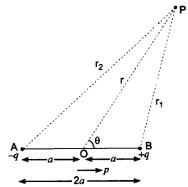
Consider an electric dipole having charges $-q $ and $+q$ at separation $ '2a\ '$.
The dipole moment of dipole is $\vec{p}=q(\overrightarrow{2} a)$ directed from $- q$ to $+ q$.
The electric potential due to dipole is the algebraic sum of potentials due to charges $+q$ to $-q$
If $r_1$ and $r_2$ are distances of any point $P$ from charge $+q$ to $-q$ respectively as shown in the figure, then the potential due to electr dipole at point $P ,$ is

Image 
$V=\frac{1}{4 \pi \varepsilon_0} \frac{q}{r_1}-\frac{1}{4 \pi \varepsilon_0} \frac{q}{r_2}=\frac{q}{4 \pi \varepsilon_0}\left[\frac{1}{r_1}-\frac{1}{r_2}\right] ..(i)$
If $( r , \theta)$ are polar coordinates of point $P$ with respect to mid $-$ point $O$ of dipole, then
By geometry,
$r_1^2=r^2+a^2-2 a r \cos \theta \ldots \text { (ii) }$
and $, r_2^2=r^2+a^2-2 a r \cos \theta \ldots \text { (iii) }$
From $(ii), r_1^2=r^2\left[1-\frac{2 a \cos \theta}{r}+\frac{a^2}{r^2}\right]$
If $r \gg \ a$ i e., $\frac{a}{r}<<1$, then it is sufficient to retain terms only upto first order in $\left(\frac{a}{r}\right)$.
$\therefore r_1^2=r^2\left[1-\frac{2 a \cos \theta}{r}\right] \Rightarrow r_1=r\left[1-\frac{2 a \cos \theta}{r}\right]^{\frac{1}{2}}$
Similarly from $(iii), r_2{ }^2=r^2\left[1+\frac{2 a \cos \theta}{r}\right]$
$ \Rightarrow r_2=r\left[1+\frac{2 a \cos \theta}{r}\right]^{\frac{1}{2}}$
From $(iv$) and $(v),$
$\frac{1}{r_1}=\frac{1}{r}\left[1-\frac{2 a \cos \theta}{r}\right]^{\frac{-1}{2}}$ and $, \frac{1}{r_2}=\frac{1}{r}\left[1+\frac{2 a \cos \theta}{r}\right]^{\frac{-1}{2}}$
Using binomial theorem and retaining terms upto first order in $\left(\frac{a}{r}\right)$ only, we have
$\frac{1}{r_1}=\frac{1}{r}\left[1-\left(-\frac{1}{2}\right) \frac{2 a \cos \theta}{r}\right]=\frac{1}{r}\left[1+\frac{a}{r} \cos \theta\right]$
and, $\frac{1}{r_3}=\frac{1}{r}\left[1-\frac{a}{r} \cos \theta\right]$
Substituting these values in $(i),$ we get
$V=\frac{q}{4 \pi \varepsilon_0}\left[\frac{1}{r}\left(1+\frac{a}{r} \cos \theta\right)-\frac{1}{r}\left(1-\frac{a}{r} \cos \theta\right)\right]$
$=\frac{1}{4 \pi \varepsilon_0} \frac{q}{r}\left[1+\frac{a}{r} \cos \theta-1+\frac{a}{r} \cos \theta\right]$
$=\frac{1}{4 \pi \varepsilon_0} \frac{q}{r}\left[\frac{2 a}{r} \cos \theta\right]=\frac{1}{4 \pi \varepsilon_0} \frac{(q 2 a) \cos \theta}{r^2}$
or $, V=\frac{1}{4 \pi \varepsilon_0} \frac{p \cos \theta}{r^2} $
But, $p \cos \theta=\vec{p} \cdot \hat{r}$ where, $\hat{r}$ is unit vector along position vector $\vec{O} P=\vec{r}$.
Electric potential due to an electric dipole is
$V=\frac{1}{4 \pi \epsilon_0} \frac{\vec{p} \cdot \hat{r}}{r^2}($ for $r \gg a )=\frac{1}{4 \pi \epsilon_0} \frac{\vec{p} \cdot \vec{r}}{r^3}$
Contrasting features: The electric potential due to a dipole depends on distance $r$ and also on the angle between position vector $\vec{r}$ and dipole moment $ \vec{p}$ .
The electrostatic potential at large distances falls off, as $\frac{1}{r^2}$ and not as $\frac{1}{r}$ which is the characteristic of potential due to a single charge.
potential due to a single charge.
Special Cases:
$i.$ When point $P$ lies on the axis of dipole, then $\theta=0^{\circ}$
$\therefore \cos \theta=\cos 0=1$
$\therefore V=\frac{1}{4 \pi \varepsilon_0} \frac{p}{r^2}$
$ii$. When point $P$ lies on the equatorial plane of the dipole, then
$\therefore \cos \theta=\cos 90^{\circ}=0$
$\therefore V=0$
It may be noted that the electric potential at any point on the equitorial line of a dipole is zero.
 

Need a full question paper?

Generate a complete, print-ready paper with questions like this in minutes — across 16+ boards, with answer keys.
Start Generating Free

Similar questions

Assume that there is no repulsive force between the electrons in an atom but the force between positive and negative charges is given by Coulomb’s law as usual. Under such circumstances, calculate the ground state energy of a $He -$ atom.
If a $LC$ circuit is considered analogous to a harmonically oscillating spring block system, which energy of the $LC$ circuit would be analogous to potential energy and which one analogous to kinetic energy?
A particle A having a charge of $2.0 \times 10^{-6}C$ and a mass of $100g$ is placed at the bottom of a smooth inclined plane of inclination $30^\circ $. Where should another particle B, having same charge and mass, be placed on the incline so that it may remain in equilibrium?
Obtain an expression for the frequency of radiation emitted when a hydrogen atom de $-$ excites from level n to level $(\text{n – ncy })$ of revolution of the electron in the orbit.
A long cylindrical wire carries a positive charge of linear density $2.0 \times 10^{-8}Cm^{-1}.$ An electron revolves around it in a circular path under the influence of the attractive electrostatic force. Find the kinetic energy of the electron. Note that it is independent of the radius.
Find the expression for the energy stored in the capacitor. Also find the energy lost when the charged capacitor is disconnected from the source and connected in parallel with the uncharged capacitor. Where does this loss of energy appear?
A solid aluminium sphere and a solid copper sphere of twice the radius are heated to the same temperature and are allowed to cool under identical surrounding temperatures. Assume that the emissivity of both the spheres is the same. Find the ratio of:
  1. The rate of heat loss from the aluminium sphere to the rate of heat loss from the copper sphere.
  2. The rate of fall of temperature of the aluminium sphere to the rate of fall of temperature of the copper sphere. The specific heat capacity of aluminium $= 900Jkg^{-1^\circ }C^{-1}$ and that of copper $= 390Jkg^{-1^\circ }C^{-1}$. The density of copper $= 3.4$ times the density of aluminium.
Two small balls, each of mass m are connected by a light rigid rod of length L. The system is suspended from its centre by a thin wire of torsional constant k. The rod is rotated about the wire through an angle $\theta_0$ and released. Find the tension in the rod' as the system passes through the mean position.
A long, straight wire carries a current i. Let $B_1$, be the magnetic field at a point Pat a distance d from the wire. Consider a section of length l of this wire such that the point $P$ lies on a perpendicular bisector of the section. Let $B2$ be the magnetic field at this point due to this section only. Find the value of $\frac{\text{d}}{\text{l}}$ so that $B_2$_ differs from $B_1$, by $1\%.$
A glass vessel measures exactly $10\ cm \times 10\ cm \times 10\ cm$ at $0^\circ C$. It is filled completely with mercury at this temperature. When the temperature is raised to $10^\circ C, 1.6\ cm^3$ of mercury overflows. Calculate the coefficient of volume expansion of mercury. Coefficient of linear expansion of glass $= 6.5 \times 10^{-6 ^\circ} C.$