Questions

5 Marks Questions

Take a timed test

6 questions · self-marked practice — reveal the answer and mark yourself.

Question 15 Marks
i. With the help of a diagram, explain the principle and working of a device which produces current that reverses its direction after regular intervals of time.
ii. If a charged capacitor C is short-circuited through an inductor L, the charge and current in the circuit oscillate simple harmonically. a. In what form the capacitor and the inductor store energy? b. Write two reasons due to which the oscillations become damped.
Answer
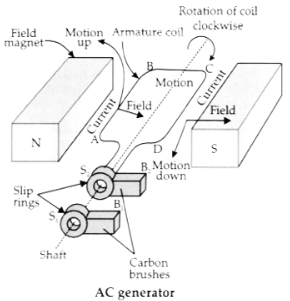
i. AC generator: it converts mechanical energy into the alternating form of electrical energy. Basic elements of an AC generator:
a. Rectangular coil: Also called as an armature
b. Strong permanent magnets: The magnetic field is perpendicular to the axis of rotation of the coil.
c. Slip rings
d. Brushes
Image
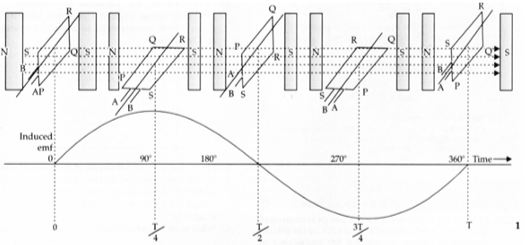
Principle: It is based on the principle of electromagnetic induction. That is, when a coil is rotated about an axis perpendicular to the direction of the uniform magnetic field, an induced emf is produced across it. 
Working of AC Generator
Image

ii.  a. The capacitor stores energy in the form of an electric field and the inductor stores energy in the form of a magnetic field.
b. Oscillation becomes damped due to :
  • The resistance of the circuit
  • Radiation in the form of EM waves
View full question & answer
Question 25 Marks
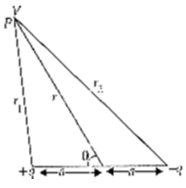
Derive an expression for potential due to a dipole for distances large compared to the size of the dipole. How is the potential due to dipole different from that due to a single charge?
Image
Answer
Consider origin at the centre of dipole.
As per superposition principle, potential due to dipole will be the sum of potentials due to charges $q$ and $-q$
$V=\frac{1}{4 \pi \varepsilon_0}\left[\frac{q}{r_1}-\frac{q}{r_2}\right]$
Where,
$r_1$ and $r_2=$ distances of point $P$ from $q$ and $-q$.
$ r_1^2=r^2+a^2-2 \operatorname{ar cos} \theta $
$ r_2^2=r^2+a^2+2 \operatorname{ar cos} \theta $
If r is greater than a, and taking terms upto first order in $a / r$
$ r _1^2= r ^2\left[1-\frac{2 a \cos \theta}{r}+\frac{a^2}{r^2}\right]$
$=r^2\left[1-\frac{2 a \cos \theta}{r}\right]$
Also $,  r _2^2= r ^2\left[1+\frac{2 a \cos \theta}{r}\right]$
With the help of Binomial theorem, keeping terms upto first order is shown below:
$\frac{1}{r_1} \equiv \frac{1}{r}\left[1-\frac{2 a \cos \theta}{r}\right]^{\frac{1}{2}}$
$\equiv \frac{1}{r}\left[1+\frac{a}{r} \cos \theta\right]$
$\frac{1}{r_2} \equiv \frac{1}{r}\left[1+\frac{2 a \cos \theta}{r}\right]^{\frac{1}{2}}$
$\equiv \frac{1}{r}\left[1-\frac{a}{r} \cos \theta\right] $
As $p = qa$
$ V=\frac{1}{4 \pi \varepsilon_0} \frac{q(2 a) \cos \theta}{r^2}$
$V=\frac{p}{4 \pi \varepsilon_0} \cdot \frac{\cos \theta}{r^2} $
Now, $p \cos \theta=\vec{p} . \hat{r}$
Hence electric potential of dipole for distances large compared to size of dipole is given as below :
$ V=\frac{1}{4 \pi \varepsilon_0} \cdot \frac{\vec{p} \hat{r}}{r^2} \text { for } r \gg a$
$---$ For potential at any point on axis, $\theta=[0, \pi]$
$V= \pm \frac{1}{4 \pi \varepsilon_0} \cdot \frac{q}{r} $
potential is positive when $\theta=0$
potential is negative when $\theta=\pi$
Hence, electric potential falls at large distance, as $\frac{1}{r^2}$ and not as $\frac{1}{r}$
View full question & answer
Question 35 Marks
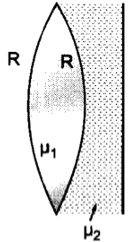
A biconvex lens with its two faces of equal radius of curvature $R$ is made of a transparent medium of refractive index $\mu_1$. It is kept in contact with a medium of refractive index $\mu_2$ as shown in the figure.
Image
$a$. Find the equivalent focal length of the combination.
$b$. Obtain the condition when this combination acts as a diverging lens.
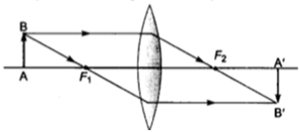
$c$. Draw the ray diagram for the case $\mu_1>\frac{\left(\mu_2+1\right)}{2}$, when the object is kept far away from the lens. Point out the nature of the image formed by the system.
Answer
$a$. If refraction occurs at first surface
$\frac{\mu_1}{v_1}-\frac{1}{u}=\frac{\left(\mu_1-1\right)}{R} \ldots( i )$
Image
If refraction occurs at second surface, and the image of the first surface acts as an object
$\frac{\mu_2}{v}-\frac{u_1}{v}=\frac{\mu_2-\mu_1}{-R}...(ii)$
On adding equation $(i)$ and $(ii), $ we get
$\frac{\mu_2}{v}-\frac{1}{u}=\frac{2 \mu_1-\mu_2-1}{R}$
If rays are coming from infinity, i.e., $u=-\infty$ then $v=f$
$\frac{\mu_2}{f}+\frac{1}{\infty}=\frac{2 \mu_1-\mu_2-1}{R}$
$ \Rightarrow f=\frac{\mu_2 R}{2 \mu_1-\mu_2}$
$b$. If the combination behave as a diverging system then $f < 0$.
This is possible only when
$2 \mu_1-\mu_2-1<0$
$\Rightarrow 2 \mu_1<\mu_2+1$
$\Rightarrow \mu_1<\frac{\left(\mu_2+1\right)}{2}$
Nature of the image formed is real.
Image
$c$. If the combination behaves as a converging lens then $> 0$.
Itis possible only when
$ 2 \mu_1-\mu_2-1>0$
$\Rightarrow \mu_1->\mu_2+1$
$\Rightarrow \mu_1>\frac{\left(\mu_2+1\right)}{2} $
Nature of the image formed is real.
View full question & answer
Question 45 Marks
$a.$ Draw the diagram of a device which is used to decrease high ac voltage into a low ac voltage and state its working principle. Write four sources of energy loss in this device.
$b.$ A small town with a demand of $1200 \ kW$ of electric power at $220 \ V$ is situated $20 \ km$ away from an electric plant generating power at $440 \ V$ . The resistance of the two wire line carrying power is $0.5 \Omega\text{ per \ km}$. The town gets the power from the line through a $4000-220 V$ step $-$ down transformer at a sub$-$station in the town. Estimate the line power loss in the form of heat
Answer
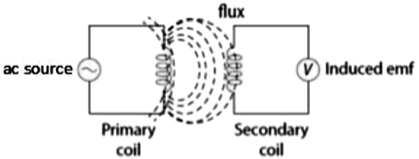
$a.$ The device used to decrease high ac voltage into a low ac voltage is called transformer $($step$-$down transformer$).$
Working principle:
Transformer works on the principle of Faraday’s law of electromagnetic induction. The law of electromagnetic induction states that when magnetic flux linked with a coil changes, an emf is induced in the coil. Transformer consists of two coils called primary coil and secondary coil. The ac current in primary coil changes magnetic flux linked with the secondary coil and thus an emf is induced in the secondary coil.
Image

Sources of energy loss in transformer
$i.$ Copper loss: The coils of transformer $($made of copper$)$ have a finite resistance due to which some energy in lost as heat.
$ii.$ Iron loss: Due to induced eddy currents in the iron core, some energy is lost in the bulk.
$iii.$ Magnetic loss: Since all magnetic flux in primary coil does not pass through the secondary coil, there is some loss of energy due to leakage of flux.
$iv.$ Hysteresis loss: alternating magnetization and demagnetization of the iron core cause some loss of energy in form of heat
$b.$ Demand of electric power $= 1200 \ kW$
Distance of town from power station $= 20 \ km $ Two wire $= 20 \times 2 = 40 \ km$
Total resistance of line $= 40 \times 0.5 = 200$
The town gets a power of $4000$ volts
Power $=$ voltage current
$I=\frac{1200 \times 10^3}{4000}=\frac{1200}{4}=300 A$
The line power loss in the form of heat $= I ^2 \times R$
$=(300)^2 \times 2$
$=9000 \times 20=1800 \ kW$
View full question & answer
Question 55 Marks
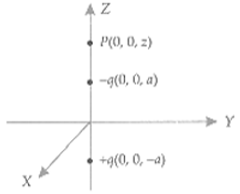
Two point charges $q$ and $-q$ are located at points $(0,0,-a)$ and $(0,0, a)$ respectively.
$i$. Find the electrostatic potential at $(0,0, z)$ and $(x, y, 0)$.
$ii$. How much work is done in moving a small test charge from the point $(5,0,0)$ to $(-7,0,0)$ along the $X-$ axis?
$iii$. How would your answer change if the path of the test charge between the same points is not along the $x-$ axis but along any other random path?
$iv$. If the above point charges are now placed in the same positions in a uniform external electric field $\vec{E}$, what would be the potential energy of the charge system in its orientation of unstable equilibrium? Justify your answer in each case.
Answer
$i$. Potential at point $P(0,0,2)$ due to charge $+q(0,0,-a)$ is
$ V_{+}=\frac{1}{4 \pi \varepsilon_0}, \frac{q}{z-(-a)}=\frac{1}{4 \pi \varepsilon_0} \cdot \frac{q}{z+a} $
Image

Potential at point $P (0,0, z )$ due to charge $- q (0,0, a )$ is $V_{-}=\frac{1}{4 \pi \varepsilon_0} \cdot \frac{-q}{z-a}$
Total potential at point $P(0,0, z)$ is
$V=V_{+}+V_{-}=\frac{1}{4 \pi \varepsilon_0}\left[\frac{q}{z-a}-\frac{q}{z-a}\right]$
$=-\frac{1}{4 \pi \varepsilon_0} \cdot \frac{2 q a}{z^2-a^2}
=-\frac{1}{4 \pi \varepsilon_0} \cdot \frac{p}{z^2-a^2}$
Potentials at point $(x, y, 0)$ will be
$V_{+}=\frac{1}{4 \pi \varepsilon_0} \cdot \frac{q}{\sqrt{x^2+y^2+a^2}}$
$V_{-}=\frac{1}{4 \pi \varepsilon_0} \cdot \frac{-q}{\sqrt{x^2+y^2+a^2}}$
The total potential at point $(x, y, 0)$ will be
$V=V_{+}+V_{-}=0$
$ii$. Points $(5, 0, 0)$ and $(-7, 0, 0)$ are the points on the $X -$ axis i.e., these points lie on the perpendicular bisector of the dipole. The electric potential at each of these points will be zero.
$ii.$ Points $(5, 0, 0)$ and $(-7, 0, 0)$ are the points on the $X -$ axis i.e., these points lie on the perpendicular bisector of the dipole. The electric potential at each of these points will be zero.
$W = q \left( V _1- V _2\right)= q (0-0)=0$
$iii$. No, the work done will not change.
This is because the electric field is a conservative field.
Work done against this field is path independent.
$iv$. The dipole will be in unstable equilibrium if its dipole moment $\vec{p}$ is antiparallel to the external field $\vec{E}$
Then its potential energy will be $U=+p E$
View full question & answer
Question 65 Marks
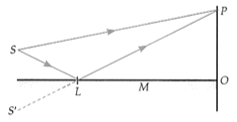
Figure shows an outline of Lloyd's mirror experiment. $M$ is a plane mirror; $S$ is a narrow slit illuminated by some source of light $($not shown$)$ and $S$' is the image of S in $M. M, S$ and $S\ '$ are in a plane perpendicular to the paper. $O$ is the line of intersection of the mirror and the screen.
$a$. What is the origin of fringes observed on the screen?
Image

$b$. Why is the slit $S$ placed so as to have very oblique angle of incidence of light striking the mirror?
$c.$ The two path lengths $PS$ and $PS\ '$ are equal when $P$ coincides with $O$. Yet the fringe at $O$ is found in the experiment to be dark not bright. What does this observation imply?
Answer
$a. S\ '$ is the virtual image of source $S$ formed by mirror $M$.
So $S$ and $S\ '$ act as two coherent sources of light.
Light waves coming directly from the source $S$ and the reflected waves $($which appear to come from virtual source $S\ ')$ interfere to produce a fringe pattern.
$b$. Very oblique angle of incidence requires the source $S$ to be placed very close to the mirror.
In that case the separation between the coherent sources $S$ and $S\ '$ will be small, as required in Young's double $-$ slit experiment for obtaining broad and distinct interference fringes.
$c$. The light wave reflected by the mirror suffers a phase change of $180^{\circ}$ which is equivalent to a change in the path length of $\frac{\Delta}{2}$.
Then the path difference for any point $P$ on the screen becomes
$ p=S^{\prime} P-sP+\frac{\lambda}{2} $
Consequently, the condition for a dark fringe is
$ p=S^{\prime} P-SP+\frac{\lambda}{2}=(2 n+1) \frac{\lambda}{2}$
or $ S^{\prime} P-SP=n \lambda$
This condition is satisfied by the central fringe for which $S ^{\prime} P = SP$.
Hence the central fringe in Lloyd's mirror method is dark.
View full question & answer