MCQ
A drop of liquid of diameter $2.8\, mm$ breaks up into $125$ identical drops. The change in energy is nearly ......... $ergs$ (Surface tension $= 75\, dyne/cm$)
  • A
    $0$
  • B
    $19$
  • C
    $46$
  • $74$

Answer

Correct option: D.
$74$
d
$\Delta \mathrm{E}=4 \pi \mathrm{R}^{2} \mathrm{T}\left(\mathrm{n}^{1 / 3}-1\right)$

$=4 \times 3.14 \times\left(1.4 \times 10^{-1}\right)^{2} \times 75\left[(125)^{\frac{1}{3}}-1\right]$

$=73.85$ erg $=74$ erg

Need a full question paper?

Generate a complete, print-ready paper with questions like this in minutes — across 16+ boards, with answer keys.
Start Generating Free

Similar questions

What should be the angular speed with which the earth have to rotate on its axis so that a person on the equator would weigh $\frac{3}{5}$ th as much as present?
If $Q , E$ and $W$ denote respectively the heat added, change in internal energy and the work done by a closed cycle process, then
The percentage errors in the measurement of mass and speed are $2\%$ and $3\%$ respectively. How much will be the maximum error in the estimation of the kinetic energy obtained by measuring mass and speed  ......... $\%$
If Young's modulus for a material is zero, then the state of material should be
$Assertion :$ One mole of any substance at any temperature or volume always contains $6.02\times10^{23}$ molecules.
$Reason :$ One mole of a substance always refers to $S.T.P.$ conditions.
A motor cycle driver doubles its velocity when he is having a turn. The force exerted outwardly will be
The dimensions of stress are equal to
A wave disturbance in a medium is described by $y(x,\,t) = 0.02\cos \,\left( {50\,\pi t + \frac{\pi }{2}} \right)\cos (10\pi x)$, where $ x$ and $y$ are in metres and $t$ in seconds
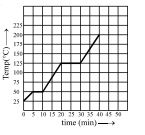
The graph shown in the figure represent change in the temperature of $5 \,\,kg$ of a substance as it abosrbs heat at a constant rate of $42 \,\,kJ min^{-1}$. The latent heat of vapourazation of the substance is ......... $kJ \,kg^{-1}$
Two particles oscillating in $SHM$ along two very close parallel path such that they have same mean position. The equation of $SHM$ of two particles are $x_1 = A\, sin\,\omega t$ and $x_2 = A\,sin(\omega t + \phi )$ respectively. If maximum distance between them is $\frac{6A}{5}$ then $\phi $ equal to ..... $^o$