MCQ
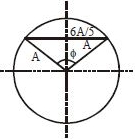
Two particles oscillating in $SHM$ along two very close parallel path such that they have same mean position. The equation of $SHM$ of two particles are $x_1 = A\, sin\,\omega t$ and $x_2 = A\,sin(\omega t + \phi )$ respectively. If maximum distance between them is $\frac{6A}{5}$ then $\phi $ equal to ..... $^o$
  • A
    $60$
  • B
    $37$
  • $74$
  • D
    $90$

Answer

Correct option: C.
$74$
c
$\sin \frac{\phi}{2}=\frac{3}{5}$

$\phi=74^{\circ}$

Need a full question paper?

Generate a complete, print-ready paper with questions like this in minutes — across 16+ boards, with answer keys.

Start Generating Free

Similar questions

A steel rod of length $1\,m$ and cross sectional area $10^{-4}\,m ^2$ is heated from $0^{\circ}\,C$ to $200^{\circ}\,C$ without being allowed to extend or bend. The compressive tension produced in the rod is $........\times 10^4\,N$ (Given Young's modulus of steel $=2 \times 10^{11}\,Nm ^{-2}$, coefficient of linear expansion $=10^{-5}\, K ^{-1}$.
Four bodies $P, Q, R$ and $S$ are projected with equal velocities having angles of projection $15^o , 30^o , 45^o $  and $60^o $ with the horizontal respectively. The body having shortest range is
According to Hook’s law force is proportional to
What is the velocity $v$  of a metallic ball of radius $r$  falling in a tank of liquid at the instant when its acceleration is one-half that of a freely falling body ? (The densities of metal and of liquid are $\rho$ and $\sigma$ respectively, and the viscosity of the liquid is $\eta$).
Work done by air when it expands from $50\, litres$ to $150\, litres$ at a constant pressure of $2$ atmosphere is
Main scale division of vernier calliper is $1\ mm$ and vernier scale division are in $A.P. ; 1^{st}$ division is $0.95\ mm$ ; $2^{nd}$ division is $0.9\ mm$ and so on. When an object is placed between jaws of vernier calliper, zero of vernier lies between $3.1\ cm$ and $3.2\ cm$ and $4^{th}$ division of vernier coincide with main scale division. Reading of vernier is  .......... $cm$
A uniform ring of radius $R$ is moving on a horizontal surface with speed $v$, then climbs up a ramp of inclination $30^{\circ}$ to a height $h$. There is no slipping in the entire motion. Then, $h$ is
Which of the following is not an example of perfectly inelastic collision
On the $x-$axis and a dsitance $x$ from the origin, the gravitational field due to a mass distribution is given by $\frac{A x}{\left(x^{2}+a^{2}\right)^{3 / 2}}$ in the $x-$direction. The magnitude of gravitational potential on the $x-$axis at a distance $x,$ taking its value to be zero at infinity, is
A particle moves in a circular path of radius $R$ with an angular velocity $\omega = a -bt$ where $a$ and $b$ are positive constants and $t$ is time. The magnitude of the acceleration of the particle after time $\frac {2a}{b}$ is