Question
Explain electric charge. Verify by experiment that there is repulsion between like charges and attraction between unlike charges.

Answer

SELF

Need a full question paper?

Generate a complete, print-ready paper with questions like this in minutes — across 16+ boards, with answer keys.
Start Generating Free

Similar questions

A particle stays at rest as seen in a frame. We can conclude that:
  1. The frame is inertial.
  2. Resultant force on the particle is zero.
  3. The frame may be inertial but the resultant force on the particle is zero.
  4. The frame may be non-inertial but there is a non-zero resultant force.
A parallel beam of white light is incident normally on a water film $1.0 \times 10^{-4}\ cm$ thick. Find the wavelength in the visible range $(400\ nm - 700\ nm)$ which are strongly transmitted by the film. Refractive index of water $= 1.33$.
A long solenoid $'S \ '$ has $'n\ '$ turns per meter, with diameter $'a\ '$. At the centre of this coil we place a smaller coil of $'N\ '$ turns and diameter $'b\ ' ($where $b < a)$. If the current in the solenoid increases linearly, with time, what is the induced emf appearing in the smaller coil. Plot graph showing nature of variation in emf, if current varies as a function of $mt^2 +C$.
A box weighing 2000N is to be slowly slid through 20m on a straight track having friction coefficient 0.2 with the box.
  1. Find the work done by the person pulling the box with a chain at an angle $\theta $ with the horizontal.
  2. Find the work when the person has chosen a value of $\theta $ which ensures him the minimum magnitude of the force.
A sample of an ideal gas $(\gamma=1.5)$ is compressed adiabatically from a volume of $150\ cm^3$ to $50\ cm^3$. The initial pressure and the initial temperature are $150kPa$ and $300K$. Find,
  1. The number of moles of the gas in the sample.
  2. The molar heat capacity at constant volume.
  3. The final pressure and temperature.
  4. The work done by the gas in the process.
  5. The change in internal energy of the gas.
  1. Draw a labelled diagram of a moving coil galvanometer. Describe briefly its principle and working.
  2. Answer the following:
  1. Why is it necessary to introduce a cylindrical soft iron core inside the coil of a galvanometer?
  2. Increasing the current sensitivity of a galvanometer may not necessarily increase its voltage sensitivity. Explain, giving reason.
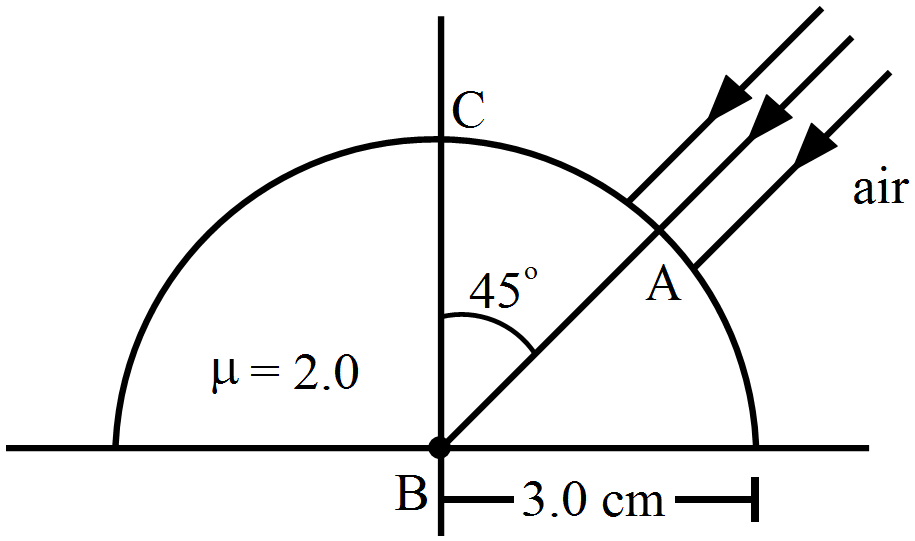
Figure shows a transparent hemisphere of radius 3.0cm made of a material of refractive index 2.0.
  1. A narrow beam of parallel rays is incident on the hemisphere as shown in the figure. Are the rays totally reflected at the plane surface?
  2. Find the image formed by the refraction at the first surface.
  3. Find the image formed by the reflection or by the refraction at the plane surface.
  4. Trace qualitatively the final rays as they come out of the hemisphere.
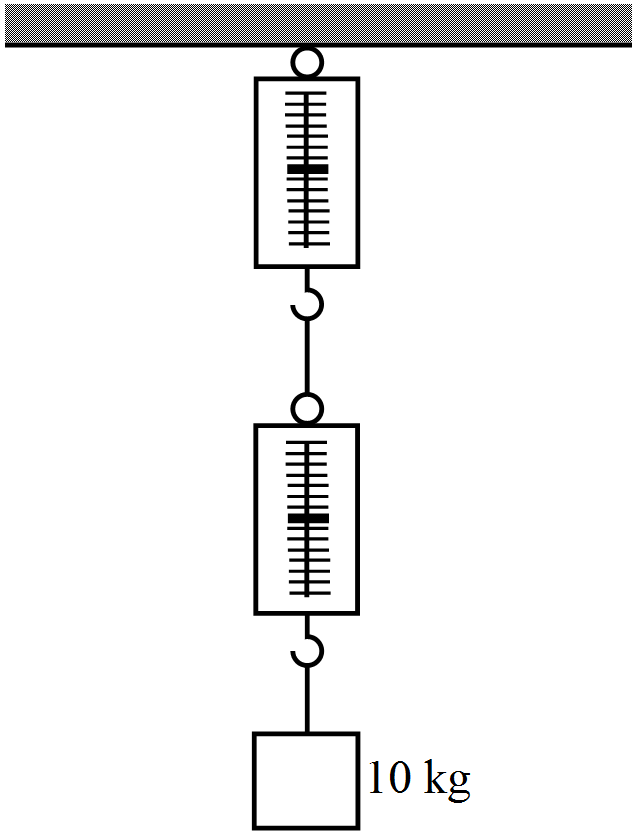
A block of mass $10\ kg$ is suspended through two light spring balances as shown in figure:
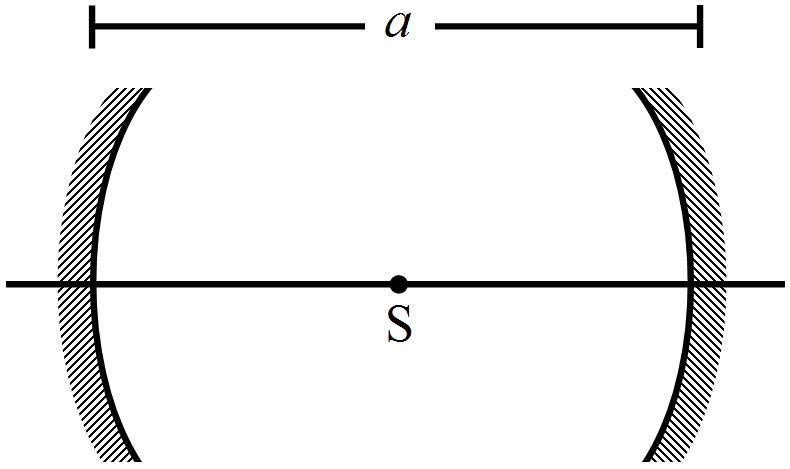
A point source S is placed midway between two converging mirrors having equal focal length f. Find the values of d for which only one image is formed.
A neutron moving with a speed $υ$ strikes a hydrogen atom in ground state moving towards it with the same speed. Find the minimum speed of the neutron for which inelastic $($completely or partially$)$ collision may take place. The mass of neutron $=$ mass of hydrogen $= 1.67 \times 10^{-27}kg$.