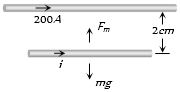
A fixed horizontal wire carries a current of $200\, A$. Another wire having a mass per unit length ${10^{ - 2}}\,kg/m$ is placed below the first wire at a distance of $2\, cm$ and parallel to it. How much current must be passed through the second wire if it floats in air without any support? What should be the direction of current in it
Medium
Download our app for free and get startedPlay store
For floating the second wire
$\left| \begin{array}{l}\,{\rm{Down}}\;{\rm{ward}}\;{\rm{weight}}\,\\\;\;{\rm{of}}\;{\rm{second}}\;{\rm{wire}}\end{array} \right| = \left| \begin{array}{l}\,{\rm{Magnetic}}\;{\rm{force}}\,\\\;\;\;\;\;{\rm{on}}\;{\rm{it}}\end{array} \right|$
$ \Rightarrow mg = \frac{{{\mu _0}}}{{4\pi }}.\frac{{2{i_1}{i_2}}}{a} \times l$
$ \Rightarrow \left( {\frac{m}{l}} \right)g = \frac{{{\mu _0}}}{{4\pi }}.\frac{{2{i_1}{i_2}}}{a}$
$ \Rightarrow {10^{ - 2}} \times 9.8 = {10^{ - 7}} \times \frac{{2 \times 200 \times i}}{{2 \times {{10}^{ - 2}}}} \Rightarrow i = 49\,A$
$($Direction of current is same to first wire$)$
art

Download our app
and get started for free

Experience the future of education. Simply download our apps or reach out to us for more information. Let's shape the future of learning together!No signup needed.*

Similar Questions

  • 1
    Mark the correct statement
    View Solution
  • 2
    A long straight wire, carrying current $I,$ is bent at its midpoint to from an angle of $45^o.$ Induction of magnetic field at point $P,$ distant $R$ from point of bending is equal to :
    View Solution
  • 3
    What is the magnitude of magnetic force per unit length on a wire carrying a current of $8\,A$ and making an angle of $30^o$ with the direction of a uniform magnetic field of $0.15\, T$ ?.....$Nm^{-1}$
    View Solution
  • 4
    A long straight wire of circular cross-section (radius $a$) is carrying steady current $I$. The current $I$ is uniformly distributed across this cross-section. The magnetic field is
    View Solution
  • 5
    When a current of $5\ mA$ is passed through a galvanometer having a coil of resistance $15\ \Omega$, it shows full scale deflection. The value of the resistance to be put in series with the galvanometer to convert it into to voltmeter of range $0 - 10\ V$ is
    View Solution
  • 6
    $AB$ and $CD$ are long straight conductor, distance $d$ apart, carrying a current $I$. The magnetic field at the midpoint of $BC$ is
    View Solution
  • 7
    A conductor (shown in the figure) carrying constant current $I$ is kept in the $x-y$ plane in a uniform magnetic field $\vec{B}$. If $F$ is the magnitude of the total magnetic force acting on the conductor, then the correct statement$(s)$ is(are) $Image$

    $(A)$ If $\vec{B}$ is along $\hat{z}, F \propto(L+R)$

    $(B)$ If $\overrightarrow{ B }$ is along $\hat{ x }, F =0$

    $(C)$ If $\vec{B}$ is along $\hat{y}, F \propto(L+R)$

    $(D)$ If $\overrightarrow{ B }$ is along $\hat{ z }, F =0$

    View Solution
  • 8
    A galvanometer of resistance $100 \Omega$ when connected in series with $400 \Omega$ measures a voltage of upto $10 \mathrm{~V}$. The value of resistance required to convert the galvanometer into ammeter to read upto $10 \mathrm{~A}$ is $\mathrm{x} \times 10^{-2} \Omega$. The value of $\mathrm{x}$ is :
    View Solution
  • 9
    In a toroid the number of turns per unit length is $1000$ and current through it is $\frac{1}{4 \pi}$ ampere. The magnetic field produced inside (in $weber / m ^2$ ) will be
    View Solution
  • 10
    A proton is accelerating in a cyclotron where the applied magnetic field is $2 \,T$. If the potential gap is effectively $100 \,kV$ then how much revolutions the proton has to make between the "dees" to acquire a kinetic energy of $20 \,MeV$ ?
    View Solution