A flat plate of area $10\,cm^2$ is separated from a large plate by a layer of glycerine $1\, mm$ thick. If the coefficient of viscosity of glycerine is $20$ poise, the force required to keep the plate moving with a velocity of $1\,cm/sec$ is .......... $dyne$
Easy


Download our appand get started for free
Experience the future of education. Simply download our apps or reach out to us for more information. Let's shape the future of learning together!No signup needed.*
Similar Questions
- 1The total area of cross-section is $0.25\,m^2$. If the blood is flowing at the rate of $100\, cm^3/sec$, then the average velocity of flow of blood through the capillaries is ........ $mm/sec$View Solution
- 2An object with uniform density $\rho$ is attached to a spring that is known to stretch linearly with applied force as shown below.When the spring object system is immersed in a liquid of density $\rho_1$ as shown in the above figure, the spring stretches by an amount $x_1\left(\rho > \rho_1\right)$. When the experiment is repeated in a liquid of density $\left(\rho_2 < \rho_1\right)$, the spring stretches by an amount $x_2$. Neglecting any buoyant force on the spring, the density of the object isView Solution
- 3A tiny spherical oil drop carrying a net charge $q$ is balanced in still air with a vertical uniform electric field of strength $\frac{81 \pi}{7} \times 10^5 \mathrm{Vm}^{-1}$. When the field is switched off, the drop is observed to fall with terminal velocity $2 \times 10^{-3} \mathrm{~ms}^{-1}$. Given $\mathrm{g}=9.8 \mathrm{~ms}^{-2}$, viscosity of the air $=1.8 \times 10^{-5} \mathrm{Ns} \mathrm{m}^{-2}$ and the density of oil $=$ $900 \mathrm{~kg} \mathrm{~m}^{-3}$, the magnitude of $\mathrm{q}$ isView Solution
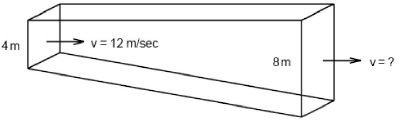
- 4A river gradually deepens, from a depth of $4 \ m$ to a depth of $8\ m$ as shown. The width, $W$, of the river does not change. At the depth of $4 \ m$, the river's speed is $12\ m/sec.$ Its elocity at the $8\ m$ depth is ......... $m/sec$View Solution
- 5View SolutionWater containing air bubbles flows without turbulence through a horizontal pipe which has a region of narrow cross-section. In this region, the bubbles
- 6A barometer kept in an elevator reads $76 \,cm$ when the elevator is accelerating upwards. The most likely pressure inside the elevator (in $cm$ of $Hg$ ) is ........View Solution
- 7Two cubical blocks identical in dimensions float in water in such a way that $1^{st}$ block floats with half part immersed in water and second block floats with $3 / 4$ of its volume inside the water. The ratio of densities of blocks is $..........$View Solution
- 8Two solids $A$ and $ B$ float in water. It is observed that $A$ floats with $\frac{1}{2}$ of its body immersed in water and $ B$ floats with $\frac{1}{4}$ of its volume above the water level. The ratio of the density of $ A$ to that of $B$ isView Solution
- 9A tank with a small hole at the bottom has been filled with water and kerosene (specific gravity $0.8$). The height of water is $3\,m$ and that of kerosene $2\,m$. When the hole is opened the velocity of fluid coming out from it is nearly ........ $ms^{-1}$ .(take $g\, = 10\, m s^{-2}$ and density of water $= 10^3\, kg\, m^{-3}$)View Solution
- 10In Guericke's experiment to show the effect of atmospheric pressure, two copper hemispheres were tightly fitted to each other to form a hollow sphere and the air from the sphere was pumped out to create vacuum inside. If the radius of each hemisphere is $R$ and the atmospheric pressure is $p$, then the minimum force required (when the two hemispheres are pulled apart by the same force) to separate the hemispheres isView Solution